
SAFe LPM Certification: Exam Format, Domains and Study Tips
Many people assume the SAFe LPM certification is a budgeting course for finance staff. It is not. The SAFe Lean Portfolio Manager credential checks whether you can tie strategy, funding and flow together across a whole portfolio. You earn it by completing Scaled Agile's two-day Lean Portfolio Management course and then passing a 45-question, 90-minute online exam with a score of 77% or better. The exam is still written for LPM 6.0, which we confirmed in September 2026.
This guide takes the myth apart and puts something more useful in its place. It covers what the credential really says about you, how the exam is set up and what it costs, why LPM has not joined the AI-Empowered releases, how the seven domains are weighted, the handful of portfolio tools that most questions return to, a study plan built around the course, the errors that sink otherwise capable candidates, and a frank view of who should take it.
What does the SAFe LPM certification actually prove about you?
A portfolio in SAFe is a set of development value streams that share one budget and one strategy. Lean Portfolio Management is the function that decides how that money is spent, which large initiatives go ahead, and how leaders know whether the portfolio is delivering what the business needs. Scaled Agile describes Lean Portfolio Management as the competency that aligns strategy and execution through Lean and systems thinking applied to investment funding, Agile portfolio operations and governance.
So the certification is less about spreadsheets and more about a change of habit. Traditional portfolio management funds projects, asks each project for a detailed business case up front, and measures success by whether it stayed on budget and schedule. LPM funds long-lived value streams instead, lets the people closest to the work decide how to use that money inside agreed limits, and judges progress by outcomes and flow. Passing the exam shows you understand why that shift matters and can explain the practices that make it work.
Three groups of responsibility
The course organises LPM into three dimensions, and the exam follows the same map:
- Strategy and investment funding. Connecting the portfolio to enterprise strategy, keeping a portfolio vision and roadmap, and funding value streams rather than projects.
- Agile portfolio operations. Coordinating value streams, supporting the Agile Release Trains that do the work, and helping them run well. An Agile PMO or Value Management Office often carries much of this.
- Lean governance. Spending oversight, audit and compliance, forecasting and measurement, handled continuously and lightly rather than through stage gates.
Who usually sits in the course
Scaled Agile's Lean Portfolio Management certification page lists executive leaders, enterprise architects, product management leaders, PMO leaders, agile coaches and SAFe Practice Consultants as the intended audience. In practice the room is a mix of people who own money and people who own delivery, and much of the value of the two days comes from hearing how the other side thinks. The course is rated advanced and assumes you already know how SAFe works at the team and train level.
How is the LPM exam set up, and what does it cost to sit?
The exam is available only after the course. When you finish the class you find it in the learning plan in your SAFe Studio account, alongside a practice test. The figures below come from the LPM 6.0 exam study guide that Scaled Agile last revised in April 2026, which we checked in September 2026.
| Exam detail | LPM 6.0 |
|---|---|
| Vendor | Scaled Agile, Inc. (SAFe) |
| Exam code | LPM |
| Certification | Certified SAFe Lean Portfolio Management (LPM) |
| Questions | 45 |
| Time limit | 90 minutes |
| Passing score | 77% |
| Question style | Multiple choice, one correct option per question |
| How it is taken | Online in your browser, closed book, working alone |
| First attempt | Included in the course fee if taken within 60 days of finishing the course |
| Each later attempt | $50 |
| Course length | 2 days, remote or in person |
| Renewal | Yearly |
| Version | SAFe 6.0 |
What the numbers mean in practice
Seventy-seven percent of 45 questions works out to 35 correct answers, so you can afford to miss ten. That sounds comfortable until you notice how many items describe a portfolio situation and offer four reasonable-sounding responses. Ninety minutes for 45 questions gives you two minutes each, which is generous for recall questions and tight for the longer scenarios about budgets and epics. Unanswered questions score zero, and when the clock hits zero your answers are sent as they stand, so never leave a blank.
Paying for the course, the exam and any retakes
There is no separate exam fee for most candidates. The course price is set by the training partner who runs it and varies by country and delivery format, and your first exam attempt is bundled into it as long as you sit the exam within 60 days of the course ending. After that, each attempt costs $50. Scaled Agile spaces out the retakes:
- You can try again straight away after a first unsuccessful attempt.
- Your third attempt opens 10 days after the second one.
- Your fourth attempt opens 30 days after the third.
- Every attempt beyond that also needs a 30-day gap.
Two consecutive failures therefore cost you more than money: you lose at least a week and a half, and a third failure pushes the next try a full month out. Treat the second attempt as seriously as the first. Once certified, you renew yearly through Scaled Agile to keep the credential and the digital badge active.
Why is LPM still on SAFe 6.0 when other SAFe exams have moved on?
During 2026 Scaled Agile moved several of its best-known courses to date-based AI-Empowered releases, including Leading SAFe, Implementing SAFe, SAFe Scrum Master, SAFe Product Owner/Product Manager and SAFe Release Train Engineer. Lean Portfolio Management was not part of that wave. Scaled Agile's list of exam study guides still shows LPM as version 6.0, the guide itself carries an April 2026 revision date, and no AI-Empowered LPM exam page existed when we checked in September 2026.
For a candidate this has three practical consequences:
- Study the 6.0 outline. The seven domains in the next section are the ones the exam is written against today, and the lessons of the course map to them one for one.
- Expect newer vocabulary around you. Colleagues coming from AI-Empowered courses may use newer terms and talk about AI in portfolio work. The LPM exam does not have an AI domain, so do not spend study time on one.
- Check again before you book. Scaled Agile has updated one course after another this year. If an AI-Empowered LPM release appears, the exam details page will change, and a course taken after that date will lead to the new exam.
If you are planning a route through several SAFe courses, note that Scaled Agile rates LPM as an advanced course for people already familiar with agile at scale, rather than naming one required certificate. Many candidates take Leading SAFe first simply because it gives them the vocabulary the LPM course assumes.
How are the seven LPM exam domains weighted?
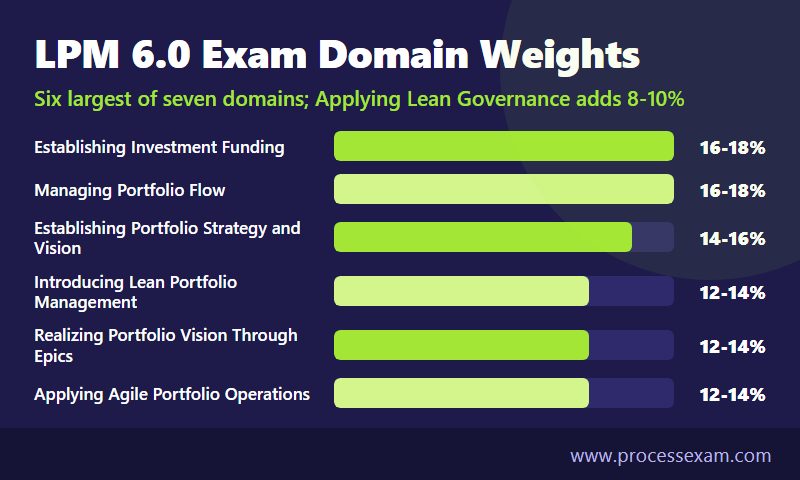
Scaled Agile publishes each domain as a percentage range. Across 45 questions a range of 16-18% is about seven or eight items, while 8-10% is about four. The ranges are close together, which tells you something important: there is no single domain you can skip, and the exam rewards even coverage more than deep expertise in one area.
| Domain | Weight | Approximate questions out of 45 |
|---|---|---|
| Introducing Lean Portfolio Management | 12-14% | 5-6 |
| Establishing Portfolio Strategy and Vision | 14-16% | 6-7 |
| Realizing Portfolio Vision Through Epics | 12-14% | 5-6 |
| Establishing Investment Funding | 16-18% | 7-8 |
| Managing Portfolio Flow | 16-18% | 7-8 |
| Applying Agile Portfolio Operations | 12-14% | 5-6 |
| Applying Lean Governance | 8-10% | 4 |
The question counts are our own arithmetic on the published ranges. Our SAFe LPM exam syllabus page lists every topic under each domain, which makes a handy checklist while you work through the course workbook.
Introducing Lean Portfolio Management (12-14%)
Why LPM exists. Expect questions on the Lean-Agile mindset and SAFe principles, the problems of project-cost accounting, what organising around value means, how a SAFe portfolio is structured, and the shift from traditional to Lean approaches. The classic item contrasts funding a temporary project team with funding a stable value stream and asks which choice reduces delay and handoffs.
Establishing Portfolio Strategy and Vision (14-16%)
How the portfolio connects to enterprise strategy. You should know what strategic themes do, how the portfolio canvas captures the current state and possible future states, how a portfolio vision is expressed, and how a portfolio roadmap differs from a fixed project plan. Questions often ask what an LPM team should do first when strategy changes.
Realizing Portfolio Vision Through Epics (12-14%)
Epics are the large initiatives that turn vision into change. This domain covers portfolio epics, the epic hypothesis statement, how epic costs are estimated, the Lean business case, and innovation through the SAFe Lean Startup cycle: build a minimum viable product, measure it against the hypothesis, then decide to pivot or persevere.
Establishing Investment Funding (16-18%)
One of the two heaviest domains. It covers Lean budgets and the guardrails that govern spending within them, value stream budgets, participatory budgeting, and the strategic portfolio review and portfolio sync events where funding and priorities are revisited. The four guardrails come up again and again: guiding investments by horizon, optimising value and solution integrity with capacity allocation, approving significant initiatives, and continuous business owner engagement.
Managing Portfolio Flow (16-18%)
The other heavy domain. It is about moving epics through the portfolio Kanban, from the funnel through reviewing, analysing and ready into implementation, and about setting work-in-process limits so the portfolio does not start more than it can finish. Weighted Shortest Job First (WSJF) is used here to decide which epics move forward first, so expect at least one calculation or comparison.
Applying Agile Portfolio Operations (12-14%)
How the portfolio supports execution. Topics include coordinating several value streams that depend on each other, supporting Agile Release Train execution, and building operational excellence through communities of practice and an Agile PMO. Answers that turn the PMO into a control office for status reports are usually wrong.
Applying Lean Governance (8-10%)
The smallest domain, but easy marks if you prepare. It covers measuring portfolio performance and continuous compliance. The theme is that governance happens through frequent evidence, such as working solutions and flow measures, not through milestone documents signed off months apart.
Which portfolio tools does the LPM exam keep testing?
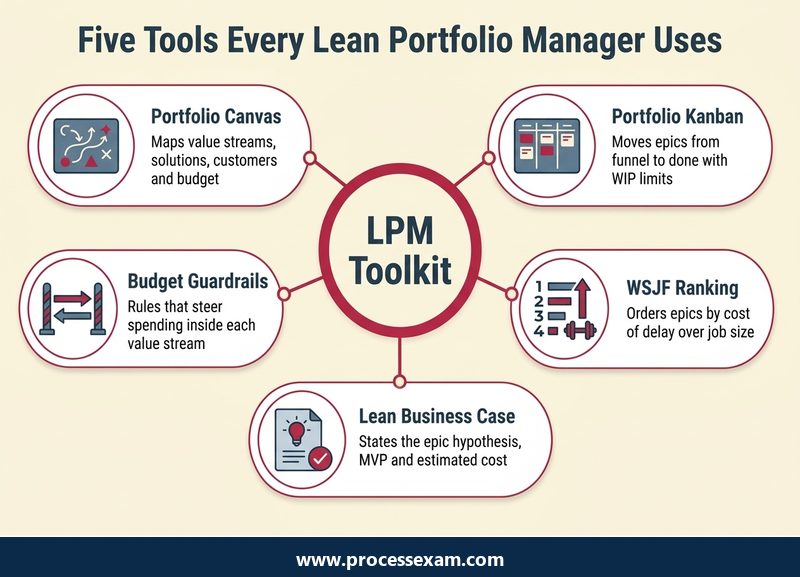
Reading domain names only gets you so far. Most scenario questions are really asking whether you know which tool fits the situation and what it produces. Five tools account for a large share of what you need to handle confidently.
Portfolio canvas
A one-page model of the portfolio adapted from the business model canvas. It records the value streams, the solutions they deliver, the customers they serve, the budget, and the key partners and activities. LPM teams use it twice: once to describe where the portfolio stands today, and again to sketch possible future states when strategy shifts. A question that asks how to explore options for a new strategic theme is often pointing at the canvas.
Portfolio Kanban
The visual system that manages the flow of epics. Its states make the decision points visible, and its work-in-process limits protect the portfolio from starting everything at once. The exam likes questions about what happens at each state and who is involved, especially the Epic Owner who shepherds an epic through analysis and the LPM decision to approve it.
Lean budget guardrails
The policies that let value stream leaders spend without asking permission for every item while keeping the portfolio in line with strategy. Capacity allocation splits capacity between new features, enablers, maintenance and similar needs. A threshold decides when an epic is large enough to need LPM approval. Business owners stay involved throughout rather than appearing only at a review.
Weighted Shortest Job First
WSJF ranks work by its cost of delay divided by its job size. Cost of delay adds three relative scores: user-business value, time criticality, and risk reduction or opportunity enablement. A short illustration: epic A scores 20 for cost of delay and 10 for size, giving a WSJF of 2.0; epic B scores 13 and 3, giving about 4.3. Epic B goes first even though A looks more valuable, because B delivers its value far sooner. Questions rarely need exact arithmetic, but they do test whether you remember that a small, urgent item can outrank a large, valuable one.
Lean business case
A short document that states the epic hypothesis, the minimum viable product, the expected benefits and the estimated costs. It replaces the thick up-front business case of project funding. The exam often asks what happens when the MVP results arrive: the portfolio decides to pivot or persevere based on evidence, not on the money already spent.
How should you plan your LPM study around the two-day course?
The course does most of the teaching, so the plan below is about what you do before, during and after it. It assumes you will sit the exam two to four weeks after the class, well inside the 60-day window. Stretch or compress it to fit your calendar.
Before the course: arrive with a portfolio in mind
Pick one real portfolio you know, even a small one, and note how it is funded today, who approves large initiatives, and how leaders track progress. During the class, every concept will then land on something concrete. If your SAFe knowledge is thin, spend an evening on the basics of value streams, Agile Release Trains and PI Planning, because the course moves fast past them.
During the course: take notes by domain
The workbook is arranged in seven lessons, and each lesson matches one exam domain. Keep a page per lesson and write down every term the instructor defines and every exercise your group completes. Those seven pages become your revision notes, and you keep permanent access to the workbook and the online learning platform afterwards.
Week one after the course: rebuild the flow of an epic
Without looking at the workbook, write the life of one epic from idea to done: who raises it, how it enters the Kanban, what the Lean business case contains, when LPM approves it, how the MVP is funded and what decides whether it continues. Then check against the workbook. Gaps in this story are gaps in the two heaviest domains.
Week two: funding and governance in your own words
Explain the four guardrails, participatory budgeting and the strategic portfolio review to someone outside SAFe, or write a half-page summary as if you were briefing your finance director. If you cannot explain why a value stream budget reduces delay compared with project funding, you are not ready for the scenario questions on investment funding.
Weeks three and four: timed practice
Take the course practice test under exam conditions: 45 questions, 90 minutes, no notes. It has unlimited attempts and a coaching report, so use it to find weak domains, not to memorise answers. Once you start recognising its questions, switch to fresh ones; our LPM practice exam gives you new timed sets with the same domain spread, which shows whether you understand the ideas or only remember the wording. Log each wrong answer against its domain and reread that lesson before the next set.
Exam day
The exam runs in your browser, so check the computer, connection and a quiet room the day before. Read the last line of each question first to see what it is asking, whether the best action, the first step or the option that does not fit. Answer every item, flag the ones you doubt, and use any spare minutes at the end to revisit them.
Which errors cost LPM candidates the 77% they needed?
With room for only ten misses, a few repeated habits decide the result. These are the ones that turn up most often in LPM preparation.
- Thinking like a project office. Options that demand detailed up-front plans, phase-gate sign-offs or funding tied to one project are almost always the distractors. LPM funds value streams and governs through evidence.
- Mixing up budgets and guardrails. The budget is the money a value stream receives; guardrails are the rules for spending it. Many wrong options quietly swap the two.
- Getting WSJF backwards. A higher WSJF means do it sooner. Candidates who remember the formula but not the direction lose easy marks.
- Treating an approved epic as a promise. Approval funds the MVP and the next step, not the whole epic. If the hypothesis fails, stopping is the correct answer, not a failure.
- Skipping the small domain. Lean governance carries only 8-10%, but its questions are among the most predictable. Four easy marks matter when the margin is ten.
- Studying AI-Empowered material by mistake. Guides for the newer SAFe releases include content the LPM 6.0 exam does not test, and can use different terms.
- Letting the 60 days slip. After the window closes, even the first attempt costs $50. Put the exam date in your calendar on the last day of the course.
Is the SAFe LPM certification worth it for your career?
It depends on where you sit and what your organisation is doing. The credential is most valuable if your company runs, or is moving to, SAFe at portfolio level, and you are one of the people who decide how money and priorities flow across several trains. For them, the course often matters as much as the certificate, because it gives leaders from finance, architecture, product and delivery the same language for the same decisions.
Roles where it pays off
- PMO and VMO leaders moving from project reporting to supporting value streams.
- Portfolio and product management leaders who own the roadmap and epics.
- Enterprise architects who shape enabler epics and the technical side of strategy.
- Agile coaches and SAFe Practice Consultants who lead portfolio-level change and need to coach executives, not just teams.
- Finance partners asked to adopt Lean budgeting and wanting to understand what it asks of them.
When it is the wrong choice
If you work mainly inside a single team or train, a team-level or train-level SAFe credential will serve you better first; LPM assumes you already see the bigger picture. If your organisation does not use SAFe, the vocabulary will transfer only partly, and a general agile portfolio or finance qualification may be the better investment. And like any certificate, it does not replace experience: hiring managers for portfolio roles will ask what you changed, not only what you studied.
Making the credential count
The candidates who get the most from LPM treat the course as the start of a small change in their own portfolio: a first portfolio canvas, a trial of WSJF on the next set of epics, one value stream funded with guardrails. Those results are what you talk about in interviews and promotion reviews, and they also happen to be the best preparation for the exam's scenario questions.
Frequently Asked Questions
How do I get the SAFe LPM certification?
Complete Scaled Agile's two-day Lean Portfolio Management course with a certified instructor, then pass the online LPM exam that appears in your SAFe Studio learning plan. The exam has 45 multiple-choice questions, a 90-minute limit and a 77% pass mark. The certification is renewed yearly with Scaled Agile.
How hard is the SAFe LPM exam?
It is moderately hard. You need 35 of 45 answers right, so there is room for about ten misses, and many questions describe portfolio situations with several reasonable options. Candidates who understand why Lean budgets and flow replace project funding find it manageable; those who only memorise terms struggle.
How much does the SAFe LPM certification cost?
The course fee is set by the training partner and varies by country and format. It includes your first exam attempt if you take the exam within 60 days of finishing the course. After that, or for any retake, each attempt costs $50, with waiting periods between later retakes.
Is the LPM exam part of the SAFe AI-Empowered release?
Not yet. When we checked in September 2026, Scaled Agile still published the LPM exam as version 6.0, with a study guide revised in April 2026, while several other SAFe courses had moved to AI-Empowered releases. Check the vendor's exam details page before booking in case this changes.
Which domains carry the most weight on the LPM exam?
Establishing Investment Funding and Managing Portfolio Flow each carry 16-18%, followed by Establishing Portfolio Strategy and Vision at 14-16%. Three domains sit at 12-14%, and Applying Lean Governance is the smallest at 8-10%, so even coverage of all seven matters more than depth in one.
- Scaled Agile |
- LPM Question Bank |
- LPM Exam Questions Download |
- LPM Test Questions |
- SAFe Lean Portfolio Management Test Questions |
- Lean Portfolio Management Simulator |
- Lean Portfolio Management Mock Exam |
- SAFe Lean Portfolio Management Book |
- Lean Portfolio Management Certification Cost |
- Lean Portfolio Management Certification Requirements |
- SAFe Lean Portfolio Management Sample Questions |
- Lean Portfolio Management PDF


