
SAFe for Architects Certification: Is It Worth It?
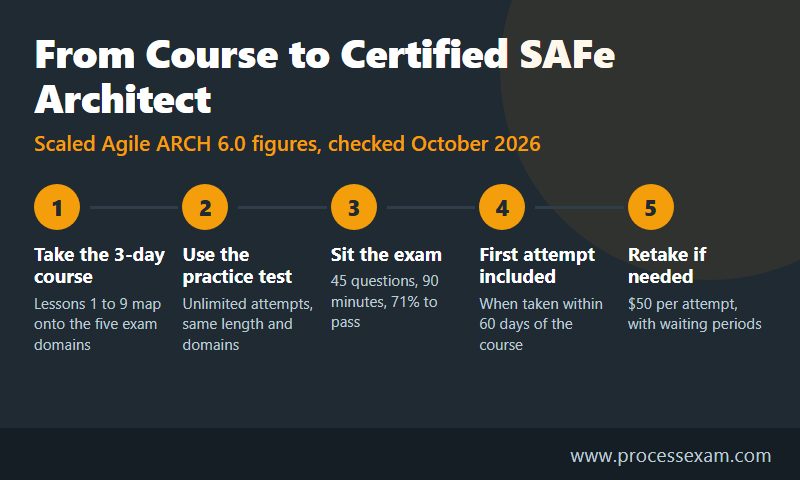
Yes, SAFe for Architects is worth it for a system, solution or enterprise architect whose employer already runs Agile Release Trains or is about to start them, and it adds little if your company does not use SAFe at all. The credential does not test how to design systems. It tests how an architect works inside the Scaled Agile Framework. The exam has 45 questions, 90 minutes and a 71% pass mark, and you sit it after a three-day course.

People search for "SAFe for Architects certification" and "SAFe for Architects exam" when a manager has just offered a seat on the course, or when a job advert lists the credential and they want to know what it proves before spending three days on it. This guide gives a straight answer to the worth-it question first, then the exam facts as Scaled Agile publishes them in October 2026, the five domains that carry the marks, a four-week plan for a working architect and the habits that help when a scenario clashes with your own design instincts.
Who gets real value from SAFe for Architects, and who can skip it?
Scaled Agile aims the course at senior technical people in a SAFe enterprise: system architects, solution architects and enterprise architects. Its certification page labels the course advanced level and describes the audience as people already familiar with enterprise and solution architecture. It does not list a formal prerequisite, so nobody checks your CV at the door, but the course assumes you have lived with real architecture trade-offs and want to see how SAFe expects them to be handled.
Where the credential pays for itself
- You work on or beside a train. If your architecture decisions feed PI Planning, you will recognise most of the course on day one, and the exam turns that habit into a shared vocabulary your colleagues also use.
- Your organisation is moving to SAFe. Architects are often asked to explain how a long architecture runway fits into short, fixed planning intervals. The course gives you that argument in the framework's own terms.
- You consult or contract for SAFe clients. A named credential from the framework's owner shortens the conversation about whether you will fit the way the client plans.
- You are moving from team-level design to solution-level design. The exam spends about a third of its marks on how strategy, value streams and Solution Intent shape architecture, which is exactly the step up many senior engineers need to make.
Where it adds less
If your company plans with fixed annual projects and has no intention of adopting SAFe, most of the material will describe a world you do not work in. An architecture certification from a cloud vendor or an enterprise architecture body will say more about your design skill. SAFe for Architects is about the working agreement between architecture and Agile delivery, so its value tracks how much SAFe surrounds you. Be honest about that before you book, because the course and exam are an investment of time even when your employer pays the fee.
Which version of the exam is current in October 2026?
Scaled Agile has been moving several courses to newer releases, so the version matters before you buy any study material. We checked Scaled Agile's own pages in October 2026. Its support site publishes "ARCH (6.0) - SAFe for Architects" as the study guide for this exam, and the certification page still describes the three-day SAFe for Architects course ending in a timed, 45-question multiple-choice exam. We found no ARCH 6.1 or 7.0 notice and no sign that the exam has been retired or renamed.
Scaled Agile has also said that it is moving away from version numbers on newer courseware and dating releases by year and month instead, and some other SAFe exams have already been rebuilt that way. If you see a newer date-style name for the architect course when you register, read the matching study guide on Scaled Agile's support site before relying on any figure here. That guide carries the line "subject to change at any time", so treat every number on this page as a snapshot of October 2026.
The ARCH 6.0 blueprint is also what our SAFe ARCH syllabus page lays out, so the domains below line up with it.
What do 45 questions, 90 minutes and a 71% pass mark mean in practice?
The exam is web-based, closed book and in English. You reach it through the Learning Plan that opens after the course, you accept a candidate agreement first, and the timer shows once the questions appear. Every question is multiple choice with a single answer. Scoring is by correct answers, and an unanswered question counts as wrong, so a blank is never better than a guess.
| Detail | SAFe for Architects (ARCH) |
|---|---|
| Certification | Certified SAFe for Architects (ARCH) |
| Questions | 45 |
| Duration | 90 minutes |
| Passing score | 71% |
| Version | SAFe 6.0 |
| Delivery | Training class, then exam through the Scaled Agile learning platform |
| First attempt | Covered by the course fee if sat inside 60 days of finishing the class |
| Each retake | $50 |
Seventy-one percent of 45 is 31.95, so the practical target is 32 correct answers, which allows 13 wrong ones. At 90 minutes for 45 questions you have two minutes per question, which is generous for a multiple-choice paper and tells you something: these are scenario questions with long stems and plausible options, not recall prompts. The real risk is not the clock. It is reading a stem quickly and answering the question you expected instead of the one asked.
The practice test is part of the package
Scaled Agile provides a practice test whose question count, difficulty, time limit and domains match the real exam, with unlimited attempts. Its own guide notes that passing it does not guarantee passing the exam, which is fair: it samples the same domains but not the same questions. Use it as a diagnostic after your first pass through the course material, not as the first thing you do. Scoring comfortably above the pass mark on it before the live exam is a sensible bar.
What does the exam fee cover, and what does a retake cost?
Your first sitting is paid for by the course registration fee as long as you use it inside 60 days of finishing the course. Some older guides quote a shorter 30-day window, but Scaled Agile's current study guide says 60 days, so plan around 60 and check your Learning Plan for the exact date it gives you. Past that window, or after a failed first attempt, each attempt costs $50.
Failing once does not lock you out for long, but the gaps grow. Per the study guide, you may sit a second try the moment the first one ends in a fail. A third try needs a 10-day wait, a fourth needs 30 days after the third, and every try beyond that needs another 30 days between sittings.
Those rules make the economics simple. Retakes are cheap in money but expensive in momentum, because the waiting periods stretch quickly and the scenario habits you built in the course fade. Treat the first attempt as the one that counts, sit it while the course is fresh, and keep the retake rules as insurance rather than strategy.
Course prices vary by training partner and format, and no single course fee is published on the Scaled Agile page, so check the figure with the partner running your class. Scaled Agile's certification page also says the certification is renewed yearly, but the public pages show no renewal fee, so confirm it in your SAFe Community account before you quote a cost for the second year.
Which five domains carry the marks, and what does each one ask?
Scaled Agile publishes the ARCH blueprint as five domains with a weight range each. The ranges below come from the ARCH 6.0 study guide, and the rough question counts for a 45-question paper are our own arithmetic from those ranges, not a Scaled Agile figure.
| Domain | Weight | Roughly, in 45 questions | Course lessons |
|---|---|---|---|
| PI Execution | 34-38% | 15 to 17 | 5, 6 and 7 |
| Architecture with Business Value | 31-35% | 14 to 16 | 3, 4 and 8 |
| Leading during a Lean-Agile Transformation | 11-15% | 5 to 7 | 9 |
| DevOps and Release on Demand | 9-13% | 4 to 6 | 2 |
| Agile Architecture and SAFe | 5-7% | 2 to 3 | 1 |
Two domains hold roughly two-thirds of the paper. That shapes the plan more than any other fact on this page.
PI Execution (34-38%)
This is the biggest domain, and it is where an architect's calendar lives. You are expected to know how to prepare for and contribute to PI Planning, take part in Management Review and Problem-Solving, contribute to the solution after planning, guide architecture and continuous delivery during the interval, prepare for iteration reviews and the System and Solution Demos, and improve through Inspect and Adapt. Questions give you a moment in the interval, such as a dependency discovered on day three of planning, and ask what the architect does next. The pattern to learn is that SAFe wants the architect to make the constraint visible and shape the plan with the teams, not decide it alone.
Architecture with Business Value (31-35%)
Here the exam tests whether you can connect architecture to money and strategy. Topics include how Strategic Themes, the Portfolio Canvas and the Portfolio Vision influence architecture, how value streams support the business, how Agile Release Trains and Solution Trains deliver value, how to align architecture to enterprise strategy, how to evolve the solution portfolio and contribute enabler epics to the Portfolio Kanban, how to coordinate across value streams, how to contribute to Solution Intent, how to manage quality with non-functional requirements and the Lean quality management system, and how to contribute to roadmaps. Enablers are the key idea: architecture work competes for capacity with features, so you must be able to argue for it in terms the portfolio can rank.
Leading during a Lean-Agile Transformation (11-15%)
The smallest of the three large domains, but one that surprises technical candidates. You need the attributes of a Lean-Agile leader, how to lead the shift to Agile architecture during a transformation, and how to build an action plan for the organisation. Expect questions about resistance and sequencing, where the right answer is usually a small, evidence-led step instead of a mandate.
DevOps and Release on Demand (9-13%)
This covers promoting a DevOps culture, the flow of value through the continuous delivery pipeline, architecting for continuous exploration, integration and deployment, and release on demand. For a working architect it is the most familiar ground, so do not over-study it. The architecture angle is what the exam wants: how design choices such as modularity, test automation hooks and deployment independence make frequent release possible.
Agile Architecture and SAFe (5-7%)
The opening lesson is also the lightest domain. Learn the attributes of Agile architecture, the SAFe architect role and its responsibilities, how to collaborate with other enterprise roles and how SAFe principles guide architecture. It is only a handful of marks, but the vocabulary here is used in every other domain, so skim it early and revisit it last.
How does a working architect turn the course into a pass in four weeks?
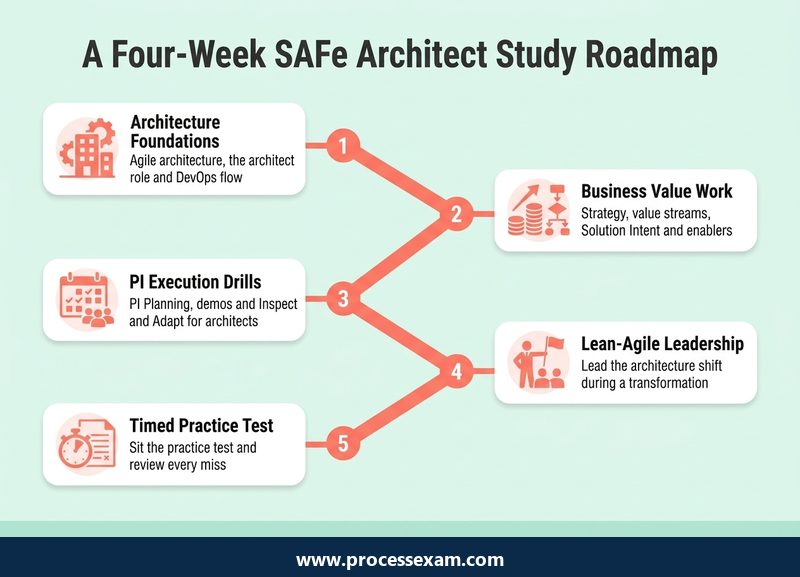
The course lasts three days, and the exam window gives you up to 60 days, but most architects do better by finishing within about a month while the lessons are still easy to recall. This plan assumes about five hours a week alongside a full-time job. Shorten it if you were already running PI Planning, and lengthen it if the portfolio side of SAFe is new to you.
| Week | Focus | What to finish |
|---|---|---|
| 1 | Agile Architecture and DevOps (lessons 1 and 2) | Reread the course notes, write the architect's responsibilities in your own words, and trace one release through the pipeline stages |
| 2 | Architecture with Business Value (lessons 3, 4 and 8) | Draw how Strategic Themes flow to value streams, Solution Intent and enabler epics; write one enabler as a business case |
| 3 | PI Execution (lessons 5, 6 and 7) | Walk a full planning interval: preparation, planning, demos, Inspect and Adapt, noting the architect's output at each step |
| 4 | Leadership, then timed practice | Lesson 9, then the practice test under exam timing, and a review of every wrong or guessed answer |
Two habits make the difference. First, write short notes by domain and keep a running list of the questions you got wrong, because the same misunderstanding usually causes three or four misses. Second, rehearse with your own work: take the last architecture decision you made and ask what SAFe would have called it, whose capacity it consumed and which event it should have appeared in. That exercise does more than rereading definitions.
When you want to measure yourself against a realistic paper, a SAFe ARCH practice exam from ProcessExam lets you rehearse the 45-question, 90-minute format before you spend your included attempt.
What to do in the last three days
Stop adding material. Take the practice test once more, review only the errors, and reread the PI Execution and Business Value notes, since they hold about two-thirds of the paper. The day before, confirm your Learning Plan access, the date your 60-day window closes, and the device and connection you will use. Sleep matters more than a final cram.
How do you answer a SAFe scenario when your own design instinct disagrees?
Experienced architects often find the exam uncomfortable for one reason: the most technically elegant answer is sometimes not the SAFe answer. The exam rewards the option that fits the framework's way of working, and these patterns help you spot it.
- Prefer shared, visible decisions to unilateral ones. If one option has the architect deciding alone and another has the architect making the constraint visible to the teams and to product management, the second is usually closer to what SAFe wants.
- Treat architecture work as backlog items with value. Enablers need a business case and a place on the Kanban. An answer that says to start the platform rewrite now because it is the right thing is rarely correct.
- Look for the smallest step that produces evidence. SAFe favours incremental architecture, early integration and fast feedback over big up-front designs.
- Match the event to the problem. If the stem describes a cross-team risk, think PI Planning or Problem-Solving. If it describes a recurring weakness, think Inspect and Adapt.
- Read the role in the stem. System, solution and enterprise architects have different scopes, and a distractor often assigns a decision to the wrong level.
When two options look right, ask which one a Release Train Engineer or Product Manager would also accept. The exam is written around collaboration, so the answer that works with other roles tends to beat the one that works around them. For the framework background behind these roles, the general overview of the Scaled Agile Framework is a neutral place to start, though the course material remains the source for the exam.
Where does the credential take an architect, and how is it renewed?
The credential changes the conversation more than the job title. In a SAFe organisation it tells hiring managers and train leaders that you already speak the framework, which shortens onboarding onto a solution train or a portfolio architecture group. Typical next steps are senior solution architect, enterprise architect or lead architect roles with a SAFe delivery context, or consulting work where SAFe fluency is part of the brief. No salary figures appear here because none could be tied to a salary survey we can cite.
Scaled Agile describes the certification as renewed yearly, so plan the renewal on the day you pass. Look at the renewal requirements and fee in your SAFe Community account, because the public pages do not state them, and put the date in your calendar. The practical value of the credential is highest in the first year, when the course is fresh and you can apply it on a real train; the architects who get the most from it use their first PI afterwards to put one enabler through the Portfolio Kanban and one architecture decision through PI Planning in SAFe language.
If your next step is a broader SAFe path, the architect credential sits alongside the other role courses rather than ahead of them, so there is no required order. What matters is that the credential matches the role you hold now. For a solution or system architect on a train, it is a good fit. For an architect outside SAFe, a different credential will probably do more for you. Read Scaled Agile's SAFe for Architects certification page for the current course dates and formats, and its ARCH 6.0 study guide for the blueprint and retake rules before you book.
Frequently Asked Questions
Is SAFe for Architects worth it?
It is worth it for a system, solution or enterprise architect whose organisation runs Agile Release Trains or is adopting SAFe, because it gives you the framework's vocabulary for architecture work. If your employer does not use SAFe, a design-focused credential will probably say more about your skills.
How many questions are on the SAFe for Architects exam?
The ARCH 6.0 exam has 45 multiple-choice, single-answer questions in 90 minutes. Scaled Agile marks unanswered questions as incorrect, so answer every one. Seventy-one percent is the pass mark, which works out to 32 correct answers out of 45.
What is the passing score for the SAFe ARCH exam?
Scaled Agile sets the passing score at 71%. On 45 questions that means at least 32 correct answers, because 71% of 45 is 31.95. Scoring is by the number of correct answers, and you can pass with up to 13 wrong ones.
How much does the SAFe ARCH exam cost?
The first attempt is included in the course registration fee when you take it within 60 days of finishing the course. After that window, or after a failed first attempt, each attempt costs $50. Course prices vary by training partner, so confirm the fee with the partner.
Which domains carry the most marks on the ARCH exam?
PI Execution is largest at 34-38%, followed by Architecture with Business Value at 31-35%. Leading during a Lean-Agile Transformation is 11-15%, DevOps and Release on Demand 9-13%, and Agile Architecture and SAFe 5-7%. Together the first two domains hold roughly two-thirds of the paper.


