
PSU I Exam: How UX Fits Into Scrum and How to Pass
Updated on 12 October 2026. What’s new: the assessment password has no expiry date and is valid for one attempt, and the certification is lifetime with no annual renewal fee.
When a product lead asks where UX work sits in Scrum, the answer Scrum.org gives is inside the Sprint, in the same Product Backlog and the same Increment as everything else, not in a phase that finishes before the Sprints begin. The Professional Scrum with User Experience (PSU I) assessment tests that answer: 60 questions in 60 minutes, USD $200 per attempt, and 85% to pass.

That framing matters for how you prepare. PSU I is not a design exam, and nobody asks you to draw a wireframe or name a research method from memory. It is a Scrum exam with a strong UX slant: the questions describe a team, a product and a design or discovery problem, and ask which choice keeps the work inside the framework. This guide walks through what the credential proves, how the assessment is built, what each focus area asks, how discovery and delivery fit into one Sprint, and a study order that works.
What does the PSU I badge prove that a general Scrum badge does not?
Scrum.org describes PSU I as proof of a fundamental understanding of how to integrate modern UX practices into Scrum and work effectively within Scrum Teams. A Professional Scrum Master badge says you know the framework. PSU I says you know where research, design and experiments live once the framework is running, and that is the gap many teams struggle with.
Think about the three conversations the credential prepares you for. A designer joins a Scrum Team and asks whether they must finish mock-ups a Sprint ahead of the developers. A Product Owner asks how a discovery task can be a Product Backlog item without being a deliverable. A Scrum Master hears a stakeholder demand that design be approved before any build starts. In each case the PSU I answer is the same: UX is part of the team's work, it is ordered and inspected like the rest, and it serves outcomes rather than hand-offs.
Who gets the most from it
- UX designers and researchers learn to plan their work in Sprints and to show it on the Product Backlog instead of working in a parallel studio.
- Product Owners learn how to order discovery and delivery work together and how to judge value with evidence from users.
- Scrum Masters learn how to coach a team that includes design specialists without recreating a hand-off process.
- Developers and product managers learn enough UX vocabulary to talk to customers directly and to take part in discovery.
Scrum.org says attendance at a Professional Scrum with User Experience class is not a prerequisite for the assessment, only highly recommended. You can read the vendor's own summary on the Scrum.org PSU I certification page.
What does the PSU I assessment cost, and how is it set up?
The assessment is a single online test. You buy a password, the password is valid for one attempt, and you start whenever you are ready. Scrum.org's page lists the following details.
| Detail | PSU I |
|---|---|
| Vendor | Scrum.org |
| Full name | Scrum.org Professional Scrum with User Experience |
| Number of questions | 60 |
| Time limit | 60 minutes |
| Passing score | 85% |
| Fee | USD $200 per attempt |
| Item types | Multiple choice, multiple answer and true/false |
| Test language | English |
| Credential lifetime | No expiry and no annual renewal fee |
Three points in that table deserve a second look. First, 85% of 60 questions means you can miss at most nine. Second, the formats include multiple answer: read each stem for how many options it asks you to pick. Third, the password has no expiry date but works for one attempt only, so the clock that matters is the one you set yourself. Scrum.org also includes a free Credly digital credential with a pass, and it says the Scrum.org class includes a free attempt at the assessment, which is worth knowing before you pay twice.
Candidates who prefer to sit the test in another language can use the Google Translate plugin, which Scrum.org mentions on the same page; it also says it cannot guarantee the quality of the translation. Anyone who needs an accommodation for a physical or intellectual disability is asked to write to Scrum.org's support address, and each case is examined individually.
Which focus areas do the 60 questions come from?
Scrum.org says PSU I draws on the focus areas defined in its Professional Scrum Competencies. It does not publish a percentage for each, so treat the list below as a map of topics and not as a weighting. The wording of the areas is Scrum.org's own; the right-hand column describes how a question on that area usually behaves.
| Focus area | Topics Scrum.org lists | What a question tends to ask |
|---|---|---|
| Understanding and Applying the Scrum Framework | Empiricism, Scrum Values, Scrum Team, Events, Artifacts, Done | Which Scrum rule applies when design work enters the Sprint |
| Developing People and Teams | Self-Managing (Cross-Functional) Teams, including UX | Who decides how design and build are shared inside one team |
| Managing Products with Agility | Product Value, Product Backlog Management, Stakeholders and Customers, Work Management with UX | How research and design items are ordered against build items |
| Complementary Practices | Lean UX Practices and Techniques | Which Lean UX technique fits a stated problem |
Notice how much of the list is plain Scrum. Three of the four areas would appear on a PSM I or PSPO I assessment in some form, and the fourth, Complementary Practices, is where the UX flavour is concentrated. If you are weak on the Scrum Guide, fix that first, because it supports every other area. The ProcessExam PSU I syllabus outline lays out the same topics in study order if you want a checklist.
What "including UX" changes in the team questions
The Scrum Guide does not add a role for designers. People with UX skills are part of the Developers, meaning everyone who builds the product's working Increment, whatever their specialty. Questions that mention a "UX team" sitting outside the Scrum Team, handing designs across, are usually describing the anti-pattern the course was written to remove.
What the Complementary Practices area really expects
Scrum.org lists Lean UX practices and techniques under Complementary Practices, which signals that they sit beside the framework and never replace any part of it. A question here usually names a technique, such as framing a problem, writing a hypothesis or running a quick experiment, and asks when it helps. The safe reading is that a technique earns its place when it helps the team learn about customers faster and the result is inspected at a normal Scrum event. A technique that needs a new role, a long approval chain or a separate schedule fails that test, however sensible it sounds.
How do discovery and delivery share one Sprint?
Scrum.org's course description uses the phrase dual-track agile: members of the Scrum Team balance discovery work, which finds out what is worth building, with delivery work, which builds it. The important word is "balance". Both tracks are visible, ordered and finished inside the same cadence by the same people, so nobody waits for a design department to release a specification.
What counts as discovery work
Discovery work covers anything that reduces the risk of building the wrong thing: talking to customers, observing how they use the product today, testing a prototype, running a small experiment on live behaviour. In PSU I terms these are legitimate Product Backlog items. They have a purpose, an expected learning and a place in the order, and they can be part of a Sprint Goal.
What counts as delivery work
Delivery work turns what the team has learned into a usable, Done Increment. Design is not "finished" the moment a mock-up exists; the Definition of Done applies to the whole Increment, and that includes the usability of what was built. A question that asks when UX work is complete almost always has an answer tied to the Increment and the Definition of Done, not to a design sign-off meeting.
Thinking in problems, outcomes and experiments
The course learning objectives that Scrum.org publishes read like a list of exam topics. They include framing work as problems to solve with a Business Problem Statement, focusing on outcomes and impact over outputs, releasing so that measurements can validate outcomes, and testing hypotheses with low-cost, low-risk experiments. The course was created with Jeff Gothelf and Joshua Seiden, the authors of the book Lean UX, so the vocabulary follows that book. When a question offers one answer that delivers a feature and another that tests an assumption first, expect the exam to prefer the one that learns cheaply.
How does a UX hypothesis turn into Product Backlog work?
A worked example shows the pattern better than a definition. Imagine a clinic's patient app. Patients book appointments but frequently cancel by phone because rebooking is hard. The team writes a Business Problem Statement in Lean UX style: the app was meant to help patients keep their care on schedule; it is not doing so, which creates empty slots; how might the team fix this so patients can manage their own appointments, given the clinic's existing booking system?
From that problem the team writes hypotheses rather than requirements. A common Lean UX form is: we believe that doing this for these people will achieve this outcome, and we will know it is true when we see this measurable signal. Each hypothesis then becomes one or more Product Backlog items, ordered by the Product Owner with everything else.
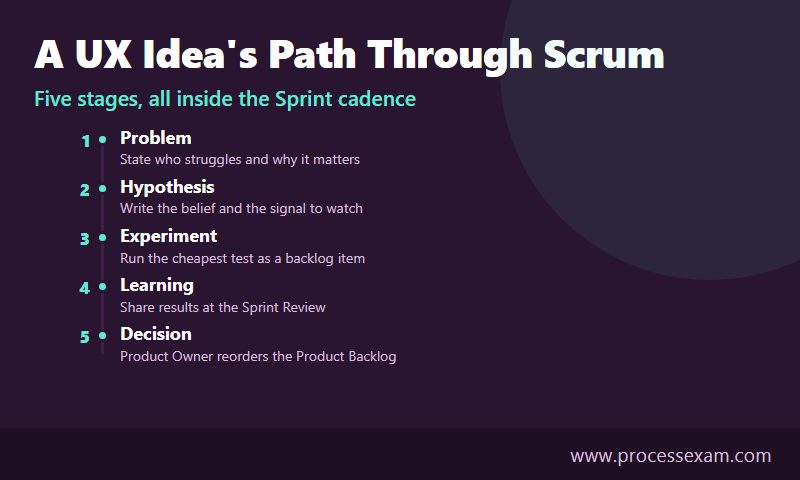
| Stage | What the team does | Where it shows up in Scrum |
|---|---|---|
| Problem | States the business problem and the people affected | Product Goal and Product Backlog ordering |
| Hypothesis | Writes what it believes and the signal that would confirm it | Product Backlog refinement |
| Experiment | Chooses the cheapest test, such as an interview round or a clickable prototype | A Product Backlog item inside a Sprint |
| Learning | Reviews what the test showed with stakeholders and users | Sprint Review |
| Decision | Builds more, changes direction or stops | Product Owner reorders the Product Backlog |
The point the exam keeps returning to is that every stage lives inside an existing Scrum element. No new phase, role or meeting appears. If an answer option invents a "design sprint zero" or a separate discovery team that reports to a different manager, it is usually wrong, because it adds structure Scrum does not ask for.
Also notice who decides at the end. The Product Owner is accountable for maximizing the value of the product and for the Product Backlog, so the team's evidence informs the Product Owner's decision; it does not replace it. A question that says the designer overrules the Product Owner on ordering, or that stakeholders vote on a design, will contain a wrong answer in that direction.
Which myths about design and Scrum will the questions test?
Scrum.org's course says one goal is to dispel myths about the relationship between UX, Agile and Scrum. Those myths are exactly what the wrong options in multiple-choice questions are built from. The ones below come up in practice questions and in real teams.
| The myth | What Scrum.org teaches instead |
|---|---|
| Design must be finished before development starts | Discovery and delivery run together, and learning continues through the Sprints |
| UX is a separate team that hands designs to Developers | People with UX skills are part of the cross-functional Scrum Team |
| Research is too slow to fit into a Sprint | Small experiments can be sized to fit a Sprint and ordered like any other item |
| A designer approves work before it can be Done | Done is defined by the Definition of Done that the team agrees |
| Only the designer talks to users | Anyone on the Scrum Team can support UX practices and learn about the customer |
| Output is the measure of progress | Outcomes and impact matter more than the number of features shipped |
How to spot the trap in a question
Read each option and ask whether it moves work out of the Scrum Team, adds a gate Scrum does not have, or measures activity instead of value. Options that do any of the three are rarely right. Options that keep work with the whole team, make learning visible at the Sprint Review and let the Product Owner decide on evidence usually are.
Watch the absolute words as well. "Always", "never" and "only" in an option are warning signs, because the Scrum Guide hardly uses them for practices. A question about whether UX research can ever happen outside the Sprint is better answered with the principle than with a rule.
In what order should you study before buying the attempt?
Most of the preparation is reading the Scrum Guide with a UX lens, then testing yourself on the open assessments Scrum.org lists as practice. Here is a route that fits a working person who already knows the basics of Scrum.
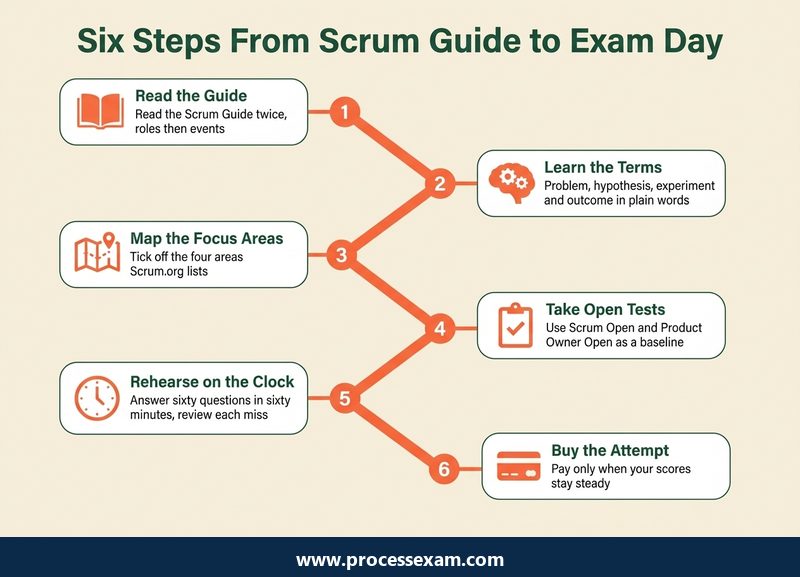
| Step | Task | Move forward once |
|---|---|---|
| 1. Scrum Guide | Read it twice, once for the roles and events and once for accountability and Done | You can explain each event's purpose without looking |
| 2. Course material | Read the learning objectives on the Scrum.org course page and note each unfamiliar term | You can describe a Business Problem Statement and a hypothesis in one sentence each |
| 3. Lean UX ideas | Study how experiments, assumptions and outcomes are described in the Lean UX book the course draws on | You can pick the cheapest experiment for a stated assumption |
| 4. Open assessments | Take the free Scrum Open and Product Owner Open until the results are steady | You score high on both, and can explain every miss |
| 5. Timed rehearsal | Sit 60 questions in 60 minutes with multiple-answer items included | You finish with time left to review |
| 6. Buy the attempt | Purchase the password and pick a quiet hour | No new material in the last evening |
Scrum.org's own Scrum Open is a free assessment of thirty questions drawn at random from a larger pool, and the Product Owner Open is shorter, at fifteen. Neither includes any certification, and neither is UX-specific, so they confirm the Scrum and Product Owner parts of PSU I rather than the whole exam. Their pages recommend reading the Scrum Guide first, and that is good advice here too. The Scrum Open assessment is a sensible first benchmark.
The UX-specific questions need a different kind of practice: take a scenario, name the problem, state the hypothesis and decide where the work goes on the Product Backlog. When you want to rehearse the wording of multiple-answer items before spending the fee, the PSU I practice exam on ProcessExam is a cheaper place to find out where you hesitate.
How long should it take?
There is no vendor figure for preparation time. A team member who works with Scrum daily and has read the Scrum Guide recently may need only a short refresh and the Lean UX vocabulary. Someone new to both Scrum and UX should allow longer and consider the two-day class, which Scrum.org describes as hands-on and built around an ongoing case study. Judge readiness by your open-assessment results and your ability to justify each answer, not by calendar days.
How do you pace 60 questions in 60 minutes, and does the certificate expire?
Sixty questions in sixty minutes leaves about a minute for each. Scenario questions take longer, so true/false items and short recall items should go faster than average to buy time. A pace check is simple: aim to be at question 30 around the half-hour mark.
A simple pace for the hour
Go through the paper once, answering everything you can settle in under a minute, and mark the scenario questions that need a second look. Spend the remaining time on the marked ones, starting with those where you have already ruled out two options. Give every item a considered answer before time runs out. Keep a few minutes at the end to re-read multiple-answer items, where a skipped word such as "two" or "which of these would not" changes the answer.
Reading multiple-answer questions
Count the options the question asks for before you look at the choices. Pick only the answers you can defend from the Scrum Guide or from Scrum.org's course ideas, and do not add a third because it sounds true. With 85% needed, a handful of wasted multiple-answer items can decide the result.
After the result
Scrum.org says you receive a breakdown of your performance by Professional Scrum Competencies, but not details of which questions you got right or wrong. Use the breakdown to target any retake. A pass comes with a free Credly digital credential, and the certification is lifetime with no annual renewal fee, according to the Scrum.org assessment page.
What it does for different roles
A designer can show hiring managers that they understand how design operates inside Scrum, which is useful when a team has had a bad experience with hand-off processes. A Product Owner gains a shared vocabulary for discovery and a stronger case for ordering research next to features. A Scrum Master can point to the framework's own reasoning when a stakeholder asks for design to finish first. None of this replaces experience with real users, and the credential should be presented that way: as evidence that you know how to fit UX into Scrum, supported by examples of doing it.
Frequently Asked Questions
How many questions are on the PSU I exam and what is the passing score?
The Scrum.org PSU I assessment has 60 questions to answer in 60 minutes. The passing score is 85%, so you can miss at most nine questions. The format mixes multiple choice, multiple answer and true/false items, and the test is delivered in English.
How much does the PSU I certification cost?
Scrum.org charges USD $200 per attempt for PSU I, with taxes added at checkout where they apply. The password is valid for one attempt only and has no expiry date. A free Credly digital credential is included, and the Scrum.org class includes a free attempt.
Do I need to attend the course before taking PSU I?
No. Scrum.org says attending the Professional Scrum with User Experience class is not a prerequisite, though it is highly recommended. The two-day, hands-on class includes a free attempt at the assessment, so people who plan to attend do not need to buy a separate password.
Does the PSU I certification expire?
No. Scrum.org describes PSU I as a lifetime certification, with no annual renewal fee required. Only the assessment password is limited, because each one is valid for a single attempt, so a candidate who does not pass has to buy a new password to try again.
What should I use to practise for PSU I?
Scrum.org lists its free Scrum Open and Product Owner Open assessments as practice, with thirty and fifteen questions respectively. Combine them with a close reading of the Scrum Guide and the course learning objectives, because the UX-specific questions are not covered by those two open assessments.
- Scrum |
- Scrum.org Professional Scrum with User Experience Test Questions |
- PSU I Question Bank |
- Scrum.org Professional Scrum with User Experience Book |
- Professional Scrum with User Experience Certification Cost |
- Professional Scrum with User Experience Certification Requirements |
- Scrum.org Professional Scrum with User Experience Sample Questions |
- PSU I Exam Questions Download |
- PSU I Test Questions |
- Professional Scrum with User Experience PDF


