
OMG OCSMP Model User (MU100): Which SysML Exam Fits You?
Myth: the arrival of SysML v2 ended the OCSMP Model User exam. It did not. OMG still sells OMG-OCSMP-MU100, which tests whether you can read a SysML v1.2 model, on a paper of 90 multiple-choice questions where 56 correct answers pass. The fee is US$350. OMG's own v2 page says the two certification series run side by side, and that newcomers may enter either one depending on the SysML version their organization uses.
Which Model User exam suits you, the SysML v1.2 one or the newer v2 one?
This is the question the old advice on this page never had to answer. OMG now runs two entry-level exams with nearly the same name. The OCSMP Model User exam covered here, code OMG-OCSMP-MU100, is built on SysML v1.2. The SysMLv2 Model User exam, code OMG-SYSML2-MU100, is built on SysML v2.0 and is a separate credential on a separate OMG page. OMG describes the v2 series as independent of, and complementary to, the OCSMP series, and states that existing OCSMP certifications will not be superseded.
| Point of comparison | OCSMP Model User (OMG-OCSMP-MU100) | SysMLv2 Model User (OMG-SYSML2-MU100) |
|---|---|---|
| Language version examined | SysML v1.2 | SysML v2.0 |
| Fee | US$350 plus taxes | US$400 plus taxes |
| Questions | 90 | 90 |
| Time allowed | 90 minutes in native English-speaking countries, 120 minutes elsewhere | 150 minutes in native English-speaking countries, 180 minutes elsewhere |
| Pass mark | 56 / 90 (62%) | 63 / 90 (70%) |
| Builder exams that follow it today | Fundamental, Intermediate and Advanced are all on sale | Model Builder Fundamental is in development, with OMG anticipating a 2027 release |
The figures for the v1.2 exam are the ones on OMG's SysML certifications page and in its Model User information sheet. The v2 column comes from OMG's SysMLv2 certification page and its v2 Model User exam details, which we cover in a separate guide to that exam.
Who should sit the v1.2 exam
- Engineers whose project, supplier or customer still keeps its models in SysML v1.x. Reading those models correctly is exactly what MU100 certifies.
- Candidates who want the full certification ladder available today. OMG states that Model User is a prerequisite to the remaining SysML Model Builder exams, and all three of those builder exams exist now on v1.2.
- Anyone whose employer asks for "OCSMP" by name in a job advert or a contract clause. That wording points at this series.
Who should look at the v2 exam instead
- People whose organization has already moved its modeling to SysML v2, or is migrating this year. OMG says its v2 exam covers both the graphical and the textual syntax, so it rewards a different habit of reading.
- Candidates who already hold an OCSMP certificate. OMG says OCSMP holders receive a significant discount on the v2 Model User exam, so a sensible order of events can be v1.2 first and v2 afterwards.
If you cannot tell which camp you are in, ask a simple question at work: which version does the team's modeling tool save by default? That answer, not the fashionable one, should decide the exam. Because OMG's own wording leaves the choice to the version in use at your organization, there is no penalty for picking the older exam when the older language is the one on your desk.
What do you need to know about OMG-OCSMP-MU100 before you book it?
| Detail | OMG-OCSMP-MU100 |
|---|---|
| Certification | OMG-Certified Systems Modeling Professional - Model User |
| Vendor | OMG |
| Exam fee | US$350 |
| Questions | 90 |
| Duration | 90 minutes in English-speaking countries, 120 minutes everywhere else |
| Passing score | 56 / 90 (62%) |
| Standard covered | SysML v1.2 |
| Prerequisites | None |
| Delivery | Pearson VUE |
Several rules that are not in the facts table also matter. OMG's information sheet gives the fee as US$350 plus taxes, converted to your regional currency at checkout. Questions are multiple choice and can include images, so some of them will show you a diagram and ask what it means. The exam is offered in English and Japanese, and the sheet specifically prohibits translation apps during the sitting. Extra time for candidates outside native English-speaking countries is confirmed by email after the order is complete, which is why you should not plan your pace until that email arrives.
Booking, cancelling and retaking
You book through a Pearson VUE account at a secure test centre or online. OMG's page tells online candidates to run the system test before scheduling, and the sheet says to contact Pearson VUE customer service for technical problems. Cancel through Pearson VUE's OMG page at least a day ahead and you are refunded in full; leave it later and the fee is lost. A failed attempt comes with a 20% retake voucher printed on the score report. Learning or physical disability accommodations are requested by emailing the address printed on OMG's sheet, not through the booking screen.
How long does the credential last?
The certificate expires three years after the exam date. You extend its validity by taking the same exam again or any higher-level exam, which is one more reason people who plan to continue treat Model User as step one rather than a destination. A digital credential arrives through Credly within hours of a pass, and a PDF certificate can be printed.
What does each of the four syllabus areas actually ask you to read?
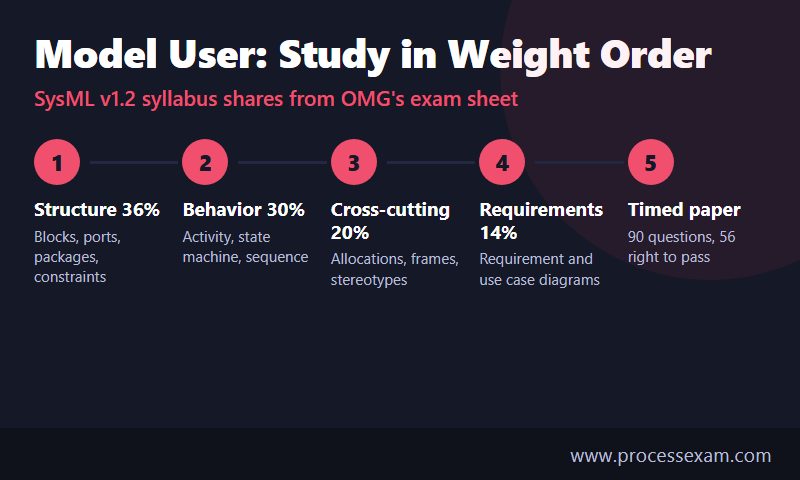
The Model User exam is an interpretation exam. OMG says it tests the knowledge and skills needed to interpret a basic SysML model of a system, covering behavior, structure and requirements as well as cross-cutting constructs. Nothing in the information sheet asks you to build a model from a blank page. Every topic is phrased as "Interpreting...", and the weights below are the ones OMG publishes.
| Syllabus area | Weight | What you interpret |
|---|---|---|
| Models of system structure | 36% | Block diagrams (22%), package diagrams (7%), constraint blocks and parametric diagrams (7%) |
| Models of system behavior | 30% | Activity diagrams (13%), state machine diagrams (10%), sequence diagrams (7%) |
| Cross-cutting constructs | 20% | Allocations, diagram frames, ports and parameters on frames, stereotypes, comments, rationale, problem and constraint notations |
| Models of requirements | 14% | Requirement diagrams (7%) and use case diagrams (7%) |
OMG publishes percentages, not question counts, so do not expect an exact number of items per area; the shares tell you where to spend revision hours. The full topic wording, down to which relationships and notations are in scope, is on the OMG-OCSMP-MU100 syllabus page alongside the same four weights.
Structure: the largest share and the biggest single topic
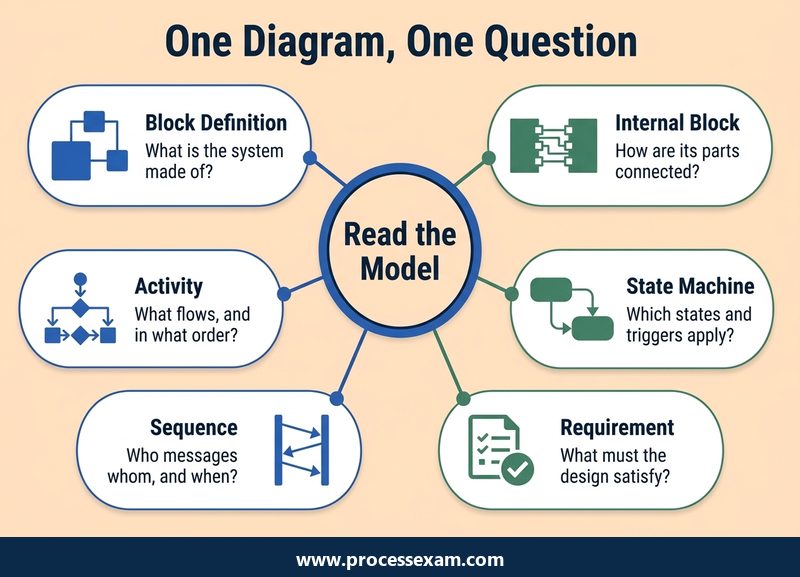
Block diagrams alone are 22% of the paper, more than any behavior diagram. The sheet expects you to distinguish a definition from a usage, to read a value type with its units, and to identify block features such as value properties, parts, references and operations. On a block definition diagram you must read compartments, specialization, associations with multiplicities, and composite aggregation. The sheet is specific that composite, but not shared, aggregation is in scope. On an internal block diagram you work with the enclosing block, parts, flow ports and standard ports, connectors and item flows.
Package diagrams are small (7%) but have crisp facts to learn: ownership, namespace, containment, dependency, and the idea of a view conforming to a viewpoint. The remaining 7% is parametrics, where you read constraint blocks, constraint properties, parameters and expressions, and follow binding connectors that tie a constraint parameter to a value property.
Behavior: three diagram types, three different questions
Activity diagrams (13%) are about flow. You read object flow and control flow, parameter nodes and pins, control nodes, swimlanes called activity partitions, and actions including call behavior, send signal and accept event. State machine diagrams (10%) are about reaction: states, regions, initial and final states, transitions triggered by time or signal events with guards and effects, and the entry, exit and do behaviors inside a state. Sequence diagrams (7%) are about conversation: lifelines, synchronous and asynchronous messages, and interaction references that point outside the diagram.
Cross-cutting and requirements: the quick marks that people under-revise
Twenty per cent is cross-cutting material and it is easy to under-study because it has no diagram of its own. Allocation is the heart of it: what allocation is for, how AllocatedFrom and AllocatedTo read, and how an allocation appears as a callout, a compartment, an allocate activity partition or a table. The rest is the grammar around diagrams, namely frames, headers, descriptions, ports and parameters on frames, and stereotypes. Requirements (14%) are two short topics. One is the requirement concept and its relationships: derive, verify, satisfy, refine, trace and containment. The other is use case diagrams, with actors, subject, include, extend and generalization.
How do you read a model the way the exam does, with a worked example?
Take a small system that does not appear in OMG's own examples: a garden irrigation controller. Imagine a block definition diagram in which the IrrigationController block owns one MoistureSensor and between one and four Valve parts. The filled diamond sits at the controller end, so the parts live and die with it. Each Valve has a value property flowRate with a unit, and the controller has an operation openValve. A question might ask how many valves a controller can own, whether a Valve can exist without a controller, or which compartment holds flowRate. Every answer is on the diagram if you know the notation.
Switch to the internal block diagram
Now the same controller is shown as an enclosing block with its parts inside. A connector joins the sensor to the controller, and an item flow labelled with a water type runs from a pump part to a valve. Exam-style questions ask what is flowing, which direction it flows, and whether the connection is made through a flow port or a standard port. The trick is to read the arrowhead and the port symbol before you read any text, because both are fixed notation.
Add behavior on top
A state machine for the controller has states Idle and Watering. A transition from Idle to Watering is labelled with a timer trigger, a guard on moisture below a threshold, and an effect that calls openValve. Watering has an entry behavior and an exit behavior. A candidate who knows the order trigger, guard, effect can answer "what must be true for this transition to fire?" in seconds. A candidate who reads the label as a sentence usually cannot.
The same system on an activity diagram would show an accept event action waiting for the timer, a decision node testing moisture, and a call behavior action that decomposes watering into smaller activities. Then a requirement such as "water the bed within five minutes of a dry reading" is linked by a satisfy relationship from the controller block, and verified by a test case. One small system has therefore walked through all four syllabus areas. That is the habit worth building: pick any model and ask the structural, behavioral, cross-cutting and requirement question about the same element.
Which look-alike symbols should a Model User be able to tell apart?
Most lost marks in a reading exam come from pairs that look similar. Learn each pair as a contrast, not as two separate facts.
- Definition versus usage. A block on a block definition diagram defines a kind of thing. A part on an internal block diagram is one use of that kind inside a particular whole.
- Composite versus shared aggregation. The filled diamond means composition and is in the syllabus. The hollow diamond is the shared form, which OMG's sheet places outside scope.
- Control flow versus object flow. Control flow only says "this action comes next". Object flow carries something, such as water or data, through pins and parameter nodes.
- Synchronous versus asynchronous messages. On a sequence diagram the arrowhead style tells you whether the sender waits for the receiver.
- Include versus extend. Both are dashed arrows between use cases. Include points from the base use case to the one it always uses. Extend points from the optional behavior back to the base.
- Satisfy, verify, derive, refine and trace. All five relate a requirement to something else. Satisfy comes from a design element, verify from a test case, derive from a lower requirement to its source, and refine from a model element that clarifies the requirement.
- Flow port versus standard port. A flow port is about what passes through, a standard port about the services offered or required. The exam expects you to recognise both on an internal block diagram.
Why diagram frames deserve ten minutes
Every SysML diagram sits in a frame with a header that names the diagram kind, the model element and the diagram name. Questions in the cross-cutting area ask what a header tells you and where parameters and ports on a frame appear. This is one of the cheapest topics to learn and one of the most often skipped, because it never appears in a textbook chapter of its own.
How can you build model-reading fluency in six weeks?
OMG lists its recommended study materials on the information sheet. The list opens with chapters 3 and 4 of A Practical Guide to SysML (Friedenthal, Moore and Steiner, who contributed to the standard and the exam). It continues with four more books and papers on SysML, the OMG SysML Tutorial, the Hybrid SUV example modeled in v1.2, and a notations and conventions reference. Pick one book plus the examples rather than collecting them all. Whatever you pick, make sure it covers v1.2, not v2, since the two languages differ.
- Week 1, orientation. Read the information sheet end to end, then Friedenthal chapters 3 and 4. Learn the frame header and the vocabulary of block, part, port and flow before touching any detail.
- Week 2, structure. Read block definition and internal block diagrams from the Hybrid SUV example. For each one write down what is defined, what is used and what is connected. Add packages and constraint blocks at the end of the week.
- Week 3, behavior. Take one activity, one state machine and one sequence diagram. Rewrite each as plain sentences, then check your reading against the text that accompanies it.
- Week 4, cross-cutting and requirements. Learn allocation notations, stereotypes and the five requirement relationships. Draw the include and extend arrows by hand until the direction is automatic.
- Week 5, whole models. Read the Hybrid SUV model across diagram types, tracing a single requirement from its text, to a satisfying block, to a behavior and to a test case.
- Week 6, timed papers. Sit full 90-question papers within the time that applies to you, review every guessed answer, and revisit only the weakest area.
Hands-on use of a modeling tool helps, but you are reading models, not building them, so reading someone else's finished model is a perfectly good substitute. Study groups and a mentor are worth the effort for one specific reason. Explaining a diagram aloud shows you quickly whether you read it or only recognised it. When you reach week six, the OMG-OCSMP-MU100 practice exam gives you full-length timed papers on exactly this syllabus, so you can see which of the four areas still leaks time.
Pacing the paper
With 90 questions in 90 minutes, a candidate in a native English-speaking country has one minute per question. Those in other countries have 120 minutes, about 80 seconds. Diagram questions take longer than definition questions, so settle on a first pass that answers every quick item and flags every diagram you have to trace, then return to the flagged ones with the time you banked. Because you need 56 correct answers, 34 wrong answers is the most you can afford, and that margin is a useful reminder that perfection is not required.
What does the Model User credential do for a junior engineer or project manager?
OMG positions the certification as proof that you can be a productive contributor, for example as a junior systems engineer, in a team that uses SysML-based model-based systems engineering. The point is the verb. The exam proves you can interpret models other people build, which is what most people on a project actually do with them: a reviewer checking that a requirement is satisfied, a tester tracing what must be verified, a program manager reading a structure diagram to understand a decomposition.
It also opens the OCSMP ladder. OMG lists Model User as the prerequisite to the Model Builder Fundamental exam, and the builder exams then run through Intermediate and Advanced. If you later decide to move to the v2 track, OMG gives OCSMP holders a reduced price for the v2 Model User exam, so this fee is not simply lost when your employer changes version. You can read more about the discipline itself in the general article on the Systems Modeling Language, which explains how SysML grew out of UML as a language for systems engineering.
What it will not do
The certificate does not prove you can build a good model, and it does not certify any particular tool. That is the job of the Builder exams. Treat MU100 as evidence of reading ability and as a structured way to learn the notation, which several people quoted on OMG's own page describe as the real benefit of studying for the SysML exams. Check OMG's SysML certifications page before you book, because exam fees, versions and discounts are set by OMG and can change.
Frequently Asked Questions
Is the OCSMP Model User exam still available now that SysML v2 exists?
Yes. OMG still lists the SysML Model User exam, OMG-OCSMP-MU100, on SysML v1.2, and says the v2 certification series is independent of and complementary to the OCSMP series. Existing OCSMP certifications are not superseded, and newcomers may enter either series.
How much does the OMG-OCSMP-MU100 exam cost?
The exam costs US$350 plus taxes, with the regional currency equivalent shown at checkout. A failed attempt produces a 20% retake discount code on the score report. The SysMLv2 Model User exam is priced separately at US$400, so check OMG's page for the exam you actually plan to sit.
How many questions are on the OCSMP Model User exam and what is the pass mark?
The exam has 90 multiple-choice questions, some with images, and you need at least 56 correct answers, which is 62%. Candidates in native English-speaking countries get 90 minutes; candidates elsewhere get 120 minutes, confirmed by email after the order is completed.
Are there any prerequisites for OMG-OCSMP-MU100?
No. OMG lists no prerequisites for the Model User exam. It is itself the prerequisite to the remaining SysML Model Builder exams, so most candidates take it first. The credential is valid for three years, and taking the same or a higher exam extends it.
Should I take the SysML v1.2 or the SysML v2 Model User exam?
Choose by the SysML version your organization uses. OMG states that new practitioners may enter either series on that basis. The v1.2 exam leads to Builder exams available today, while OMG expects the v2 Builder Fundamental exam in 2027. OCSMP holders also get a discount on the v2 exam.
- OMG-OCSMP-MU100 Question Bank |
- SysML Certifications |
- OMG-OCSMP-MU100 Exam Questions Download |
- OMG-OCSMP-MU100 Test Questions |
- SysML MU Mock Exam |
- SysML MU Simulator |
- OMG SysML MU Book |
- OMG SysML MU Question Bank |
- OMG SysML MU Study Guide |
- SysML MU Certification |
- SysML MU Certification Cost |
- SysML MU Certification Requirements |
- OMG SysML MU Exam Questions |
- OMG SysML MU Sample Questions |
- SysML MU |
- SysML MU PDF


