
ITIL vs Six Sigma: Which Certification Fits Your IT Job?
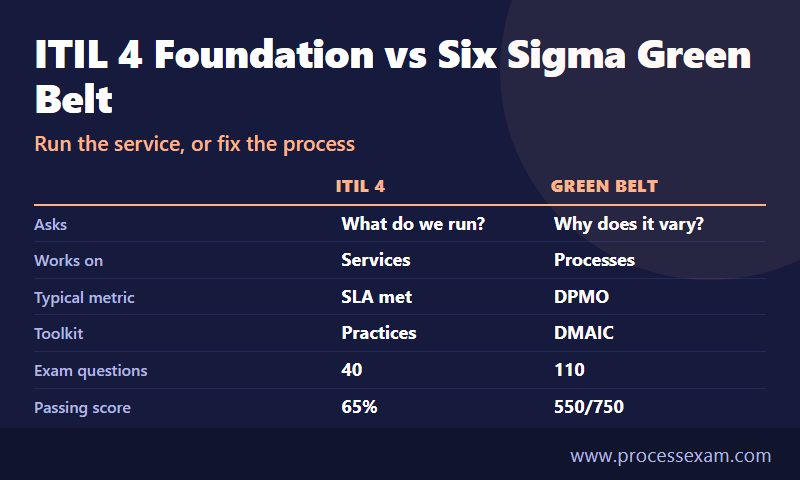
ITIL and Six Sigma are not rivals, and picking one is mostly a question of what your job produces. ITIL 4 Foundation (40 questions, 60 minutes, 65% to pass, USD $463) proves you can run IT services the way a service provider should. An ASQ Six Sigma belt proves you can measure a process and shrink its variation. Service desks use the first; improvement teams use the second.

People who search "itil vs six sigma" usually have one of two jobs in mind. Either they run or support IT services and wonder whether a quality credential would add anything, or they work in quality and operations and keep hearing that IT is a good place to apply their tools. Both groups are right to wonder, because the two bodies of knowledge were built to answer different questions and fit together better than their reputations suggest. The sections below set out what each one does, how the exams compare, where the methods meet, and which one to sit first.
What problem does each one actually solve?
Think of a support team that closes most tickets inside the promised time but still has a bad month. ITIL helps you describe the team's work as services, agree what "promised" means, and organise the practices behind it. Six Sigma helps you ask why the bad month happened and whether it will happen again. One gives you the operating model; the other gives you the measuring instrument.
What ITIL gives a service team
ITIL is a framework for IT service management, now owned and examined by PeopleCert. ITIL 4, the current generation, treats everything the IT function does as co-created value with the customer. It supplies a shared vocabulary (service, outcome, output, risk, utility, warranty) and a set of management practices, among them incident handling, service requests, change enablement, service levels and continual improvement. Its answer to "what should we be doing, and who owns it?" is the framework itself.
ITIL deliberately stays at the level of guidance. It tells you that a service level should exist and be reviewed; it does not tell you how to decide whether last quarter's response times show a real change or ordinary noise. That statistical gap is exactly where the second toolkit earns its place.
What Six Sigma gives a process team
Six Sigma is a data-driven method for finding and removing the causes of defects. Its target is a process that produces no more than 3.4 defects per million opportunities, and its working structure is DMAIC: define, measure, analyse, improve, control. It arrived from manufacturing, but the idea that any repeatable activity has an output, a defect and a spread applies just as well to invoice handling, loan approval or the time it takes to restore a failed service. The general background on Six Sigma traces that history if you want the longer story.
Six Sigma says little about what an IT organisation should do day to day. It will not tell you whether a change record needs an approver or how to separate an incident from a request. It assumes the process exists and asks how well it performs.
Is the old line that they are "not used together" true?
Older write-ups on this topic claim the two are never applied together in a genuine sense. That was a reasonable description of organisations that kept IT and quality in separate buildings. It is a poor description of a modern service provider, where the continual improvement practice in ITIL 4 explicitly invites you to use improvement methods and data, and where a Six Sigma project can use ITIL's incident, problem and change records as its raw material. They are usually applied in sequence: ITIL structures the service, Six Sigma investigates the part that is not performing.
How do the ITIL 4 Foundation and ASQ Six Sigma exams compare on paper?
ITIL 4 Foundation is a single entry exam, while the ASQ Six Sigma route has three belts, so it takes four rows to compare fairly. Each row uses the figures published for that exam at the time of writing.
| Exam | Body | Questions | Time | Passing score | Fee (USD) |
|---|---|---|---|---|---|
| ITIL 4 Foundation | PeopleCert | 40 | 60 minutes | 65% | $463 |
| Six Sigma Yellow Belt (CSSYB) | ASQ | 90 | 138 minutes | 550/750 | Members $334, non-members $434, retakes $234 |
| Six Sigma Green Belt (CSSGB) | ASQ | 110 | Exam time 258 minutes, total appointment 270 | 550/750 | Members $383, non-members $483, retakes $283 |
| Six Sigma Black Belt (CSSBB) | ASQ | 165 | Exam time 258 minutes, total appointment 270 | 550/750 | Members $485, non-members $585, retakes $385 |
PeopleCert publishes the current details for the entry exam on its ITIL 4 Foundation page, and ASQ does the same for the belts, for example on the Green Belt page and the Yellow Belt page. Read those before you book, because fees and delivery options change.
What the table does not show
The first difference is the style of the paper. PeopleCert describes ITIL 4 Foundation as multiple choice and closed book, so what you remember is what you have. ASQ papers are also multiple choice, but ASQ states that its examinations are open book and each candidate brings their own reference material. That changes how you prepare. For ITIL you memorise definitions and relationships; for a belt you build an indexed set of references and practise finding the right formula quickly.
The second is what a question counts for. On the ASQ Green Belt computer-delivered paper, 100 of the 110 questions are scored and ten are unscored trial items that you cannot tell apart, so you answer all of them seriously. The ITIL paper has no such padding to wonder about: 40 questions, and a pass needs 65%.
The third is the scale. A Foundation candidate with some service-desk exposure can be ready in a few weeks of evenings. A Green Belt candidate has to be comfortable with probability, control charts, hypothesis tests and measurement systems, which is a different kind of study, and the longer paper reflects that. ASQ describes the Green Belt as suited to people with at least three years of work experience, so check the entry notes before you commit.
Where does the cost go?
On fees alone, the cheapest way into either field is the Yellow Belt at USD $334 for ASQ members, with ITIL 4 Foundation at $463 for the one-hour paper. But exam fees are only part of the bill. The belt exams are open book, which means the cost shows up as hours spent building a reference binder and practising calculations. The ITIL exam asks for less preparation time but for firmer recall. Judge the cost by hours as well as dollars.
Where does Six Sigma plug into ITIL's practices?
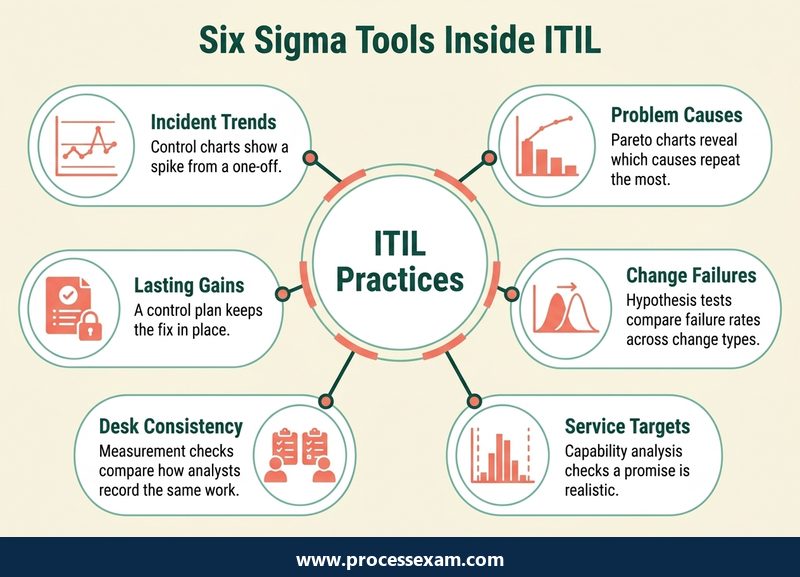
The most useful way to see the pairing is practice by practice. Each ITIL practice produces records and targets; each Six Sigma tool turns those records into a decision. The table lines them up.
| ITIL practice | The question it leaves open | Six Sigma tool that answers it |
|---|---|---|
| Incident management | Is a spike in resolution time a trend or a one-off? | Control chart on resolution times |
| Problem management | Which cause sits behind the repeating incidents? | Pareto chart, then cause-and-effect analysis |
| Change enablement | Why do some changes fail and others do not? | Hypothesis test on failure by change type or team |
| Service level management | Does the target match what the process can actually deliver? | Process capability analysis |
| Service desk | Are two analysts or two shifts handling the same work differently? | Measurement system analysis and variation study |
| Continual improvement | Did the improvement really change the result? | Before-and-after comparison with a control plan |
Incident versus problem, seen through a quality lens
ITIL makes a careful distinction between an incident, which is an unplanned interruption you restore, and a problem, which is the underlying cause you remove. In practice teams spend most of their effort on incidents because the restore clock is visible. Six Sigma pushes attention upstream: it treats every repeat incident as a defect and every defect as evidence about a cause. A Pareto chart of last quarter's tickets by cause often shows a handful of categories carrying most of the volume, which tells problem management where to start.
Service levels and what a process can promise
A common failure in service level management is signing a target that the process cannot meet without heroics. Process capability, a standard Six Sigma idea, compares the natural spread of a process with the limit you have promised. If the spread already crosses the limit, no amount of reminder e-mails will fix it, and the honest options are to change the process or renegotiate the target. ITIL asks you to agree and review service levels; Six Sigma gives you the arithmetic for judging whether the number is realistic.
Continual improvement needs evidence
The continual improvement model in ITIL 4 walks a team through a vision, a current state, a target state, a plan, action, an evaluation and a decision on how to keep momentum. DMAIC maps onto that sequence closely: define the vision and scope, measure the current state, analyse the gap, improve toward the target, control to keep it. If your team already uses the ITIL model, learning DMAIC adds method to the middle of it, not a competing process.
To judge how much of the ITIL vocabulary you already know, a timed run through an ITIL 4 Foundation mock exam will tell you in an hour.
What does the combined approach look like on a real queue?
An example makes the split clearer. The numbers below are invented for illustration, but the steps are the ones a belt project follows.
Imagine an internal service desk that handled 8,000 tickets last month. Under its service level agreement, a ticket is a defect if it is resolved later than the target, and 400 tickets missed that target. The service management reports show 95% on time, which looks acceptable. A belt project asks what that 5% hides.
Define and measure
The team defines one opportunity per ticket and writes down the defect: resolved after the agreed time. Defects per million opportunities (DPMO) is the number of defects divided by the number of opportunities, multiplied by one million. Here that is 400 divided by 8,000, times a million, which gives 50,000 DPMO. That is a little over three sigma on the usual conversion table, a long way from the six sigma target of 3.4. Nothing in ITIL's reporting would have made that comparison, but it is a useful way to see how much room for improvement is left.
The team also checks that the data can be trusted: do two analysts record the "resolved" time the same way, or does one close tickets when the customer replies and the other when the fix is applied? A measurement check of that kind is routine in a belt project and often surfaces the first real finding.
Analyse
Splitting the 400 late tickets by category shows that a small number of categories account for most of them. One of them, access requests that need a manager approval, is slow not because analysts are slow but because the approval step waits in someone's inbox. This is a problem record in ITIL terms; a statistical test confirms the approval wait is the difference, not shift timing or analyst skill.
Improve and control
The fix is a process change: reminders after four hours, a delegate for absent approvers, and a standard template that stops requests bouncing for missing detail. The change goes through change enablement like any other. Then comes the control phase that service reports rarely include: a control chart on approval time with a rule for when a person should investigate, an owner for the chart, and a date to review it. The result is a service that is both documented and statistically stable, which is what each framework was aiming at in the first place.
Which kind of workplace pulls the two together?
The combination is not equally common everywhere. Four settings stand out.
Managed service providers
A provider sells outcomes and penalties, so it needs both a service framework customers recognise and numbers it can defend. ITIL defines the services in the contract; Six Sigma is how the account team finds out why one customer's incident volume is double another's. Staff here often carry the ITIL 4 Foundation plus a Green Belt.
Shared service centres and outsourced operations
In finance, HR or customer-care operations, the work is already organised as processes with volumes, error rates and handling times. IT service management sits beside it, and the same improvement office often covers both. A quality specialist moving into the IT side of such a business finds the ITIL vocabulary a short hop away, and the Foundation exam is a sensible first step.
Regulated IT in banks, insurers and health care
Where an audit trail matters, ITIL's change and incident records supply evidence, and Six Sigma's control plans show that an improvement stayed in place. Auditors like both. Roles here include service delivery manager, process owner and operational risk analyst.
Manufacturers with in-house IT
Plants that already run Lean or Six Sigma programmes sometimes expect their IT teams to use the same language. An engineer who adds ITIL gets a shared vocabulary with the IT department, while an IT service manager who adds a Yellow or Green Belt can join plant improvement projects as an equal.
Which one should you take first, and how do you prepare for the second?
The right order follows your current job, not the sequence on a certification chart.
If you work on a service desk or in IT operations
Start with ITIL 4 Foundation. It maps directly onto the tickets, changes and service levels you handle, so the study reinforces daily work. Once you have the vocabulary, a Yellow Belt is a gentle introduction to the improvement tools, and a Green Belt is the next step if you want to lead small projects. The Green Belt syllabus shows how much statistics is involved before you pay for the exam.
If you work in quality, operations or process improvement
You probably have, or can earn, a belt first. Then take the ITIL 4 Foundation as a vocabulary credential so that IT colleagues recognise your terms. The paper is short and closed book, and your process background will make the service value ideas feel familiar. Many people in this group are ready after a few focused weeks.
If you are early in your career
ITIL 4 Foundation is the cheaper and faster experiment. It opens service desk, service coordinator and IT support analyst roles, and it can be earned alongside a job. A belt tends to pay off once you have a process of your own to improve, because the project is the real examination of what you learned.
Do the older names in other guides still matter?
Older articles on this topic mention an ITIL Practitioner certificate and the IASSC Yellow, Green and Black Belt exams. The Practitioner name belongs to the ITIL v3 generation, so check PeopleCert's current catalogue for what sits above Foundation today rather than relying on a guide from that period. IASSC is a separate certifying body from ASQ, and the belts are not interchangeable between bodies. Employers sometimes name one, so look at the advert first. In this article, the Six Sigma figures come from the ASQ exams.
Preparing for the second credential faster
The overlap is real. If you hold a belt, the ITIL concepts of value, risk and improvement will not be new, and you can concentrate on terminology and the practice names. If you hold ITIL, most of a Yellow Belt is a set of definitions and tools you can learn in a few evenings. A Green Belt asks for more: plan separate time for probability, sampling and hypothesis testing, and practise on timed papers because you will be working with a calculator and your own notes.
What claims about ITIL and Six Sigma should you stop repeating?
A few statements recur in articles and interviews. Each one is worth correcting before it appears on your CV.
- "Six Sigma is only for factories." The method needs a process, a defect definition and data. Tickets, invoices and approvals all qualify.
- "ITIL is only a help desk manual." ITIL 4 covers service strategy, relationships, supplier management, governance and improvement as well as support work.
- "Six Sigma means 99.99966% accuracy, full stop." The 3.4 per million figure is a target for a long-term process capability, and the same defect rate can look very different depending on how many opportunities you count. State your definition of a defect whenever you quote a sigma level.
- "One replaces the other." ITIL does not give you statistics, and Six Sigma does not give you a service model. Teams that treat them as alternatives usually end up reinventing the half they skipped.
- "A higher belt means a better service manager." A belt measures analytical skill and project leadership. Running a service well also needs the stakeholder, supplier and governance skills ITIL describes.
- "The exam fee tells you the cost of the credential." Preparation hours, books and, for ASQ members, the cost of membership all move the real figure.
If you take only one point from this comparison, let it be this: choose by what your work produces, then add the other framework when you notice that your reports show a problem you cannot explain. That moment, when a service report shows a number you cannot account for, is exactly when the second credential starts to pay for itself.
Frequently Asked Questions
What is the difference between ITIL and Six Sigma?
ITIL is a framework for managing IT services, covering practices such as incident, change and service level management. Six Sigma is a data-driven method for finding the causes of defects and reducing variation in any process. ITIL tells a team what to run; Six Sigma tells it how well the run is performing.
Can ITIL and Six Sigma be used together?
Yes. ITIL practices such as problem management and continual improvement produce records and targets, and Six Sigma tools such as Pareto charts, control charts and DMAIC projects analyse them. Many service providers use ITIL to define services and a belt-led project to fix the process that misses its targets.
Which is easier to pass, ITIL 4 Foundation or a Six Sigma belt?
ITIL 4 Foundation is shorter: 40 questions in 60 minutes with a 65% pass mark, closed book. The ASQ Six Sigma belts are longer open-book papers that need statistics, with 90 to 165 questions and a 550/750 passing score. Most people find the Foundation quicker to prepare for.
How much do the ITIL 4 Foundation and Six Sigma Green Belt exams cost?
ITIL 4 Foundation costs USD $463. The ASQ Six Sigma Green Belt costs USD $383 for members and $483 for non-members, with a retake at $283. The Yellow Belt is $334 or $434 and the Black Belt $485 or $585. Check PeopleCert and ASQ before booking because fees change.
Which should I take first, ITIL or Six Sigma?
Take the one closer to your current job. If you work on a service desk or in IT operations, start with ITIL 4 Foundation, then add a Yellow or Green Belt. If you work in quality or process improvement, take the belt first and use ITIL 4 Foundation to learn the IT service vocabulary.
- ITIL 4 Foundation Question Bank |
- ITIL 4 Foundation Test Questions |
- ITIL 4 Foundation Body of Knowledge (BOK) |
- ITIL 4 Foundation Certification Cost |
- ITIL 4 Foundation Certification Requirements |
- ITIL 4 Foundation PDF |
- PeopleCert ITIL 4 Foundation Test Questions |
- ITIL 4 Foundation Simulator |
- ITIL 4 Foundation Mock Exam |
- PeopleCert ITIL 4 Foundation Book |
- PeopleCert ITIL 4 Foundation BOK PDF |
- PeopleCert ITIL 4 Foundation Sample Questions |
- ITIL 4 Foundation Exam Questions Download


