
Is the ASQ CSQE Worth It? Fee, Exam Format and Career Value
The ASQ Certified Software Quality Engineer (CSQE) is worth it if you already have about eight years in software quality work and want proof of management-level judgment. Members pay $450 and non-members $550. The exam is open book, with 175 questions in 270 minutes, and 550 out of 750 passes. It pays off less for early-career testers, who cannot qualify yet.

That short answer hides the real question, which is whether the credential changes anything for you. This guide sets the cost and the eligibility rules against what the exam actually tests and what employers tend to read into it. You will see all seven areas of ASQ's 2023 Body of Knowledge, a study plan built around their weights, the mistakes that waste marks, and an honest list of what the CSQE will not do for a career.
Who gets real value from the CSQE, and who should wait?
A credential is worth what it lets you do that you could not do before. For the CSQE that comes down to three groups of people.
Test leads and quality analysts moving into management
If you have spent years running test cycles and now write the quality plan, choose the metrics and argue with a project manager about a release date, the CSQE describes that job. Four of the seven exam areas (quality management, project management, metrics and configuration control) are about decisions rather than tools, so the exam rewards exactly the judgment a lead already uses. Passing gives you a neutral, vendor-independent statement of it.
Engineers in regulated industries
Where software touches safety, money or personal data, auditors ask who is accountable for quality. A named certificate from a body that has been certifying quality professionals for decades answers the question quickly. The Body of Knowledge itself names regulation, data privacy, safety analysis and security risk, so the material is close to what those audits discuss.
Consultants and independent contractors
Clients you have never met cannot judge your past projects, but they can read a certification. For someone who sells quality advice, a credential shortens the trust-building stage of a proposal.
Who should wait
If you are in your first three or four years of testing or development, wait. ASQ asks for experience as part of your application, so you cannot sit the exam early, and your time is better spent on hands-on skills, such as automation and scripting, that job advertisements for junior roles ask for first. Also wait if your employer only screens for tool certificates: the CSQE speaks about process, measurement and management, and a screening filter built around one specific tool will not reward it.
A quick self-test helps. If you can explain how you decided what to test, how you measured whether it worked and what you told management about the risk left over, you have the raw material for this exam. If those three questions feel new, keep working before you book.
What are the CSQE exam facts before you commit?
ASQ offers the exam on a computer at a test centre and as a paper test at scheduled ASQ sittings. Master's exam sheet, which reflects the computer-based version, gives the figures below. ASQ's own page adds that the paper version is a 160-item, four-hour sitting, that the exam is offered in English only, and that all ASQ exams are open book.
| Detail | CSQE |
|---|---|
| Full name | ASQ Certified Software Quality Engineer |
| Exam code | CSQE |
| Vendor | ASQ |
| Number of questions | 175 |
| Duration | 270 minutes |
| Passing score | 550/750 |
| Exam fee | ASQ members $450, non-members $550 |
| Retake fee | $350 |
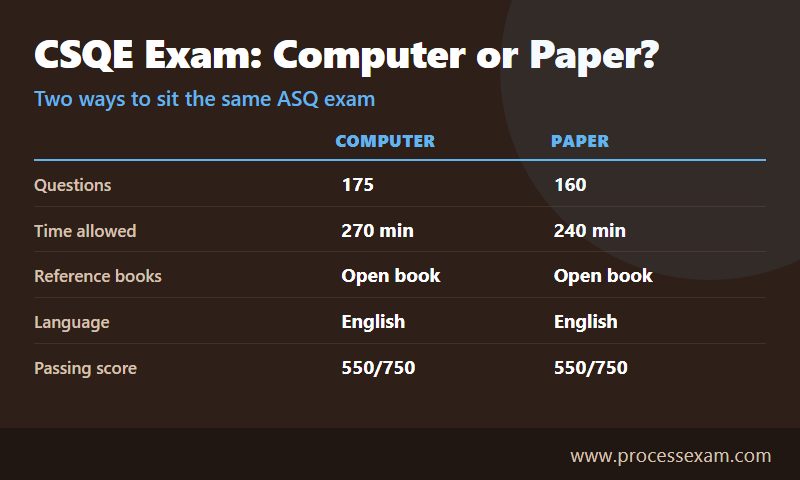
Two details deserve a second look. First, the 175 questions on the computer version are not all scored. ASQ says only 160 of them count toward your result and the other 15 are unscored trial items, and the exam does not mark them, so treat every item as if it counts. Second, 270 minutes for 175 questions is about a minute and a half each. That is generous for a recall question and tight for a long scenario that asks you to evaluate a test plan, which is why time planning matters more here than on a short exam.
The pass mark is a scaled score, 550 out of 750, not a percentage of questions answered correctly. ASQ does not publish how many raw marks that equals, and the number can differ between exam forms, so do not plan around a magic percentage. Plan around being comfortably strong in all seven areas. You can read ASQ's own description of the exam, and book a sitting, on the ASQ CSQE certification page.
Can you qualify with your degree and job history?
The rule is simple to state: you need eight years of paid work that touches at least one CSQE Body of Knowledge area, and three of the eight have to be spent where you make the calls. A decision-making role is one where you determine, or significantly influence, how work is planned, organised or approved, not simply carry out tasks handed to you. A test lead who signs off release readiness qualifies; a tester who executes a script written by someone else, on its own, does not.
Formal education can shorten the eight years. ASQ credits each level as follows.
| Your highest qualification | Years waived | Experience left to earn |
|---|---|---|
| Technical or trade school diploma | 1 | 7 |
| Associate degree | 2 | 6 |
| Bachelor's degree | 4 | 4 |
| Master's or doctorate | 5 | 3 |
Two points catch people out. The waiver reduces the total, but it does not remove the decision-making requirement, so a master's graduate must still show three years spent as the decision-maker. And a waiver is granted for one degree level, not stacked: a bachelor's followed by a master's earns the five years of the higher one, not nine.
Before you pay, write out your own timeline: each job, the dates, and for each one which Body of Knowledge area your work touched. If the total does not reach the required years, you have your answer about timing. If it does, the same document will be the backbone of your application.
What does each of the seven Body of Knowledge areas test?
The current outline is ASQ's 2023 CSQE Body of Knowledge, which you can read in full in the official PDF. It splits the 160 scored questions across seven areas, and each topic in it is tagged with the highest thinking level at which it can be tested, from Understand up to Create. Our CSQE syllabus page lays the same structure out topic by topic.
| Area | Scored questions |
|---|---|
| I. General Knowledge | 16 |
| II. Software Quality Management | 27 |
| III. System and Software Engineering Processes | 32 |
| IV. Project Management | 16 |
| V. Software Metrics and Analysis | 21 |
| VI. Software Verification and Validation | 32 |
| VII. Software Configuration Management | 16 |
Areas III and VI together carry 64 of the 160 scored questions, so two fifths of your result depends on how well you know engineering processes and verification. Those are also the areas where practising engineers usually feel at home, which is worth remembering when you decide where the extra study hours go.
General Knowledge: ethics, standards and leadership
This area covers the benefits of software quality engineering to an organisation, the ASQ Code of Ethics, regulatory and legal issues such as data-protection law and intellectual property, standards and models such as ISO 9000 and 27000, NIST guidance, IEEE software standards and CMMI, and leadership, facilitation, communication and team skills. It is easy to dismiss as common sense, but the ethics topic is tested at the Evaluate level: you are given a conflict of interest and must judge the right course.
Software Quality Management: goals, cost of quality and audits
Expect to design quality goals that match business objectives, weigh stakeholder and supplier requirements, plan for business continuity and data protection, analyse cost of quality (prevention, appraisal, internal and external failure), apply DMAIC and PDCA, evaluate corrective and preventive action, and describe audit types, roles and process. Goal-setting sits at the Create level, the highest one on the outline.
System and Software Engineering Processes: lifecycles, architecture and requirements
This area asks you to apply waterfall, iterative, agile and DevOps lifecycles and know when each fits, to analyse architectures from embedded to web and cloud, to distinguish requirement types (functional, non-functional, data, quality, compliance and security), to use elicitation methods, and to manage design, reuse, tools and maintenance. The trap is treating it as a vocabulary list: the questions usually describe a situation and ask which approach protects quality best.
Project Management: plans, tracking and risk
You will build plans from a work breakdown structure, control phase transitions with entry and exit criteria and quality gates, calculate earned value, run project and program reviews, and evaluate risk, including software security threats and safety hazards. The arithmetic is modest but real, so practise it on paper.
Software Metrics and Analysis: choosing and reading the numbers
Here the exam checks measurement vocabulary (validity, reliability, derived measures), product metrics such as size, complexity and requirements volatility, process metrics such as defect removal efficiency and defect containment, data integrity, dashboards, and the classic quality and problem-solving tools, from Pareto charts and control charts to root cause analysis. Know each metric's formula and, more importantly, when it misleads.
Software Verification and Validation: the largest testing area
Alongside area III this is the heaviest. It covers verification and validation methods, test strategies (risk-based, black-box, white-box, automation and others), test plans, design techniques such as equivalence partitioning and boundary values, the range of test types from unit to stress, coverage and code-coverage measures, environments, tools, test data, reviews and inspections, and test execution documents. Many topics are tested at Evaluate or Create level, so memorising definitions is not enough.
Software Configuration Management: control from check-in to release
The smallest-weight areas are worth points too. Configuration management covers libraries, build systems, baselines, version and change control, the configuration control board, status accounting, functional and physical audits, product release, customer deliverables and archiving. Most topics sit at the Understand level, which makes this area the most reliable source of marks for a candidate who has revised them.
How should you prepare for an open-book exam with 175 questions?
Open book changes the kind of preparation that pays. You cannot win by memorising a definition, because the definition is in the book, but you also cannot win by looking everything up, because 270 minutes disappears quickly. The aim is to know where each idea lives and to understand it well enough that a page lookup only confirms what you already suspect.
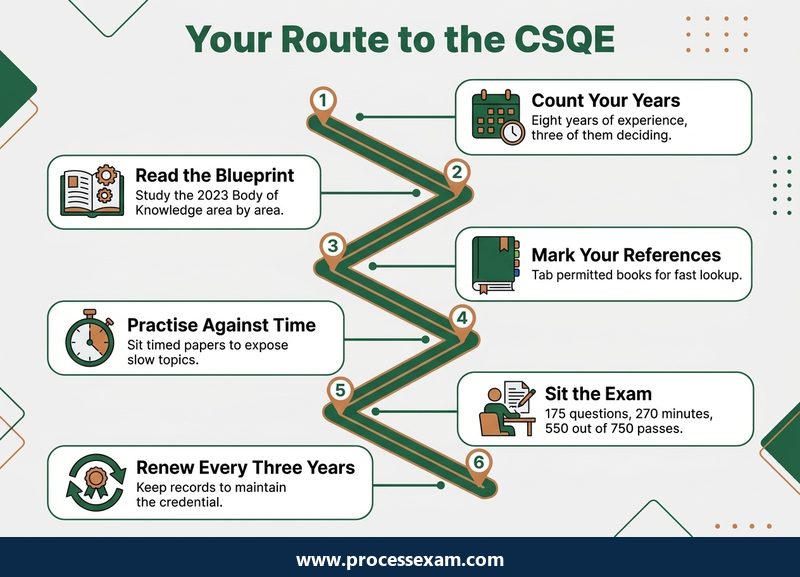
The plan below assumes ten weeks and roughly six to eight hours a week alongside a full-time job. Compress it if your experience is strong in the heavy areas, and stretch it if the management topics are new to you.
| Weeks | Focus | What to finish |
|---|---|---|
| 1 | Blueprint and gap check | Read the whole Body of Knowledge, rate each topic red, amber or green, and choose your references |
| 2-3 | Engineering processes | Lifecycles, architecture, requirements types, maintenance; a one-page comparison of waterfall, agile and DevOps |
| 4-5 | Verification and validation | Test strategies, design techniques, coverage, reviews; work several boundary-value and equivalence cases by hand |
| 6 | Quality management | Cost of quality, corrective action, audits, goals and objectives |
| 7 | Metrics and analysis | Every formula on the outline, plus a note on what each metric hides |
| 8 | Project and configuration management | Earned value calculations, gates, baselines, control board, release and archive |
| 9 | General Knowledge and reference index | Ethics scenarios, standards names; finish tabbing and indexing your references |
| 10 | Timed practice | At least two long sittings, then review every miss by area |
Build the reference set as you study
Check ASQ's current rules on which materials you may bring, then assemble them in week one rather than the night before. Mark each area with tabs, and keep a short index of where formulas, standards and lifecycle comparisons live. An index you built yourself while studying is worth more than a thicker book, because building it forces the recall you need on the day.
Practise the way the exam asks
Because so many topics are tested at Apply, Analyze and Evaluate level, the most useful practice questions are scenarios rather than definitions. The CSQE practice exam page on ProcessExam is one place to test yourself on that style. After each set, sort your misses into three piles: did not know it, knew it but misread the question, and ran out of time. Each pile has a different fix, and only the first one is solved by reading more.
Rehearse the clock
Do at least one sitting long enough to feel the fatigue of the real thing. Aim for a first pass of about a minute per question, leaving the last stretch for flagged items, and practise flagging a question rather than fighting it.
Where do experienced software people trip up on the CSQE?
- Treating open book as easy. Candidates who bring a stack of books and no index lose minutes on every lookup, and the minutes add up across 175 questions.
- Skipping the "soft" area. General Knowledge carries as many marks as project management, and its ethics and leadership items are judgment calls that need practice.
- Studying only your own specialty. A test engineer often knows area VI thoroughly and has never calculated earned value or described a configuration control board. The exam does not care which one you use at work.
- Memorising instead of choosing. Many questions offer several options that could work in some situation. The right answer is the one that best fits the conditions in the question.
- Ignoring the thinking level. If the outline tags a topic Evaluate or Create, expect a question that asks you to judge or design, not to define.
- Guessing about unscored questions. You cannot spot the trial items, so treating any question as unimportant risks a scored one.
- Leaving all practice for the last week. Timed practice early shows you which of the seven areas to revisit while there is time to fix it.
Will the CSQE move your role, or only your CV?
The credential does three useful things. It gives a hiring manager or client a vendor-neutral signal that you have been assessed against a published Body of Knowledge. It gives you a common vocabulary with quality managers, auditors and project managers, which makes it easier to be heard when you argue for a release gate or a metric. And it is one of the few credentials that treats software quality as a discipline of its own rather than as a synonym for testing.
ASQ's materials list many roles where CSQE holders work: software quality engineer, software test engineer, software development engineer, quality analyst, quality manager, auditor, inspector, computer systems analyst, consultant, program manager and director. Typical industries include energy, financial services, government, healthcare, manufacturing, medical devices and pharmaceuticals, military, telecommunications and transportation. The pattern is consistent: organisations that answer to regulators or carry heavy consequences for defects.
It does not do everything. It is not a licence, and no employer is obliged to pay more for it. It will not replace hands-on skill with test automation, continuous integration or a specific tool stack, and a technical interviewer will still ask you to demonstrate those. It also will not fix a role that has no scope for quality decisions. It is most powerful when it confirms the responsibility you already hold, and least powerful when you hope it will create that responsibility.
On pay, this article deliberately gives no salary figure. Published numbers change with country, industry and experience, and they seldom isolate the effect of one certificate. If money is central to your decision, look at current job adverts for the roles you want and see how many mention the CSQE, and check ASQ's own salary survey for the most recent data.
For general background on the field the exam sits in, the overview of software quality assurance on Wikipedia is a useful neutral read, though the Body of Knowledge, not an encyclopaedia, defines what is examined.
What happens three years after you pass the CSQE?
ASQ requires you to recertify every three years, which means the credential reflects continuing activity and not a single exam result. Exact requirements and deadlines are set by ASQ and can change, so read the current rules on ASQ's site when you pass and note your cycle date.
Treat this as a reason to keep records from day one. Keep evidence of the work, learning and contribution you do in each year, rather than reconstructing it in the final months. It also makes a practical point about the decision itself: the CSQE is a habit of staying current, not a one-time purchase, so the real cost includes the effort of maintaining it.
So is it worth it?
Weigh it this way. If you meet the eight-year rule, work in an environment where quality decisions carry consequences, and plan to move toward quality leadership, consulting or audit, the fee and ten weeks of preparation are modest against the signal you gain. If you are early in your career, or your employer values tool certificates only, put the money into experience first and return to the CSQE when your timeline and your role line up.
Frequently Asked Questions
Is the ASQ CSQE certification worth it?
It is worth it for professionals with about eight years of software quality experience who are moving toward management, audit, consulting or regulated work. Early-career testers usually gain more from hands-on skills first, because they cannot yet meet ASQ's experience requirement or use the credential's management focus.
How many questions are on the CSQE exam?
The computer-based CSQE has 175 questions in 270 minutes, of which 160 are scored and 15 are unscored trial questions. The paper version is a 160-item test lasting four hours. The exam is open book and offered in English only, so plan your reference materials and timing around that format.
What is the passing score for the CSQE?
The passing score is 550 out of 750. This is a scaled score, not a percentage of correct answers, so ASQ does not equate it to a fixed number of questions. Aim for consistent strength in all seven Body of Knowledge areas rather than a target percentage.
What experience do you need to take the CSQE?
You need eight years of on-the-job experience in one or more Body of Knowledge areas, with at least three years in a decision-making position. A technical diploma waives one year, an associate degree two, a bachelor's degree four and a master's or doctorate five.
How much does the CSQE exam cost?
The exam fee is $450 for ASQ members and $550 for non-members, and a retake costs $350. ASQ can change fees, so confirm the current amount on its certification page before you apply, and remember that recertification every three years is an additional cost.
- ASQ Software Quality Engineer Test Questions |
- CSQE Question Bank |
- CSQE Body of Knowledge (BOK) |
- ASQ Software Quality Engineer Book |
- ASQ CSQE BOK PDF |
- Software Quality Engineer Certification Cost |
- Software Quality Engineer Certification Requirements |
- ASQ Software Quality Engineer Sample Questions |
- CSQE Exam Questions Download |
- CSQE Test Questions |
- Software Quality Engineer PDF |
- Engineering |
- CSQE Handbook


