
How to Get PRINCE2 Certified: Route, Cost and Renewal
Updated on 16 October 2026. What’s new: the practitioner exam accepts several prerequisites, not only foundation, and prince2 certification is renewed every three years.
The whole PRINCE2 route costs less than most people expect, and the part they forget is the upkeep. On PeopleCert's own pages the Foundation and Practitioner exam bundles come to £817 including VAT together, and you spend 3 hours 30 minutes in the exam seat across both papers. Then a clock starts: PRINCE2 certification has to be renewed every three years, and the renewal rules decide what it really costs to stay certified.

This guide follows the route in the order you will live it: what each step costs in money and hours, which starting point lets you skip Foundation, where to buy the exam, what happens on the day, what a failed attempt costs, and then the part most guides skip, which is how to keep the certification current. Everything below was read on PeopleCert's own pages in October 2026, and PeopleCert sets these rules, so check your account before you pay for anything. PRINCE2 7, the current edition, is the version both exams now test. How the method itself works, what the practices are and how to study for each paper are covered in separate guides on this site, so this one stays on the certification journey.
What does the whole PRINCE2 route cost in money and hours?
PeopleCert sells each PRINCE2 7 exam in three bundles. The prices below are the ones its Foundation and Practitioner pages listed in October 2026, in pounds and including VAT. Training providers set their own prices for the same exams, so treat these as the direct-from-PeopleCert baseline.
| Bundle | Foundation (Version 7) | Practitioner (Version 7) | Both |
|---|---|---|---|
| Exam bundle | £393 | £424 | £817 |
| eLearning bundle | £947 | £1,019 | £1,966 |
| eLearning+ bundle | £1,143 | £1,215 | £2,358 |
PeopleCert's Practitioner page spells out what sits in each bundle. The exam bundle is the exam voucher plus a Learning Resource Kit. The eLearning bundle adds PeopleCert's Official eBook and the interactive eLearning course, which the page describes as 8 hours of self-paced content. The eLearning+ bundle adds auto-marked sample papers, a free exam re-take and PeopleCert's Official Mock Exam. The Foundation bundles carry the same names, but read that page for its own list before you assume the contents match.
The gap between the cheapest and the dearest route is large: £817 against £2,358. What you pay extra for is learning material and a safety net, not a different certificate. Someone who already has the manual, or whose employer funds a classroom course, has no reason to buy the eLearning layers. Someone studying alone with no manual and no sample papers may find the bundle that includes a free re-take is cheaper than a failed attempt on the cheapest one, which is a decision to make before you buy, not after.
How many hours do you spend in the exam seat?
The two papers add up to 210 minutes: 60 minutes for Foundation and 150 minutes for Practitioner. Add the check-in with the online proctor on each day and the total is still a short afternoon's worth of sitting across the whole certification. Official results arrive within two business days of submitting your answers, which means the gap between the papers can be as short as you choose to make it. Study time is the part PeopleCert does not fix: the only study figure on the pages checked is the 8 hours of interactive content in the Practitioner eLearning course, and the hours you personally need depend on how much project work you have already done.
What does the price leave out?
Three costs sit outside the table. The first is rescheduling: it is free up to 48 hours before the exam starts, and after that PeopleCert charges a fee that rises as the start time gets closer (the figures are in the exam-day section below). The second is a re-sit, because only the eLearning+ bundle includes a free re-take. The third is renewal. PeopleCert's pages say membership of PeopleCert Plus is the simplest way to keep certifications current, but they do not print the membership price, so look at the join page and add it to your budget before you decide the route is cheap.
Why the fee on other sites looks different
You will see the Foundation fee quoted as USD 338 and the Practitioner fee as USD 500 in exam listings. PeopleCert quotes fees in several currencies and its pages change with country and bundle, which is why a dollar figure and a pound figure for the same exam never match exactly. The vendor's own page for your country and currency is the figure to pay; the others are useful for comparing routes.
One way to lay the route out in time
PeopleCert sets no minimum or maximum study period, so the calendar is yours to design. One sensible shape, offered as an example rather than a PeopleCert rule, is to sit Foundation first, wait the two business days for the result, then book Practitioner while the vocabulary is still fresh. The one hard ceiling on the calendar is the voucher: PeopleCert's FAQ says you have 12 months to sit your exam after purchase, so if you buy both vouchers on the same day, both papers have to be sat inside that year.
Should you start at Foundation, or go straight to Practitioner?
PeopleCert's Foundation page lists no prerequisite, so anyone can book it. The Practitioner page is stricter: it says completion of one of a list of certifications is required, and the list is wider than most guides admit. The page ends in a "Show More" button, so it may hold further options than the ones that were visible.
| What you already hold | What to book next | Trade-off |
|---|---|---|
| No PRINCE2 or project qualification | Foundation, then Practitioner | Two exams, but the first one builds the vocabulary the second assumes |
| PRINCE2 Foundation (Version 7) | Practitioner | The expected route; nothing to relearn |
| PRINCE2 5th or 6th Edition, Foundation or Practitioner | Practitioner | Accepted by PeopleCert, but your notes use older terms |
| PMP or CAPM | Practitioner | Saves the Foundation fee, but the PRINCE2 method is new to you |
| PPQ, PMQ, IPMA Level A to D, CSPM-2 or CSPM-3 | Practitioner | Same: a recognised qualification opens the door, not the content |
So the claim that you must pass Foundation before you can sit Practitioner, which older guides repeat, is no longer true as a rule. It is still the route most people take, and for a good reason: skipping Foundation saves £393 and an hour in the exam seat, but it also skips the paper that forces you to learn PRINCE2's terms. Practitioner assumes you can already read a project scenario in those terms, and it is the open-book paper, so the manual helps you find an answer but cannot teach you a method you have never used.
A practical test: if you can explain, without looking it up, who the project board is, what a stage is and what "management by exception" means, a direct Practitioner booking is realistic. If those phrases are new, Foundation costs little compared with a failed Practitioner attempt. Before choosing, the PRINCE2 Foundation syllabus page shows exactly how much ground the first paper covers, which is a fair measure of how much you would be skipping.
Which level does a job advert actually want?
PeopleCert's pages do not say which level an employer will accept, so the advert for your target role is the only evidence that counts. Collect a handful for the job you want and note whether they name Foundation, Practitioner or just "PRINCE2". If the adverts name no level, Foundation is the cheaper first step and you can book Practitioner later, within the validity of its own voucher.
Does an older PRINCE2 certificate shorten the route?
It can, but only for the Practitioner prerequisite. PeopleCert accepts the 5th and 6th Edition certificates for that purpose, so a holder of an older Practitioner certificate can book the Version 7 Practitioner paper directly. What the older certificate does not do is bring you up to date: the Version 7 exam tests the current edition, and PeopleCert also lists the 5th and 6th Edition certifications among those that need renewing, so an old certificate may already be marked as outdated on your record.
Where do you book the exam: PeopleCert directly, or through a training provider?
There are two ways to end up with an exam voucher, and the choice changes the price, the support and sometimes the date you can sit.
Buying from PeopleCert is simple: its FAQ says you can book directly on its website from each certification's product page, in the bundle of your choice. The route through an Accredited Training Organisation, usually shortened to ATO, works differently. The provider sells you a course and PeopleCert then issues a voucher code that includes both your exam and your eBook access. The FAQ adds a plain warning that each training organisation charges its own prices for an exam and advises some market research before you buy.
Rules that apply to every voucher
- You have 12 months to sit your exam after purchase, and this applies to all exams.
- A voucher is non-transferable and valid only for the certification module it was bought for.
- Extending the expiry of an exam code is possible, but it carries administrative charges.
- PeopleCert's search page lists the training providers and exam centres it works with, and you check a provider's branch locations on the provider's own site.
When a training provider is the better buy
A provider is worth the extra when you need a tutor, a fixed course date to keep you on schedule, or an employer-approved supplier for expenses. Going direct is worth it when you have studied the material yourself and only need the exam. Whichever you choose, compare like with like: a provider's price for "the course" and PeopleCert's price for the exam bundle are not the same product, and the provider's price should include the voucher and eBook access.
Language matters too. Both PRINCE2 7 pages list 14 exam languages: English, Chinese, Czech, Danish, Dutch, French, German, Italian, Japanese, Norwegian, Polish, Portuguese (Brazil), Slovak and Spanish. The Foundation page also shows a "Proctor's Language" choice when you select a slot, so a candidate whose first language is not English can pick both the paper and the proctor in the language they work best in.
What happens on exam day, step by step?
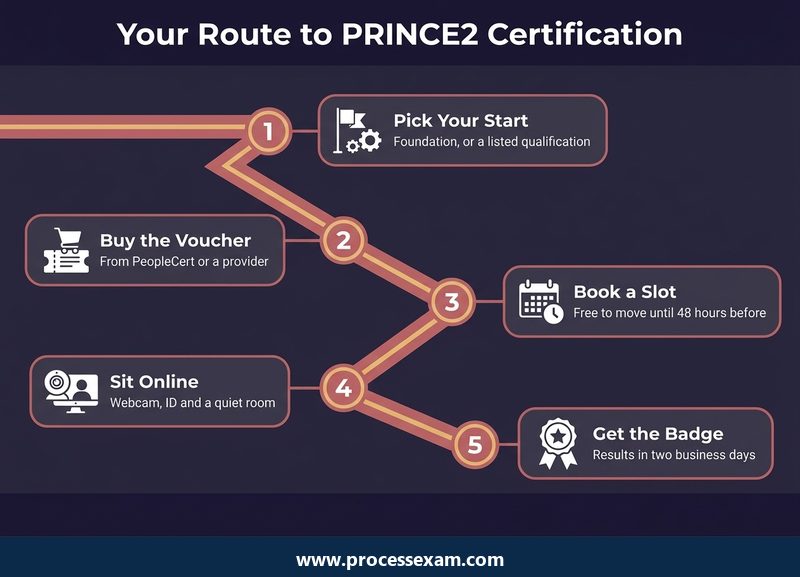
PeopleCert's FAQ sets out the requirements for online proctored exams, in which a proctor watches you through your webcam. The sequence below follows those requirements in the order you meet them.
- Choose the language and the slot. Select the exam language, the proctor's language and a date and time. Rescheduling is free until 48 hours before the start.
- Check your equipment beforehand. The FAQ lists a quiet room, a single rotatable webcam, a stable internet connection of at least 4 Mbps and a supported operating system. Test all of it on the machine you will use, not a different one.
- Have the right ID. You need a valid government-issued ID that shows a photograph and a date of birth in English characters, such as a passport or national ID card.
- Check in with the proctor. The proctor confirms your identity and your room before the paper opens.
- Sit the paper. Foundation is 60 multiple-choice questions in 60 minutes, closed book. Practitioner is 150 minutes, open book, with 56 questions and sub-questions worth 70 marks.
- Wait for the result. Official results are issued within two business days of submitting your answers.
- Collect the badge. Your digital badge is issued automatically when the results arrive.
Both papers need a pass mark of 60%, which is 36 correct answers out of 60 for Foundation and 42 of the 70 marks for Practitioner.
What does changing the date cost?
PeopleCert's Practitioner page sets out the rescheduling fees. A change up to 48 hours before the exam is free. Between 48 and 4 hours before the start the fee is USD 60, EUR 70, GBP 60, AUD 85 or JPY 6,815, plus tax where it applies. After that point a higher fee of USD 120, EUR 135, GBP 115, AUD 170 or JPY 13,635 applies. The Foundation page says changes after the free window also carry a fee. Pick a date with margin, because the higher fee in pounds is more than a quarter of the Practitioner exam bundle.
Setting the room up the day before
Clear the desk, close every other program, plug the laptop in and make sure the webcam can turn to show the room. If anyone shares your home or office, agree a quiet hour with them in advance, because the noise you cannot control is the one a proctor will notice. The aim is to spend your first minute of the exam on question one, not on a proctor asking you to move a monitor.
What happens if you do not pass the first time?
There are two ways to try again. The first is PeopleCert's Take2 re-sit, a second attempt that the FAQ says is enabled only if the first result is a fail, applies only to the exam it was bought for and is available exclusively through online proctoring. The pages do not print its price beyond calling it affordable, so read the figure in your account before relying on it. The second is the free re-take included in the eLearning+ bundle, which is the only bundle that carries one.
It is worth deciding this before the first attempt rather than after it. A candidate who buys the exam bundle at £424 and fails has to pay again for the same paper; one who buys the eLearning+ bundle has paid more up front but holds the re-take already. Neither is the right answer for everyone, because it depends on how likely you think a first-time pass is.
Candidates who want a rehearsal before paying for the real sitting can work through the PRINCE2 Foundation practice exam on this site and then decide whether to book the paper or revise further.
How long does PRINCE2 certification last?
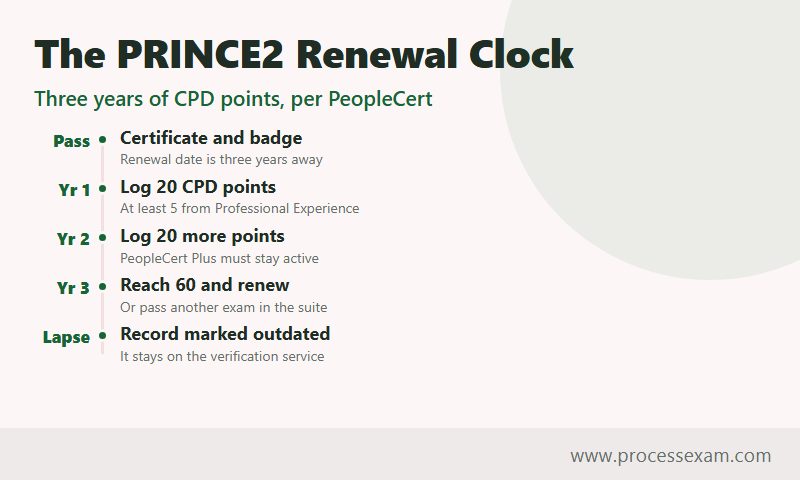
Every PRINCE2 certification has to be renewed every three years from the original certification date. This is stated on PeopleCert's Foundation and Practitioner pages ("Certification renewal every 3 years" and "60 CPD points needed for renewal") and on its "Keep your certifications current" page, which lists PRINCE2 Project Management in the 5th, 6th and 7th editions among the certifications that must be renewed. So a certificate from the 6th Edition is on the same clock as one from Version 7.
What happens if you let it lapse?
Nothing is deleted. PeopleCert says your certifications stay on the Successful Candidates Register and the Certificate Verification Service, but a note is added to your record saying they are outdated and need renewal. Its FAQ words the same thing as "not aligned with current certification requirements". The PeopleCert page mentions no grace period, so assume none and renew before the date. For a job-seeker the practical risk is a recruiter or client who verifies your certificate and sees the note, which can read as a lapse in a role that names PRINCE2 as essential.
How do you find your renewal date?
Log in to your PeopleCert account and open the Certifications tab, which shows the renewal date for each certification. Put the date in your calendar with a reminder months ahead, and record the same date next to your CPD log, because the CPD route needs three consecutive years of points and cannot be completed in a hurry.
Which renewal route fits you: CPD points, another exam or a re-sit?
PeopleCert describes three ways to renew, and they suit different people.
| Route | What you do | Best for |
|---|---|---|
| PeopleCert Plus with CPD points | Hold an active Plus subscription and log 20 CPD points a year for three consecutive years, at least 5 of them from Professional Experience activities | Working project managers who want no more exams |
| Another exam in the same Product Suite | Pass a different exam in the suite before your renewal date; it renews the certifications you hold in that suite | Foundation holders who want Practitioner anyway |
| The same exam again | Re-sit the certification; it renews and updates your renewal date | People who prefer one exam fee to a subscription |
How CPD renewal works in practice
PeopleCert's FAQ says the requirement is 20 CPD points per year per product family, and at least 5 of those points must come from Professional Experience activities. Over three consecutive years that is the 60 points shown on the certification pages. You add points by choosing "Add CPDs" next to your profile icon in your PeopleCert account. The "Keep your certifications current" page says you earn them through everyday professional activities, but it does not list which activities qualify, so keep notes of what you did and when, such as projects delivered or training taken, until you have confirmed what counts.
The CPD route also depends on the subscription being active. The FAQ says you need an active Plus subscription and 20 points a year for three consecutive years, so letting the subscription lapse for a year puts the three-year count at risk. Check the rules in your account if you ever pause it.
When another exam is the cheaper renewal
If you hold only Foundation and plan to sit Practitioner anyway, passing it inside the three years can renew your Foundation at the same time, because PeopleCert says passing any one certification in a suite renews all the certifications you hold in that suite. Compare the one-off Practitioner bundle at £424 with three years of Plus plus the effort of logging points. Confirm in your account that the exam you plan to sit counts for your edition before you pay.
When the re-sit is the simplest
Retaking the same exam is the blunt option: it renews the certification and starts a new renewal period, at the cost of a full exam fee and a paper you have to pass again. It suits someone with no project experience to log, for whom CPD points would be hard to collect.
The calculation to run is simple. Add up what each route costs over the three years, including the Plus subscription once you have its price from PeopleCert, then pick the route that fits the way you work. A project manager who logs real work as CPD pays for membership and nothing else; a Foundation holder moving up pays for Practitioner and renews as a by-product.
What does the finished route add up to?
Pulling the cost, hours and renewal figures together gives the budget most candidates never write down. Take the cheapest direct route: Foundation and Practitioner exam bundles at £817 including VAT, 210 minutes in the exam seat, and a renewal due three years after the first certificate. If you pass Practitioner inside those three years, that single paper can also renew the Foundation you hold. If you stop at Foundation, renewal through Plus and 60 CPD points, or a later Practitioner pass, is what keeps the certificate current.
The exam figures for both papers, in one place:
| Detail | PRINCE2 Foundation | PRINCE2 Practitioner |
|---|---|---|
| Exam | PRINCE2 Project Management Foundation (Version 7) | PeopleCert PRINCE2 Project Management Practitioner (Version 7) |
| Vendor | PeopleCert | PeopleCert |
| Questions | 60 | 70 marks across 56 questions and sub-questions |
| Duration | 60 minutes | 150 minutes |
| Passing score | 60% | 60% |
| Fee | USD 338 | USD 500 |
| Reference material | Closed book | Open book |
| Renewal | Three-year cycle, 60 CPD points | Same cycle as Foundation |
Read the official pages for the country and currency you pay in before you commit: PeopleCert's PRINCE2 7 Foundation page, its Practitioner page and its guide to keeping certifications current. For retakes, vouchers, ID and online proctoring, the answers sit in PeopleCert's FAQ.
Frequently Asked Questions
How long does it take to get PRINCE2 certification?
PeopleCert fixes no study period. The Foundation exam lasts 60 minutes and Practitioner 150 minutes, and official results arrive within two business days of each paper. Your exam voucher stays valid for 12 months after purchase, so that is the only hard limit on the calendar.
How much does PRINCE2 certification cost?
PeopleCert's pages listed the Foundation exam bundle at £393 and the Practitioner bundle at £424 including VAT, £817 for both. The eLearning bundles cost more, and training providers set their own prices. Check PeopleCert's page for your country and currency before you pay.
Can I take PRINCE2 Practitioner without Foundation?
Yes, if you hold another qualification PeopleCert accepts. Its Practitioner page lists PRINCE2 Foundation Version 7, PRINCE2 5th or 6th Edition, PMP, CAPM, PPQ, PMQ, IPMA Levels A to D, CSPM-2 and CSPM-3. The list may hold more options than are first shown.
Is PRINCE2 certification valid for life?
No. PeopleCert asks for renewal every three years. You can renew by logging 20 CPD points a year through PeopleCert Plus, by passing another exam in the same product suite, or by re-sitting the exam. A lapsed certificate stays on record with a note saying it is outdated.
Can I take the PRINCE2 exam online from home?
Yes. PeopleCert's FAQ describes online proctored exams, where a proctor watches you by webcam. You need a quiet room, a single rotatable webcam, an internet connection of at least 4 Mbps, a supported operating system and valid government-issued photo ID.
- Project Management |
- PRINCE2 Foundation Question Bank |
- PRINCE2 Foundation Exam Questions Download |
- PRINCE2 Foundation Test Questions |
- PRINCE2 7 Foundation Simulator |
- PRINCE2 7 Foundation Mock Exam |
- PRINCE2 7 Foundation Certification Cost |
- PRINCE2 7 Foundation Certification Requirements |
- PRINCE2 7 Foundation PDF |
- PeopleCert PRINCE2 7 Foundation Test Questions |
- PeopleCert PRINCE2 7 Foundation Book |
- PeopleCert PRINCE2 7 Foundation Sample Questions


