
CT-AI Version 2.0: What Changed for AI Testing Candidates
Updated on 10 October 2026. What’s new: ct-ai moved to version 2.0, now 40 questions in 60 minutes with a 29-point pass mark and the foundation certificate as entry rule.
Anyone studying for the ISTQB AI Testing certificate from a guide written before April 2026 is preparing for a syllabus that is on its way out. ISTQB released CT-AI version 2.0 on 17 April 2026, and its own exam page (checked October 2026) lists 40 questions, 60 minutes and a pass mark of 29 points. Version 1.0 stays available in English until 21 April 2027, but new candidates should write the paper they will actually be tested on.

This guide is built on the v2.0 syllabus itself, not on the version most older study notes describe. It lists what is different, what the paper looks like, how the seven chapters are weighted, what you must be able to calculate, and how to prepare so that the first sitting is also the last.
Which parts of CT-AI changed when version 2.0 replaced version 1.0?
ISTQB's announcement on the CT-AI page is short: v2.0 is the latest version of the certification and replaces v1.0, the English version of v1.0 stays available until 21 April 2027, and non-English versions until 21 October 2027. After those dates no exam or accredited course based on v1.0 will exist. If your employer's training provider is still teaching v1.0 material, ask which paper you will sit.
Four changes matter to a candidate.
- The scope is testing AI-based systems, with generative AI inside it. ISTQB now describes the certificate as covering machine learning systems and generative AI systems such as large language models. The syllabus has a dedicated section on testing generative AI and LLMs, including red teaming.
- Using AI to help with testing has moved out. ISTQB points candidates who want to use generative AI in the test process to its separate Testing with Generative AI certificate (CT-GenAI). CT-AI is about the system under test, not the assistant on your desk.
- The syllabus has hands-on objectives. Alongside the learning objectives sit exercises: create a model, prepare data, evaluate a model with metrics, implement a perceptron, apply metamorphic testing and run exploratory tests on an LLM. They are not examined, but the exam questions assume you have done the thinking behind them.
- The exam is scored in points. ISTQB's structure for v2.0 lists 40 questions, a pass mark of 29 and 44 total points, so the points available are more than the question count.
The syllabus also leans on ISO/IEC 25059, the standard that adds AI-specific characteristics to the usual software quality model. The standard itself is not examinable beyond what the syllabus summarises, which is good news for your reading list.
One caution about sources. Study notes, forum posts and some summaries still quote the v1.0 exam shape, with a larger question count and a higher pass mark. Those numbers belong to the retiring paper. When a figure in this article differs from an older guide, the figure here comes from ISTQB's CT-AI v2.0 page.
What do the paper, the fee and the entry rule look like in v2.0?
The paper is a single sitting of multiple-choice questions. You get 60 minutes, with 25% extra if the exam is not in your first language, and you need 29 points. Exams are booked through an ISTQB exam provider, and ISTQB's page has a finder for providers that offer the v2.0 paper.
| Detail | CT-AI v2.0 |
|---|---|
| Certification | ISTQB Certified Tester AI Testing (CT-AI) |
| Version | CT-AI Version 2.0 (syllabus released 17 April 2026) |
| Exam code | CT-AI |
| Exam fee | USD $199 |
| Duration | 60 minutes (+25% for a non-native language) |
| Number of questions | 40 |
| Passing score | 29 points (ISTQB lists a 44-point total) |
| Format | Multiple choice |
| Entry rule | ISTQB Certified Tester Foundation Level (CTFL) |
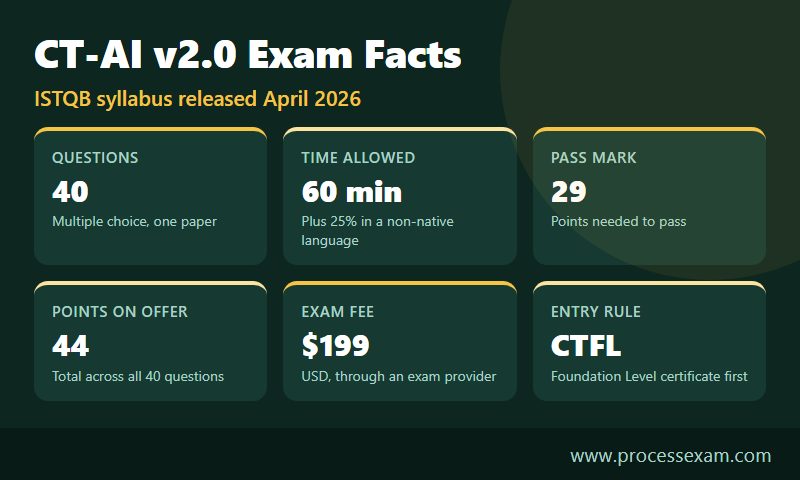
Read the points rule carefully. A pass mark of 29 against 44 available points is roughly two thirds of the marks, so there is room for a few weak spots but not for a whole weak chapter. ISTQB's page does not say which questions carry more than one point, so do not guess; aim to be secure everywhere. The preparation section below turns that into a plan.
Who has to hold what first?
ISTQB states that the Foundation Level certificate is a prerequisite for CT-AI v2.0, so a newcomer pays for two papers, not one. The syllabus adds a recommendation rather than a rule: about six months of experience as a tester, data scientist or developer, and a course accredited by an ISTQB member board. Self-study with the syllabus and sample exam is still allowed, and ISTQB says so plainly. If you have not yet sat the Foundation paper, ISTQB lists it on its Foundation Level certification page.
Who gets the most from it?
ISTQB names testers, test analysts and engineers, test managers and consultants, data analysts and data scientists, developers who build AI-based systems, and user acceptance testers. A second audience, people who only need a general picture of how AI systems are tested, runs from project and quality leads to business analysts and consultants. The syllabus is technical in places, so the second group should expect to work harder on chapter 3 than the first.
How is the seven-chapter v2.0 syllabus divided, and which chapters repay the most study?
The v2.0 syllabus has seven examinable chapters, with teaching times that add up to 1,170 minutes. Teaching time is a guide to weight rather than a guarantee, but it shows where ISTQB expects a course to spend its effort, and the spread is uneven.
| Chapter | Teaching time | What it asks of you |
|---|---|---|
| 1. Introduction to Artificial Intelligence | 120 minutes | Narrow, general and super AI, AI technologies, generative AI, hardware, hosting, frameworks, regulation |
| 2. Quality Characteristics for AI-Based Systems | 45 minutes | ISO/IEC 25059 characteristics, safety, acceptance criteria |
| 3. Machine Learning | 375 minutes | ML workflow, data preparation, performance metrics, neural networks |
| 4. Testing AI-Based Systems | 195 minutes | Locked and adaptive systems, test oracles, generative AI, red teaming, test levels, risk |
| 5. Input Data Testing for Machine Learning Systems | 180 minutes | Bias, data pipelines, representativeness, dataset constraints, labels |
| 6. Model Testing for Machine Learning Systems | 225 minutes | Adversarial, metamorphic, drift, overfitting, A/B and back-to-back testing |
| 7. Machine Learning Development Testing | 30 minutes | Development and deployment risks and their tests |
Chapter 3 alone is almost a third of the teaching time, and it is also where the confusion matrix calculation objective lives. Chapters 5 and 6 together take 405 minutes and carry most of the named test techniques. Chapter 2 is the shortest of the substantial chapters, yet the ISO/IEC 25059 vocabulary it introduces turns up in scenario questions about every other chapter, so do not skip it because it looks small.
The syllabus uses four knowledge levels. K1 is remember, K2 is understand, K3 is apply and K4 is analyse. Almost every objective in CT-AI v2.0 is K2, which means the paper mostly asks you to explain, compare, summarise or give examples. The handful at K3 are the ones that ask you to calculate or derive something, and they are the ones worth practising until they are automatic.
What must you be able to calculate and apply, not just recall?
Three objectives sit at K3, the apply level: calculating machine learning metrics from a confusion matrix, applying dataset constraint testing and using metamorphic testing to derive test cases for a scenario. A fourth, implementing red teaming for generative AI systems, also sits at K3. These deserve their own practice because they are where a recall-only candidate drops the points that matter.
Reading a confusion matrix
A confusion matrix counts four outcomes for a classifier: true positives, false positives, false negatives and true negatives. The syllabus defines accuracy, precision, recall and the F1 score from those counts. Here is a worked case you can redo on paper. A fraud classifier is run on 200 transactions and produces 40 true positives, 10 false positives, 20 false negatives and 130 true negatives.
| Metric | Formula | Result |
|---|---|---|
| Accuracy | (TP + TN) / all four counts | 170 correct among 200 = 85% |
| Precision | TP / (TP + FP) | 40 correct among 50 flagged = 80% |
| Recall | TP / (TP + FN) | 40 found among 60 real positives = 66.7% |
| F1 score | 2 x precision x recall / (precision + recall) | about 72.7% |
The lesson sits in the gap between the first row and the rest. Accuracy looks healthy at 85%, yet the model misses a third of the real fraud. Questions in this area are rarely about arithmetic alone; they describe a business setting and ask which metric matters. If missing a positive is costly, recall is the number to watch. If a false alarm is costly, watch precision. The F1 score is the harmonic mean of the two, so it is low whenever either is low. For more on the underlying idea, the Wikipedia article on the confusion matrix is a neutral refresher.
Deriving a metamorphic test
Metamorphic testing builds new test cases from a source test case that has already passed, by changing the input according to a metamorphic relation. The relation describes how the expected result should respond. It is useful because ML systems often have no cheap test oracle, so you cannot say in advance exactly what the output must be. You can still say how it must behave.
Take an image classifier that labelled a photograph as a cat. A relation of invariance says that a small brightness change must not change the label. Rotating the picture by a few degrees is another invariance relation. For a loan scoring model, a monotonicity relation says that raising declared income while holding everything else fixed must not lower the approval score. The syllabus names consistency, monotonicity and invariance as the properties testers verify. When an exam scenario offers four candidate relations, check each one against the one property it claims to preserve.
Dataset constraints and neural network coverage
Dataset constraint testing checks that the data obeys the rules the problem implies: ages that are not negative, dates in order, categories drawn from the allowed list. Neural network coverage measures are the syllabus's answer to the question of how much of a network a test set has exercised. You will not be asked to build a network, but you should be able to describe what the coverage measures count and why they are only a partial guide to quality.
How are data, models and generative AI actually tested?
Chapters 4 to 7 move from the test approach to the test objects: the input data, the trained model, the development pipeline and, since v2.0, the language model. Each chapter gives a table of risks paired with tests that mitigate them, and that table format is the easiest way to revise.
Input data: bias, pipelines, representativeness and labels
Input data testing confirms that the data used for training, testing and prediction is good enough. The syllabus covers testing for bias, several forms of data pipeline testing, representativeness, dataset constraints and label correctness. Poisoned or untrustworthy training data is on the risk list too, mitigated by provenance testing, exploratory data analysis and A/B testing.
A short scenario shows the logic. A hiring model is trained mostly on applications from one region. Testing for representativeness asks whether the training data resembles the population the model will meet in use. Testing for bias asks whether outcomes differ unfairly between groups. Label correctness asks whether the answers the model learned from were right in the first place. Three different tests, three different failure sources, and the exam likes to hand you a symptom and ask which one applies.
Models: adversarial, drift, over- and underfitting, A/B and back-to-back
Model testing addresses functional risks such as bias, overfitting and adversarial vulnerability, and non-functional risks such as robustness and efficiency. Adversarial testing feeds the model slightly altered inputs, often imperceptible to a person, to make it misclassify. Drift testing watches a live system for two kinds of change. Data drift means the incoming data no longer looks like the training data, such as a spam filter meeting phishing tactics that did not exist when it was trained. Concept drift means the relationship between input and correct output has shifted, such as a transaction type that new regulation turns from low risk to high risk.
Overfitting and underfitting are detected by comparing performance on training data with performance on data the model has not seen. A/B testing compares two models or versions on live or split traffic, and back-to-back testing compares a model against another implementation, such as a trusted legacy system, on the same inputs. Learn what question each one answers; those questions are the quickest route to the right option in a scenario.
Generative AI and large language models
The generative AI section is the newest territory in the syllabus. Explain how generative AI can be tested, and apply red teaming. ISTQB defines red teaming as a systematic, often black-box attack on an AI system to provoke harmful outputs such as privacy violations, abusive content or dangerous instructions. Once such weaknesses are found, they feed back into strengthening the system. It matters most for generative AI because the range of possible inputs and outputs is so large.
The hands-on objective for this section is exploratory testing of an LLM applying boundary value analysis. That is worth trying for yourself on any freely available assistant: pick an input with a clear boundary, such as a word limit or a numeric range in a prompt, and see where its behaviour changes. Two things you will notice are that the output varies between runs and that there is no single expected answer. That is the reason the syllabus argues for a statistical approach to testing AI-based systems, and it connects directly to the section on locked and adaptive systems and test oracles in chapter 4.
Development and deployment
Chapter 7 is only 30 minutes, but it contains two objectives, one on risks and mitigations in ML development and one on deployment testing. The risks sit in the tools and configuration rather than the model, such as incorrect use of a framework API or a poorly chosen framework, and the mitigations include API testing, framework suitability reviews and A/B or back-to-back checks. Treat it as a small, cheap block of marks.
How should you prepare, and when are you ready to book?
A realistic plan for a candidate who already holds the Foundation certificate and has used or read about machine learning is six weeks at about six hours a week. If machine learning is new, allow eight to ten. The order below follows the weight of the chapters rather than the order of the syllabus.
| Weeks | Focus | What to finish |
|---|---|---|
| 1 | Chapters 1 and 2 | AI types, generative AI, ISO/IEC 25059 characteristics, acceptance criteria |
| 2-3 | Chapter 3 | ML workflow, data preparation, confusion matrix drills, neural network basics |
| 4 | Chapters 4 and 5 | Statistical testing, red teaming, bias, pipelines, representativeness, labels |
| 5 | Chapters 6 and 7 | Metamorphic, adversarial, drift, A/B, back-to-back, deployment testing |
| 6 | Practice papers | Timed sample paper, review every miss, read the glossary terms again |
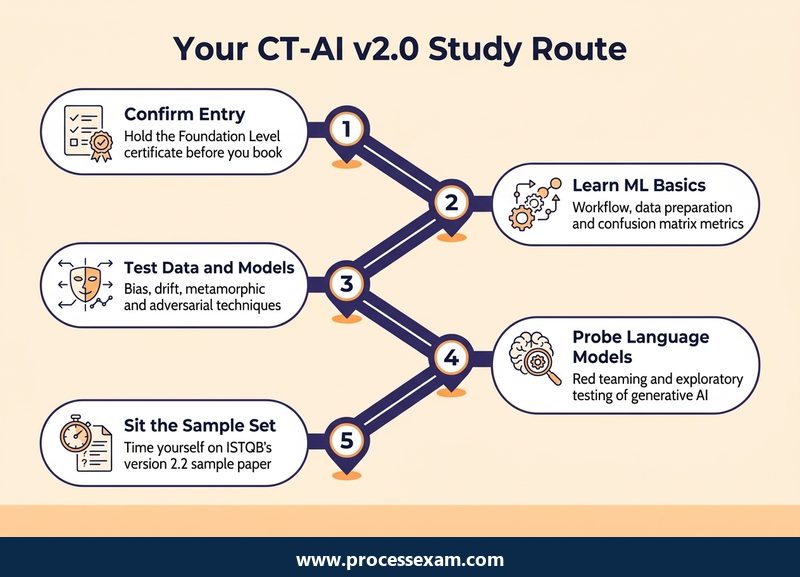
Three habits make the six weeks work. First, turn each risk-and-mitigation table into flash cards with the risk on one side and the test on the other. Second, do at least ten confusion matrix calculations by hand until you can do one in a minute, so that the K3 questions cost you seconds rather than minutes. Third, keep an error log. A wrong answer caused by a vocabulary slip needs a different fix from one caused by not knowing the technique.
Use ISTQB's own materials first. The v2.0 syllabus is a free download from the ISTQB CT-AI v2.0 syllabus PDF, and ISTQB publishes a sample exam, version 2.2 of set A, with answers. Its revision history shows a question replaced in July 2026, so download the current file rather than a copy from a forum. The question set is also published as a sample exam PDF on ISTQB's site, and ProcessExam's free sample questions for the AI Testing exam give extra scenario wording to practise on after you have finished it.
In week six, take a full timed paper. Forty questions in 60 minutes is 90 seconds a question, which is comfortable for K2 recall and tight for a calculation, so leave the calculation questions for a second pass. If your misses cluster in one chapter, give that chapter the extra days rather than rereading everything. When you can finish a paper with ten minutes to spare and your errors are scattered rather than clustered, book the exam. To rehearse that final stretch under realistic conditions, the CT-AI practice exam lets you repeat timed runs until the clustering disappears.
Mistakes that are specific to the new syllabus
- Studying from v1.0 notes. The scope, the generative AI material and the points rule differ. Confirm the version on every resource you use.
- Treating generative AI as a bonus. It has its own section, its own K3 objective and its own hands-on exercise, so it is examinable.
- Memorising metric formulas without the business reading. The question usually asks which metric to prioritise, not what the formula is.
- Confusing the three data problems. Bias, representativeness and label correctness are separate tests with separate causes.
- Mixing up the two drifts. Data drift is about inputs, concept drift is about what the right answer means.
Is CT-AI v2.0 worth holding beside CTFL and CT-GenAI?
For anyone who tests systems that include a model, the certificate gives a shared vocabulary and a defensible method. A common trap with AI features is applying ordinary test design to a system that behaves statistically, then being puzzled when results vary. CT-AI teaches the alternative: statistical acceptance criteria, data testing, metamorphic relations and adversarial probes.
It also fits next to two other ISTQB certificates. CTFL is the required starting point. CT-GenAI is the sibling for people who want to use generative AI inside the test process, which is exactly the topic v2.0 moved out of CT-AI. A tester who holds both can both test an AI feature and use an assistant to design the tests for it, and they are separate skills on separate papers.
On salary, this article makes no claim. ISTQB does not publish pay data and the figure depends heavily on country and seniority. What the certificate offers is evidence of a specific competence, that you can judge a model's quality beyond a pass-or-fail run, in a market where more products ship with a model inside. Roles that benefit include test analysts moving into data-driven products, test managers who must set acceptance criteria for AI features, data analysts who want a quality lens, and developers on ML projects who want to understand how their work will be tested.
As of October 2026 the v2.0 paper is the one to aim at. ISTQB's CT-AI certification page carries the current version notice, exam structure and provider finder, so check it again before you book in case anything has been updated.
Frequently Asked Questions
How many questions are on the CT-AI exam?
ISTQB lists 40 questions for the CT-AI version 2.0 paper, taken in 60 minutes, with 25% extra time if the exam is not in your first language. The paper is multiple choice and is scored in points, with a total of 44 points available across the 40 questions.
What is the passing score for CT-AI?
The CT-AI version 2.0 pass mark is 29 points, according to ISTQB's exam structure, out of 44 points in total. Because the 40 questions are not all worth one point, the calculation-level questions matter more than their number suggests, so practise them until they are quick.
Do I need the Foundation Level certificate before CT-AI?
Yes. ISTQB states that the Certified Tester Foundation Level certificate is a prerequisite for CT-AI version 2.0. The syllabus also recommends some experience as a tester, data scientist or developer, and an accredited course, though self-study with the syllabus and sample exam is allowed.
How much does the CT-AI exam cost?
The exam fee is listed at USD $199. Prices are set by the exam provider you book through and can differ by country or provider, so confirm the amount with your chosen provider. ISTQB's CT-AI page has a finder for providers that offer the version 2.0 paper.
Is CT-AI version 1.0 still available?
Briefly. ISTQB says version 2.0 replaces version 1.0, whose English exam stays available until 21 April 2027 and non-English versions until 21 October 2027. After those dates no exam or accredited course based on version 1.0 will exist, so new candidates should prepare for version 2.0.
- ISTQB AI Testing Test Questions |
- ISTQB AI Testing Book |
- ISTQB Artificial Intelligence Tester Question Bank |
- ISTQB Artificial Intelligence Tester Book |
- ISTQB Artificial Intelligence Tester Study Guide |
- ISTQB AI Testing Sample Questions |
- ISTQB Artificial Intelligence Tester Exam Questions |
- ISTQB Artificial Intelligence Tester Sample Questions |
- Specialist |
- CT-AI Question Bank |
- Artificial Intelligence Tester Simulator |
- Artificial Intelligence Tester Mock Exam |
- AI Testing Certification Cost |
- AI Testing Certification Requirements |
- Artificial Intelligence Tester Certification |
- Artificial Intelligence Tester Certification Cost |
- Artificial Intelligence Tester Certification Requirements |
- CT-AI Exam Questions Download |
- CT-AI Test Questions |
- AI Testing PDF |
- Artificial Intelligence Tester |
- Artificial Intelligence Tester PDF


