
CBAP, CCBA or ECBA: Which IIBA Level Fits Your Experience?
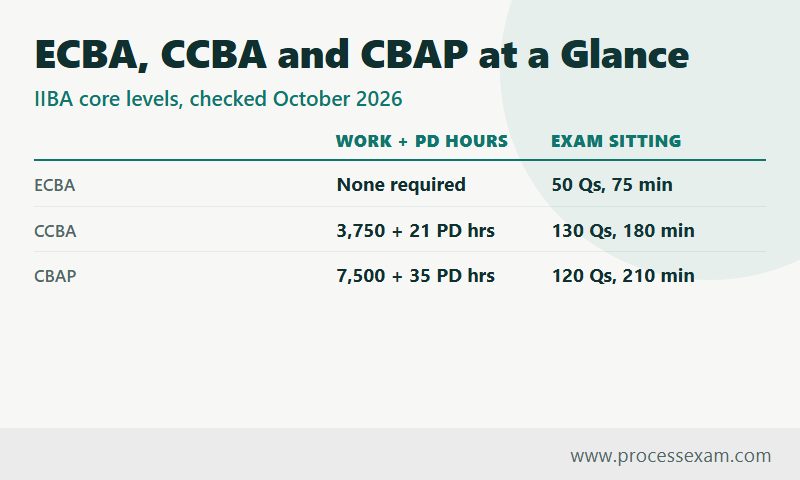
Choose the level your documented work supports. With no business analysis hours behind you, that is the ECBA. With about 3,750 hours in the last seven years, it is the CCBA. With 7,500 hours in the last ten, it is the CBAP. IIBA presents the three as separate entry points rather than a staircase, so the right pick depends on your record, not on ambition.
The question reaches us in many forms: whether the CBAP is worth chasing, what the letters mean, or whether the lower credentials are a detour. This guide answers it by laying your own career against the numbers IIBA publishes on its CBAP, CCBA and ECBA pages and in its certification handbooks, all read in October 2026. It stays on the choice between levels. The detailed application rules, exam blueprint and study plan for each one are covered in separate guides.
How many hours of work does each IIBA level ask for before you can apply?
The three levels are separated by what you must prove before buying an exam, so start there. The ECBA asks for nothing: IIBA's ECBA page lists no prior experience, no application or approval step and no course or training hours to log. The other two both begin with an application in which you document your work, your learning and two people who can vouch for you.
| Requirement | ECBA | CCBA | CBAP |
|---|---|---|---|
| Business analysis work | None | 3,750 hours | 7,500 hours |
| Look-back window | Not applicable | Last 7 years | Last 10 years |
| Rough equivalent | Not applicable | 2 to 3 years of work | 5 or more years of work |
| Professional development | None | 21 hours in the last 4 years | 35 hours in the last 4 years |
| Spread across knowledge areas | None | 900 hours in each of 2 areas, or 500 hours in each of 4 | 900 hours in each of 4 of the 6 areas, at least 3,600 in total |
| References | None | Two, who have known you at least 6 months | Two, who have known you at least 6 months |
| Application fee | None | $145 USD, non-refundable | $145 USD, non-refundable |
The hours, the windows, the development hours and the references come from IIBA's CCBA handbook, its CBAP handbook and the pages linked above.
Why the look-back windows matter more than the totals
The CBAP total is exactly double the CCBA total, but the windows do not scale the same way. The CCBA counts seven years; the CBAP counts ten. Picture an analyst who spent years 1 to 6 of a decade doing heavy requirements work, then moved into project management. Those early hours may fall outside the CCBA window yet still count towards the CBAP. The reverse also happens: someone who has been analysing steadily for exactly three years has the CCBA hours but nowhere near the CBAP total. Write your history out year by year before you decide, because a simple "I have been a BA for six years" hides how much of it is countable.
Titles do not count, tasks do
IIBA's CBAP page says the hours are business analysis work in the last ten years, whatever your job title was. A project coordinator who ran workshops, wrote requirements and traced scope changes may have more eligible hours than a "business analyst" who mostly tested software. The handbooks tie the hours to the six BABOK Guide knowledge areas, which is why the spread row in the table exists: an application heavy in one area and thin in the rest can fall short even when the total looks right.
Applying is a commitment, not a formality
For the CCBA and CBAP you buy the application first, and IIBA's pages call it non-refundable. Approval then unlocks the exam purchase. The CBAP handbook describes a twelve-month approved term in which you can purchase up to three exam attempts, each valid for six months or until the term ends, whichever comes first; the CCBA handbook gives a one-year term on the same pattern. In practical terms, apply when you can also give the next year to preparation, not just when the hours happen to line up.
Which level matches the stage your career has reached?
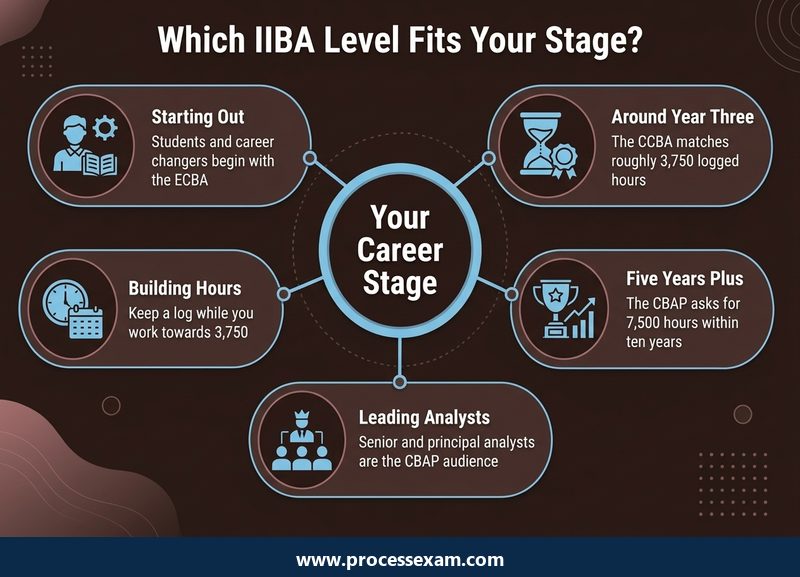
Hours are the entry test, but most readers arrive with a stage in mind rather than a number. These are the five positions we see most often, with the level that fits each.
Student, graduate or career changer
If you have no analysis hours, the ECBA is the only IIBA core credential open to you. IIBA built it for the beginning of a business analysis career and names students and career changers in its answer on whether experience is needed. It tells an employer that you know the vocabulary and the shape of the work before you have the title. Use the time between passing and your first role to start the log of tasks you will need later.
Junior analyst, one to two years in
You are in the gap that confuses people. The CCBA needs 3,750 hours, so you are probably not there yet; the ECBA is available but may feel low. Both statements can be true. If your employer values a credential now, the ECBA is a sensible stopgap; if not, spend the months building the hours and the professional development record, and apply when the numbers are real. Applying early gains nothing, because the application is judged on documented hours.
Mid-level analyst, about two to three years of solid work
This is the CCBA's territory. IIBA's CCBA page speaks to professionals with two to three years of experience and lists ECBA holders, IT business analysts, systems analysts, business process analysts and requirements analysts among those it suits. The CBAP is out of reach here, since five years of work is the stated basis for its hours.
Experienced analyst, five years or more
The hours now support the CBAP, and the question becomes whether to take the senior credential directly. IIBA's CBAP page calls it the highest level of its core certification and aims it at senior, lead and principal business professionals, plus CCBA and ECBA holders ready to advance.
Adjacent roles with analysis in them
The same CBAP page also names project, quality assurance, change and design professionals with significant business analysis practice, together with business architects, product managers and senior consultants. If that is you, your title may not say analyst but your hours can still count, which makes the CBAP a candidate even when your CV is labelled differently.
How does the exam change as you climb from the ECBA to the CBAP?
The papers get longer in different ways, and the question style shifts more than the length does. The ECBA is the shortest sitting; the CCBA has the most questions; the CBAP has the most time.
| Exam | Questions | Duration | Question style | Built from |
|---|---|---|---|---|
| ECBA | 50 | 75 minutes | Situation-based and standard multiple choice | Nine domains from The Business Analysis Standard and the BABOK Guide |
| CCBA | 130 | 180 minutes | Multiple choice, scenario-based | The BABOK Guide |
| CBAP | 120 | 210 minutes | Case study and scenario-based | The six BABOK Guide knowledge areas |
The question counts and durations match IIBA's pages and the ECBA exam blueprint.
What each paper is really asking
The ECBA blueprint states that its exam focuses on practical application and understanding of job-ready competencies at a foundational level. That means defining business analysis, explaining the six concepts of the core model, and recognising a sensible next step in a short situation. A candidate who has read the guide carefully can do well without ever having run a workshop.
The CCBA moves from recognising to applying. IIBA describes its exam as scenario-based, formed from the BABOK Guide, so a question hands you a described task and asks which technique or approach fits it. Experience helps here because you have seen the situations before, but a disciplined reader can still prepare for it.
The CBAP adds judgement under ambiguity. IIBA describes its questions as case study and scenario-based, and its CBAP page positions the credential as confirming judgement you have already developed on real projects. Expect several options to look reasonable, with the deciding detail sitting in the story and not in the technique names. The syllabus breakdown on the CBAP exam syllabus page shows which knowledge areas those stories draw from.
Pacing differs by level
Dividing the time by the questions, as our own arithmetic rather than an IIBA figure, gives the ECBA about a minute and a half per question, the CCBA roughly a minute and a third, and the CBAP about a minute and three-quarters. The CBAP's slower pace is deliberate: its questions are longer to read. The sitting is also the longest, so stamina is part of the preparation. Delivery also differs slightly: IIBA lists the ECBA as an online proctored exam, while the CCBA and CBAP can be taken online or at a PSI test centre.
If the CBAP is where your hours point, the CBAP practice exam gives you scenario items written for the 120-question paper, which tells you early whether case-style reasoning feels natural before you commit the application fee.
Can you skip a level, and when is skipping a mistake?
Nothing in the handbooks forces a sequence. IIBA's CBAP handbook sets out hours, professional development and references, and it does not require a CCBA or ECBA first. In the same handbook, a section for applicants who are not eligible points them towards the ECBA or the CCBA, which shows how IIBA itself thinks of the levels: as places you can enter according to your record.
When skipping is sensible
If you already hold 7,500 countable hours, sitting the ECBA or the CCBA first adds cost and delay without adding eligibility. An analyst of eight years who earns the ECBA mainly signals that they have studied the basics, which their experience already implies. Going straight to the CBAP is the cleaner story. The same reasoning applies to someone with about four years of analysis work who is certain a CBAP is two years away: they may still find the CCBA useful, but it is a choice rather than a requirement.
When skipping is a mistake
The common error is aiming at the CBAP with fewer hours than the handbook demands because the senior credential sounds better. Since the application is non-refundable, an application that cannot be approved has a direct price. A less obvious mistake is skipping the ECBA when you truly have no hours: you cannot apply for the others, and the ECBA is the only one you can take next month.
When climbing in steps pays off
A step is worth taking if the gap between levels is long. An analyst at 3,750 hours may spend two or three more years reaching 7,500, and a CCBA held during that period does visible work on a CV. Holding it also has a practical side effect: both handbooks allow a credentialed CCBA or CBAP to act as a reference, so you become a possible referee for colleagues who follow you.
What stepping costs in money
At the non-member list prices below, the CCBA route is $145 plus $405, which is $550, and the CBAP then adds $145 plus $505, or $650 more. That is $1,200 for both against $650 for the CBAP alone. The sums are ours, based on the fees in the next section, and they ignore any membership or discount. Whether $550 buys you years of recognition in the gap is a judgement only you can make, but it is better to see the number before choosing than after.
What will each level set you back, from application to renewal?
These are the published fees for each exam, in US dollars. Members of IIBA pay the lower rate; IIBA's pages state that the exam price includes a first year of membership.
| Fee | ECBA | CCBA | CBAP |
|---|---|---|---|
| Application | None | $145 | $145 |
| Exam | $395 | Member $250, non-member $405 | Member $350, non-member $505 |
| Retake | Not listed | Member $195, non-member $350 | Member $295, non-member $450 |
| Recertification | Not listed | Member $85, non-member $120 | Member $85, non-member $120 |
| Renewal cycle | Not listed | Every three years | Every three years |
The tables use list prices because they stay stable and let you compare levels fairly.
The ECBA is a single price with options
IIBA's ECBA page sells the exam at $395 with a learning journey and a one-year membership included, and a larger ECBA Complete bundle at $445 that adds a practice exam and an accelerator study tool. Neither needs an application. That simplicity is part of why it suits people at the very start.
What keeping a credential means
The CCBA and CBAP need renewing every three years, with the fees shown above. IIBA's CBAP page states this and gives the same fee for both. The ECBA page does not list a renewal fee, so that cell reads not listed. Treat renewal as an ongoing cost of senior credentials and ask your employer whether it falls under a professional development budget; IIBA's pages note that 70% of survey respondents say their employer has one.
Does a higher level pay back, or is a lower one enough?
A higher level pays back when the roles you want ask for it. It does not pay back automatically, and the evidence is thinner than the marketing around it suggests.
IIBA does publish headline figures. Its ECBA page says certification holders report earning 12% more than non-certified business analysis professionals, and its CBAP page gives 19% for the same comparison, both from the IIBA 2026 Global State of Business Analysis Report. The CBAP page adds that 76% of certified professionals see value within a year and that higher confidence leads every reported benefit. Read these carefully. They are survey results from IIBA's own community, they compare holders with non-holders and not one level with another, and the seven-point gap between the two pages probably reflects seniority as much as the credential. They tell you that certification correlates with higher reported earnings, not that the CBAP adds a fixed amount over the ECBA.
A better test than a percentage
Open ten job postings for the roles you want in the market you work in. Count how many name a credential, and which one. If senior postings routinely ask for a CBAP, the investment is clearly justified for that route. If they ask for none, the credential still helps you as evidence but is not a gate. If most mention the CCBA or ECBA, a senior credential may not be what the market rewards.
When a lower level is enough
Stopping at the CCBA is reasonable if your role is a mid-level one, if your employer funds one credential and prefers an earlier win, or if you have not reached the senior hours. Stopping at the ECBA is reasonable if you are moving into analysis and need proof of knowledge for a first role. None of these is a failure to reach the CBAP; each is a fit for the stage.
When the CBAP is worth the effort
The CBAP earns its cost when you lead other analysts, own the approach on large initiatives, or want a designation that recognises senior judgement in interviews and tenders. That includes consultants who need a credential that clients recognise. For these readers, the longer application and the harder paper are the point: the credential is difficult to obtain because it is meant to say something about seniority.
Which tie-breakers settle a borderline case?
Many readers sit between two levels, perhaps 6,800 hours with a CBAP in mind, or a CCBA hour count that is only just enough. These five checks settle most of them.
- Count conservatively. If your hours are within a few hundred of a threshold, count only work you could explain to a reference. A reference who cannot recall what you did is a risk you can avoid.
- Check the windows. Move the seven-year and ten-year look-backs to today's date and strike out anything older. Hours that fall away may change the answer.
- Look at the spread. A CBAP wants 900 hours in each of four knowledge areas, while a CCBA wants 900 in each of two or 500 in each of four. Heavy elicitation work alone will not satisfy either rule.
- Read the postings. The level named in the jobs you want outranks any generic advice, ours included.
- Plan the year. An approved application runs on a one-year clock, so be sure you can give the preparation time to the paper before paying. The longer CBAP paper in particular needs steady weekly practice.
If those checks leave you torn, the lower level that you can start now usually wins on time, and the higher one can follow when the hours exist. Waiting for a perfect record costs more than building one while you hold a smaller credential.
Frequently Asked Questions
What is the difference between CBAP, CCBA and ECBA?
They are IIBA's three core levels. The ECBA is the entry certificate and needs no experience. The CCBA asks for 3,750 hours of analysis work in the last seven years. The CBAP, the senior level, asks for 7,500 hours in the last ten. Question style moves from recognising concepts to applying techniques to judging cases.
Do you need the CCBA or ECBA before the CBAP?
No. IIBA's CBAP handbook lists 7,500 hours in the last ten years, 35 hours of professional development and two references, and it does not ask for an earlier credential. If your hours already meet that, you can apply directly. The lower levels are for people who do not yet meet the CBAP record.
How many years of experience does the CBAP need?
IIBA equates the 7,500 hours to five or more years of business analysis work, counted within the last ten years. At least 900 of those hours must fall in each of four of the six BABOK Guide knowledge areas, totalling 3,600 or more. Job titles do not matter; the tasks you performed do.
Is the CBAP worth it?
It is worth it when your target roles ask for senior credentials or you lead analysts. IIBA's CBAP page reports 19% higher earnings for certified holders in its 2026 survey, but that compares holders with non-holders, not levels. Check the credentials named in postings for your market before paying the 145 USD application fee.
Is the CBAP exam harder than the CCBA?
Both are scenario-based, but they test different things. The CCBA has 130 questions in 180 minutes and asks which technique fits a described task. The CBAP has 120 questions in 210 minutes, framed as case studies where several answers look reasonable. Most candidates find the CBAP harder for that judgement, not for its length.
- IIBA Business Analysis Professional Test Questions |
- CBAP Question Bank |
- IIBA Business Analysis Professional Sample Questions |
- CBAP Exam Questions Download |
- CBAP Test Questions |
- Business Analysis Professional PDF |
- IIBA Business Analysis Professional Book |
- Business Analysis Professional Certification Cost |
- Business Analysis Professional Certification Requirements |
- Business Analysis Professional Simulator |
- Business Analysis Professional Mock Exam |
- Core Business Analysis


