
Best Business Analyst Certifications and How to Choose Between Them
There is no single best business analysis certification, only the best one for the number of analysis hours you have already logged. Below roughly 3,750 hours the choice is the ECBA; from there the IIBA CCBA fits; past 7,500 hours the real decision is between the IIBA CBAP and the PMI-PBA. This guide ranks five credentials by that ladder.

Which of the five fits the analysis hours you have already logged?
Most comparison lists rank certifications by popularity. A more useful ordering is the one the credentials were designed around, which is how much documented work you can show. IIBA, the body behind four of the five credentials in this guide, builds its ladder on hours. PMI, which runs the fifth, builds its own on a separate guide and its own experience rules. Start with where you stand and the field narrows quickly.
| Credential | Who it is built for | Entry requirement |
|---|---|---|
| IIBA Entry Certificate in Business Analysis (ECBA) | People moving into analysis, graduates, career switchers | IIBA's Handbook lists no experience, degree or application stage |
| IIBA Certification of Capability in Business Analysis (CCBA) | Analysts with a couple of years behind them | 2 to 3 years of work experience in the last seven years (3,750 hours), 21 professional development hours in the last four years, two professional references |
| IIBA Certified Business Analysis Professional (CBAP) | Senior analysts who lead the approach | Five or more years of work experience in the last 10 years (7,500 hours), 35 professional development hours in the last four years, two professional references |
| PMI Professional in Business Analysis (PMI-PBA) | Analysts who work inside projects and programmes | Set by PMI on its own certification page; read it there before you plan your hours |
| IIBA Agile Analysis Certification (AAC) | Analysts working in agile delivery | IIBA's page describes a candidate with a couple of years of agile-team analysis behind them |
The IIBA hour figures above come from IIBA's own pages for the CBAP and CCBA, read in October 2026. They count work in the last seven or ten years, so an analyst who took a long break can fall short even with a decade of history. Hours also have to be analysis work, not just time spent in a business-analyst job title.
If you have fewer than 3,750 hours
Two credentials are realistic. The ECBA asks for nothing before you buy the exam, which makes it the only one of the five open to a person who has never held an analysis role. The AAC is a specialist add-on and presumes you already do analysis in agile teams, so it is not a starting point. For a person with little or no experience, the ECBA is the answer and the rest of this guide is a map of what comes after.
If you have between 3,750 and 7,500 hours
The CCBA is the IIBA fit, because its application checks the hours, the professional development and the references, and the exam tests whether you can apply the BABOK Guide. If your work sits inside a project office and your title has the word project in it, the PMI-PBA becomes the alternative, since it is written around the project lifecycle rather than the enterprise.
If you are past 7,500 hours
Now the CBAP and the PMI-PBA are both on the table, and the choice is less about difficulty and more about where your career is heading. The sections below show how they differ.
How do the five exams compare on size, length and fees?
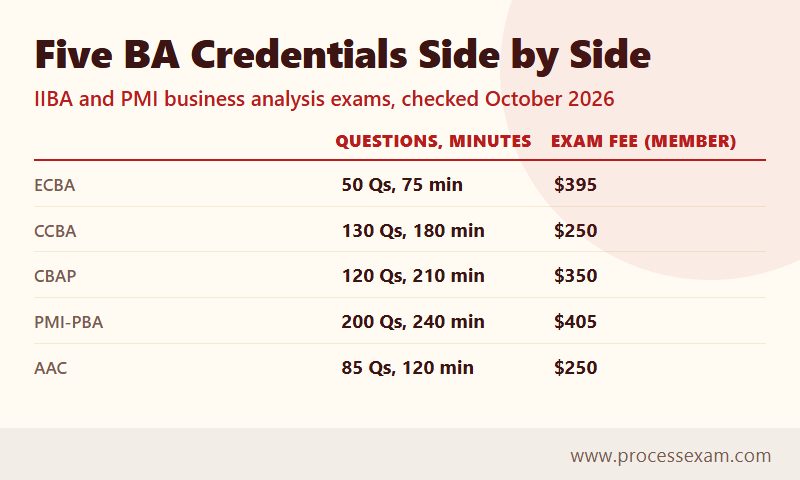
Exam size is the first thing candidates compare and the least useful on its own. A 200-question paper is not four times as hard as a 50-question one; it simply reflects who the credential is for. Read the figures below as a description of the commitment rather than a ranking of difficulty.
| Credential | Questions | Duration | Passing score | Price |
|---|---|---|---|---|
| ECBA | 50 | 75 minutes | 70 | 395 USD |
| CCBA | 130 | 180 minutes | 70 | Application Fee: $145 USD Exam Fee: Member - $250 USD, Non-Member - $405 USD Retake Fee: Member - $195 USD, Non-Member - $350 USD Recertification Fee: Member - $85 USD, Non-Member - $120 USD |
| CBAP | 120 | 210 minutes | 70 | Application Fee: $145 USD Exam Fee: Member - $350 USD, Non-Member - $505 USD Retake Fee: Member - $295 USD, Non-Member - $450 USD Recertification Fee: Member - $85 USD, Non-Member - $120 USD |
| PMI-PBA | 200 | 240 minutes | Above Target / Target / Below Target / Needs Improvement | Member Price: USD $405 Full Price: USD $555 |
| AAC | 85 | 120 minutes | 70 | Exam Fee: Member - $250, Non-Member - $405 Retake Fee: Member - $195, Non-Member - $350 Recertification Fee: Member - $30 USD, Non-Member - $50 |
What stands out in the numbers
The CCBA has more questions than the CBAP (130 against 120) in less time (180 minutes against 210). The paper for the lower level is quicker, not easier, because the questions are scenario-based and each one still asks you to apply a technique to a situation. The PMI-PBA is the longest sitting by a distance: 200 questions across 240 minutes leaves about 72 seconds for each, which is a pacing problem the IIBA exams do not have in the same form.
The PMI-PBA also reports its result differently. Instead of a single percentage, the result shows how you performed against a target level, with the bands Above Target, Target, Below Target and Needs Improvement. Anyone used to a pass mark on the IIBA side has to adjust to that, because there is no number to aim for beyond doing well in every domain.
What the fees do not show on first look
The IIBA application fee of $145 USD is a separate payment made before the exam is bought, so the member total for the CCBA starts closer to $395 USD than $250 USD, and the CBAP closer to $495 USD. IIBA keeps a certification fees page with current amounts and any membership terms. For the ECBA, the Handbook describes a single fee with no application stage, which is why its listed price is the whole entry cost.
Renewal is the cost that people forget. The CCBA and CBAP each carry a recertification fee of $85 USD for members and $120 USD for non-members, while the AAC is cheaper to keep at $30 USD for members and $50 USD for non-members. Add the cost of the professional development hours that renewal requires and the true price of a credential over five years is visibly higher than the exam fee.
Is the PMI business analysis credential still on offer, and how does it differ from IIBA's?
Yes. PMI has been reshaping parts of its portfolio, so this was checked rather than assumed. In October 2026 PMI's certification page still presents the Professional in Business Analysis (PMI-PBA) as a current credential, with a 200-question, 240-minute exam, and nothing indicates a retirement or a rename. PMI's own site blocked automated page reads while this guide was written, so before you pay, open the page and confirm the exam details and your eligibility. If the name or format has changed, trust PMI's page over any comparison, including this one.
Project-centred versus organisation-wide
The cleanest way to separate the two families is to ask where business analysis ends. PMI's credential treats analysis as a discipline inside a project or programme: understand the need, plan the work, analyse and specify requirements, trace and monitor them, and evaluate the delivered solution. It follows the lifecycle a delivery team already lives in, which is why it suits an analyst who reports into a project office or works beside a project manager every day.
IIBA's credentials rest on the BABOK Guide, which describes business analysis as something that can happen before a project exists, across a portfolio, or in a standing team that never calls its work a project. Strategy analysis and solution evaluation sit in the guide alongside requirements work. An analyst in a product organisation, a consultancy or a change team usually finds that vocabulary closer to the real job.
Which one employers recognise
Recognition depends on the employer, not on a ranking. A large delivery organisation that already trains its project managers for PMI credentials may value the PMI-PBA more, and a business-change function that follows IIBA standards will tend to ask for the CBAP. The practical test is a job board: search for the roles you want in your city and count which credential the advertisements name. That count is a better guide than any list of best certifications.
Choosing between CBAP and PMI-PBA directly
| Question to ask | Points to the CBAP | Points to the PMI-PBA |
|---|---|---|
| Where does your work start? | Before a project, at strategy or product level | Once a project or programme has been approved |
| Who do you report to? | A BA practice lead, product or change director | A project, programme or delivery manager |
| How do you like to be tested? | 120 case-study and scenario-based questions in 210 minutes | 200 questions in 240 minutes with a banded result |
| What is the reference guide? | The BABOK Guide | The PMI Guide to Business Analysis |
| What is the member exam price? | Exam Fee: Member - $350 USD, plus the application fee | Member Price: USD $405 |
If you want the depth of the senior IIBA exam, the CBAP syllabus shows how its six knowledge areas are weighted, and it is a good way to judge whether the BABOK Guide style suits you before you commit.
Do the specialist credentials earn a place alongside the core ones?
IIBA sells a second tier of credentials that sit beside the core ladder rather than above it. Two of them are relevant to anyone choosing the best business analysis certifications: the Agile Analysis Certification (AAC) and the Certification in Business Data Analytics (CBDA).
The AAC, for analysts in agile teams
The AAC has 85 multiple-choice, scenario-based questions to complete in two hours, per IIBA's page, and the pass mark is 70. It targets analysts who already work in iterative delivery and want a credential that speaks to backlog refinement, working with product owners and shaping value in small increments. It is not a stepping stone to the CCBA or CBAP; it adds a specialism on top of one of them.
The CBDA, for analysts who work with data
The CBDA has 75 questions in two hours with a passing score of 80, the highest on the list. It suits analysts whose requirements are mostly about data, reporting and analytics. Its fees match the AAC: Member - $250, Non-Member - $405 for the exam, and a recertification fee of Member - $30 USD, Non-Member - $50.
Where the specialists fit in a plan
The sensible order is a core credential first and a specialism once your daily work justifies it. A specialist exam on top of no foundation reads as a narrow qualification; on top of a CCBA or CBAP it reads as depth. The CBDA is included here because analysts keep asking whether data skills now outrank the core credentials, and the answer in the ladder IIBA has built is that they complement them.
Which credential should you pick if you were in each of these jobs?
Abstract advice only goes so far, so here are six situations that come up often. Match the one closest to yours and use the comparison above to check the details.
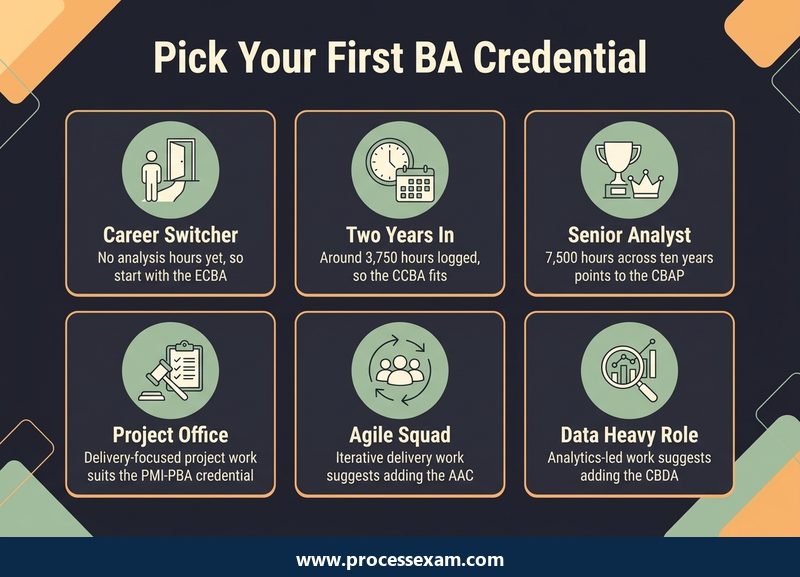
You are a graduate or a career switcher
Take the ECBA. It has no eligibility hurdle, a 50-question paper and a fee of 395 USD, and it gives an interviewer a concrete reason to believe you have studied the discipline. Start logging real analysis work from your first week so the hours are ready when you reach for the CCBA.
You are two or three years into an analyst role
Keep a log of tasks, not job titles, because IIBA asks you to show analysis work against its knowledge areas. Gather your two references early, since a reference who has left the company is the most common reason an application stalls. Then apply for the CCBA.
You are a senior analyst who now owns the approach
This is the CBAP's territory. You choose the techniques, advise a sponsor and shape how others work. The CBAP rewards that by testing your judgement on cases rather than your memory of a definition.
You sit in a project office next to a project manager
Weigh the PMI-PBA seriously. Your day is organised by project milestones, your stakeholders speak PMI language, and the credential carries recognition in that setting. Note the pacing: 200 questions in 240 minutes asks for stamina.
You work in agile squads
The core credential still comes first, then the AAC if agile analysis is where you spend your time. Agile teams tend to weigh demonstrated work heavily, so pick the credential that proves your level without stretching the budget.
You live in dashboards and data models
Consider the CBDA after a core credential. Its passing score of 80 is the highest of the credentials compared here, so allow more study time than the fee suggests.
What does it take to prepare for the one you choose?
Whichever credential you pick, preparation has the same shape: read the vendor's guide by task rather than by chapter, turn each technique into a situation you have actually met, and practise under the exam clock. The credential changes the clock and the vocabulary, not the method.
Read the guide, then break it into situations
The BABOK Guide and the PMI Guide to Business Analysis both list tasks and techniques. Reading them cover to cover is slow and yields little. Instead, take a task such as eliciting requirements or verifying them, then write down two moments from your own work where it applied. Exam questions describe a situation and ask which action fits best, so building your own situations trains the same skill.
Practise under the exam clock
Timing differs sharply: about 90 seconds a question on the ECBA, roughly 83 on the CCBA, 105 on the CBAP and 72 on the PMI-PBA, working from the figures in the table. A person who is comfortable on one pace can struggle on another, so rehearse at the pace of the exam you booked. A PMI-PBA practice exam is a useful way to find out whether a 200-question sitting is a comfortable pace for you before you pay the exam fee.
Plan the order, not just the first step
If you expect to climb the IIBA ladder, the study carries forward: the ECBA introduces the concepts, the CCBA applies them, and the CBAP tests your judgement over them. The PMI-PBA stands separately, which is a point in its favour if you are certain of a project career and a point against if you may move into product or strategy work.
Which pieces of older advice should you ignore?
Business analysis comparisons age quickly, and several claims still circulate that no longer match the vendors' pages.
"You need a degree or five years for every credential"
Not true of the ECBA, which lists no experience, degree or application stage. Eligibility is credential by credential, and the hours are counted differently for each.
"Pick whichever has the most questions"
Question count describes the format, not the value of the credential or the difficulty of the exam. The 200-question PMI-PBA and the 50-question ECBA serve entirely different readers.
"A certification replaces experience"
The IIBA hours requirement says the opposite. Two of the three core credentials ask you to prove work before you sit the paper, which is part of why employers trust them. The certificate is a record of practice, not a substitute for it.
"Salary will jump the day you pass"
No salary figure appears in this guide because the exam facts here come from the vendors, and salary is not one of them. Treat any promised percentage as marketing and look for a salary survey that names its sample and its year.
"Once certified, you are done"
The CCBA and CBAP carry recertification fees of $85 USD for members and $120 USD for non-members, and the AAC and CBDA carry $30 USD and $50 USD. Plan for the cycle as well as the exam. Pick the credential you are willing to maintain, because a lapsed credential is worth less than a smaller one kept current.
A short checklist before you book
- Write down your logged analysis hours, using the last seven or ten years as IIBA counts them.
- Check the job advertisements for the roles you want and note which credential they name.
- Confirm the exam details on the vendor's own page, because fees and formats change.
- Add the application, exam, retake and recertification fees into a single figure before deciding.
- Choose the credential you can finish in the time you have, then book the date.
Frequently Asked Questions
What is the best certification for a business analyst?
It depends on your logged hours. The ECBA suits beginners because IIBA lists no experience requirement. The CCBA fits roughly 3,750 hours of analysis work, and the CBAP fits 7,500 hours. The PMI-PBA suits analysts inside project teams. Match the credential to your experience and the employers you target.
Which business analysis certification should a beginner take?
The ECBA is the beginner credential. Its 50-question, 75-minute exam costs 395 USD, and IIBA's Handbook lists no experience, degree or application stage. Start logging real analysis tasks as soon as you can, because those hours become the evidence for the CCBA and CBAP later.
Is CBAP or PMI-PBA better?
Neither is better outright. The CBAP rests on the BABOK Guide and treats analysis as work that can happen before or beyond a project, while the PMI-PBA follows the project lifecycle. The CBAP has 120 questions in 210 minutes and the PMI-PBA has 200 in 240 minutes, so choose by role and employer.
How much do business analysis certifications cost?
IIBA's member exam fees are 250 USD for the CCBA, AAC and CBDA and 350 USD for the CBAP, plus a 145 USD application fee for the CCBA and CBAP. The ECBA costs 395 USD, and the PMI-PBA lists a member price of USD 405 and a full price of USD 555.
Can you hold both an IIBA and a PMI business analysis credential?
Yes. They are separate programmes from separate bodies, each with its own application, exam and renewal cycle, and the details in this guide did not show a rule that blocks holding both. Most analysts choose one first and add the other only if their employer or a new role asks for it, since each carries its own recertification cost.
- PMI Business Analysis Exam Questions |
- PMI Business Analysis Question Bank |
- PMI Business Analysis Questions |
- PMI Business Analysis Study Guide |
- PMI-PBA Certification |
- PMI-PBA Questions |
- PMI-PBA Practice Test |
- PMI-PBA Study Guide Material |
- PMI-PBA Sample Exam |
- Business Analysis Certification |
- PMI Business Analysis Book |
- Business Analysis Certification Cost |
- Business Analysis Certification Requirements |
- PMI Business Analysis Sample Questions |
- PMI-PBA Exam Questions Download |
- PMI-PBA Test Questions |
- Business Analysis PDF |
- PMI-PBA Quiz |
- PMI Professional in Business Analysis


