
ASQ CQE Career Path: Job Titles, Industries and Next Credentials
Updated on 29 October 2026. What’s new: corrected the exam fees to ASQ's current $450 member, $550 non-member and $350 retake prices, and the Body of Knowledge to seven areas
Dev has spent six years on the inspection bench of a machining plant. He signs first-article reports, argues with the night shift about gauge calibration, and has started to wonder whether the Certified Quality Engineer credential is meant for people like him. It is, but not yet: ASQ asks for eight years of paid work in the Body of Knowledge, so the real planning question is how to make the years you already have count, and where the credential leads afterwards.

This article follows that route. It does not walk through the application form, set the credential against the Black Belt, or forecast where the profession is heading, because other articles on this site do those jobs. Instead it follows one person through the working life around the credential: the job titles on either side of it, the industries that ask for it, how the experience rule works out in practice, and which ASQ certifications come next.
Which job titles does a Certified Quality Engineer move through?
There is no official ladder. ASQ certifies knowledge, and employers name the jobs, so the titles below are the ones that commonly appear in quality departments rather than a path ASQ prescribes. Read them as a map of the territory, and expect your own employer to use different words for the same duties.
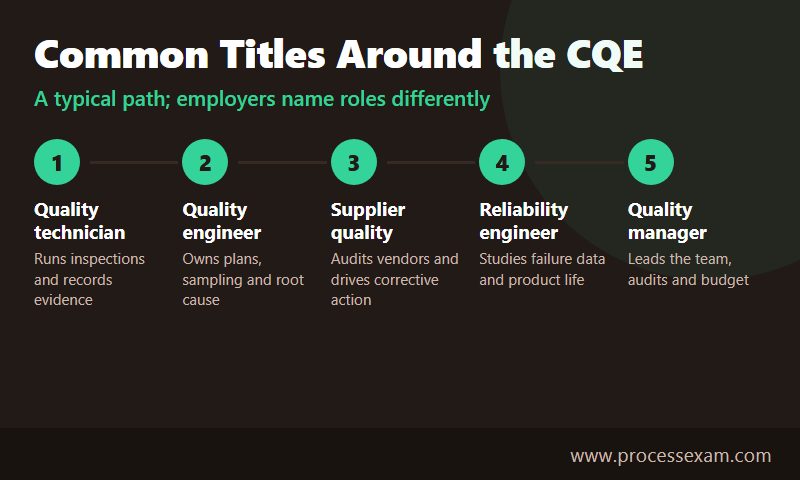
Quality technician or inspector
This is where many future CQEs start, and where Dev is today. The work is measurement and evidence: running inspections, recording results, reading drawings, keeping gauges in date and flagging what looks wrong. It is valuable because it teaches how a specification becomes a physical check. It is also the stage at which people stay longest, because the work is mostly carrying out a method somebody else defined.
Quality engineer
The step up is from carrying out the method to owning it. A quality engineer writes the inspection plan, chooses the sample size, investigates a failure back to its cause, and helps decide whether a lot ships. The CQE was built around this job: ASQ describes the work of holders as quality control, statistical analysis, product and process design, and compliance with industry standards and regulations. A technician who wants the credential should aim at this title, because it is also the one that builds decision-making years.
Supplier quality engineer
When a company buys much of what it sells, quality extends beyond its own walls. A supplier quality engineer qualifies new vendors, audits them, handles the corrective actions when parts arrive wrong and decides how much incoming inspection a supplier still needs. The same Body of Knowledge applies, with a heavier load of audit technique, sampling and communication. ASQ also lists a separate supplier quality credential, and experience gained for it can count towards the CQE, which hints at how close the two roles sit.
Reliability engineer
Some quality engineers drift towards the question of how long a product survives, not only whether it meets the drawing today. They analyse failure data, plan life tests and work on maintainability. The CQE touches this ground through the reliability topics in product design; the dedicated credential for it is the Certified Reliability Engineer, covered further down.
Quality manager
The last step is from owning a process to owning a function: a budget, a team, an audit programme and the conversation with senior management about the cost of quality. Many managers began as quality engineers, because habits the CQE rewards, such as working from data, keeping documented evidence and writing a corrective action properly, are what a manager is asked to show. ASQ has a management credential aimed at this stage, and it asks for more years than the CQE does.
One caution. Moving from one title to the next is not driven by the certificate. It follows the cases you have owned and the results you can show, and the credential works best as the receipt for experience rather than a substitute for it.
Which industries look for a CQE?
Quality engineering exists wherever a company must prove that what it made matches what it promised. Because the Body of Knowledge is about the quality system rather than any one product, the credential travels between sectors more easily than most technical qualifications. ASQ does not publish a list of employers by sector on its CQE page, so the groups below come from how the work is organised, not from a count of job adverts.
- Manufacturing of machined and moulded parts. Control plans, gauge studies, capability and acceptance sampling are daily work, and so is the quality engineer who owns them.
- Automotive and aerospace supply chains. Long chains of suppliers mean heavy documentation, formal corrective action and customer audits; supplier quality roles are most visible here.
- Medical devices and pharmaceuticals. Design controls, risk files and regulators make a documented quality system compulsory, so engineers who can build and defend one have a clear role.
- Electronics and assembly. High volumes, small tolerances and frequent design changes reward people who read process data rather than rely on inspection alone.
- Food, packaging and consumer goods. Traceability, sampling and supplier approval carry the same logic into a very different product.
- Services, software and healthcare. Quality methods are used outside factories too, although the title may read process improvement or compliance rather than quality engineer.
Choosing a sector as a technician
The practical point for a technician is portability. A plant that makes brake components and a plant that makes catheters work to different standards, yet both ask the same questions: what could go wrong, how would we know, and what did we do about it. A person who can answer in the language of the Body of Knowledge can change sector with a lighter learning curve than most.
If you are weighing a move, compare what each sector would ask of you in the first year. A regulated sector asks for discipline in documents and traceability. A high-volume sector asks for statistical fluency. A supplier-heavy sector asks for audit and communication skill. Match that to what you already do well, and the years you still need can be spent in the direction you want to go.
To see which parts of the knowledge each sector leans on, scan the topics on the CQE syllabus page and ask which of them appear in your own job today. The ones you never touch are where the years in your application will be thinnest.
What does the eight-year rule mean in practice?
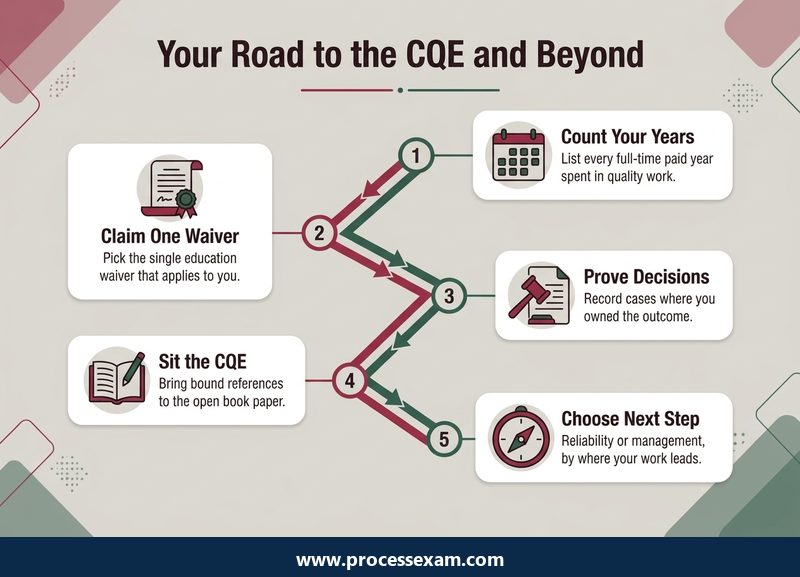
ASQ's CQE page sets the bar at eight years of full-time, paid work that falls inside the Body of Knowledge. Three of those years need to carry real authority over the outcome, and a degree or diploma can shorten the eight, though only one such reduction may be used.
Read that carefully, because each part does something different.
Eight years measures exposure, not job titles
ASQ counts the kind of work you did, not the title on your badge. A process engineer who ran statistical process control, a production supervisor who owned corrective actions, or a calibration lead who ran measurement studies can all have relevant years. Dev's six years on the bench count because the bench is where measurement and inspection live, even though his title never contained the word engineer.
Full-time and paid rule out some stories
ASQ asks for a full-time, paid role, so study, volunteering and unpaid placements are not part of the count. If part of your history was part-time, read the application form closely before you assume how it will be treated, and ask ASQ when the form does not settle it.
What the waiver does
One level of education can reduce the required years: a trade diploma takes off one, an associate degree two, a bachelor's four and a master's or doctorate five. Only one of these can be claimed, so a candidate holding a bachelor's followed by a master's does not add the two. The cases below show the effect on the years of work still needed.
| Candidate | Waiver claimed | Years of qualifying work needed |
|---|---|---|
| Dev: technician with a trade diploma | One year | Seven |
| Priya: inspector with an associate degree | Two years | Six |
| Marcus: process engineer with a bachelor's degree | Four years | Four |
| Elena: bachelor's, then a master's in industrial engineering | Five years, not nine | Three |
Dev would therefore be eligible one year earlier than the plain eight, which is why it is worth gathering his diploma evidence now rather than on the day he applies. Elena's row shows why the rule is one waiver and not a running total.
Experience can be borrowed from related credentials
Years that earned one of several other ASQ credentials can be reused here, according to the CQE page: quality auditor, reliability engineer, supplier quality professional, software quality engineer and quality manager. A candidate who qualified for one of those can use the same years, provided the work sits within the CQE Body of Knowledge too.
How do you show decision-making authority on paper?
This is the clause that takes the most thought, and it is worth treating as a documentation task. ASQ's definition of a decision-making role turns on three abilities: setting a project or process up, running or steering it, and being accountable for how it ends. Three tests follow from that.
- Define. Did you decide what the check, plan or procedure should be, or did you follow one written by somebody else?
- Control. Could you hold a shipment, release a hold, approve a deviation or close a corrective action on your own authority?
- Answer for the result. If the process failed an audit or a customer complaint arrived, was it your name on the response?
These tests are a plain-language reading, not ASQ's own list, and ASQ decides what counts when it reviews an application. They are still a useful way to examine your own history before you submit it.
What technicians can do about a gap
Dev's difficulty is likely to be the three years. A technician rarely signs a control plan, but he can ask for the work that builds the record: lead the investigation of a repeat defect, write the work instruction instead of following it, run the supplier corrective-action thread for one part family, or own the measurement system study on a new gauge. Each makes a decision-making entry easier to describe, and each is plain, honest experience rather than a title upgrade.
Keep a running evidence file
Keep a single document with the date, the problem, what you decided, what changed and who confirmed it. Eight or ten cases collected over the years give you the sentences for the application, and the same file is the raw material for a promotion conversation. Dates matter because employers change and memories fade.
Referees need something specific
An application is easier to support when the person vouching for you can confirm a concrete event, such as the day you took over the supplier corrective-action process. A manager asked to confirm a vague responsibility will write a vague reference. Ask early, and share your evidence file with them.
Asking your employer for the right work
Few managers refuse a request framed around a problem they already own. Instead of asking for a title, name an open item: the recurring customer complaint, the gauge that fails its study, the supplier whose lots keep being sorted. Offer to own it through to closure and to report the result. That conversation earns the experience, shows initiative, and costs the employer nothing it was not already paying for.
Which ASQ credentials follow the CQE?
Two follow-on credentials suit the paths above. Both are described on ASQ's own pages, and the figures below come from the exam details recorded for each plus ASQ's eligibility sections. Check ASQ's page for the one you intend to take before you plan around any number, because ASQ revises them.
| Credential | Years of work | Of which decision-making | Questions | Member fee | Non-member fee |
|---|---|---|---|---|---|
| Certified Quality Engineer (CQE) | 8 | 3 | 175 | $450 | $550 |
| Certified Reliability Engineer (CRE) | 8 | 3 | 165 | $450 | $550 |
| Certified Manager of Quality/Organizational Excellence (CMQ/OE) | 10 | 5 | 180 | $485 | $585 |
Each of the three is a single paper in which your own bound reference material is allowed. Retakes cost $350 for the CQE and the CRE and $385 for the CMQ/OE.
Certified Reliability Engineer
The CRE is for people drawn to the question of how long a product lasts. ASQ describes the holder as a professional who specialises in improving the reliability, maintainability and safety of products. The experience rule matches the CQE's, so a quality engineer who has spent the years on failure analysis and life data may reach it without extra waiting. Both exams draw on statistics and design analysis, so preparation for one carries some value into the other.
Certified Manager of Quality/Organizational Excellence
The CMQ/OE is aimed at a different reader. ASQ describes the holder as a professional who leads and champions process-improvement initiatives, with work that spans customer and supplier relations, strategic planning, measurement systems, staff and finance. It asks for ten years of work, five of them in decision-making roles, so it suits a candidate who has already run a function. Experience held for the CQE counts towards it as long as the ten-year minimum is met.
Which one first?
If your days are spent in failure data and life testing, the CRE is the natural second credential. If your days are spent in meetings about budgets, staffing and audits, aim for the CMQ/OE and plan the decision-making evidence accordingly. If you cannot decide, the CQE keeps both doors open, which is a good reason to take it first.
A note on salary
Pay depends heavily on country, sector and level, and a single figure would mislead. ASQ publishes a salary survey; read the current edition for your region and job title rather than relying on a number quoted in an article, this one included.
What does the CQE exam ask once the years are in?
The exam is the shortest part of the journey in calendar terms, but it deserves a clear picture. The table sets out the figures for the computer-based sitting.
| Detail | ASQ CQE |
|---|---|
| Exam code | CQE |
| Questions | 175 (160 scored and 15 unscored, according to ASQ) |
| Exam time | 318 minutes |
| Total appointment | 330 minutes |
| Passing score | 550/750 |
| Exam fee | ASQ members $450, non-members $550 |
| Retake fee | $350 |
| Reference material | Open book, with bound materials |
Because the exam is open book, memorising formulas is the wrong goal. The skill being tested is finding the right method quickly and applying it correctly, which is what a quality engineer does at a desk. That is another reason the experience rule makes sense: someone who has used these methods knows where to look.
The Body of Knowledge has seven areas, from management and the quality system through design, process control and improvement to quantitative methods and risk. Dev's bench years give him a head start in process control and measurement, and probably a gap in management and risk. A map of your own experience against the areas, drawn from the CQE syllabus, shows where preparation time should go.
Candidates partway through their years often want to know what the questions feel like before they commit. Working through the CQE practice exam with the reference binder you plan to carry gives a direct answer about both the style and the pace.
How can you use the years before applying?
Dev has two to three years of waiting, depending on whether his diploma counts. That is long enough to be useful, and the plan below treats the wait as preparation rather than delay.
Year one: widen the work
List the seven Body of Knowledge areas and mark the ones your job touches. Ask for projects in the unmarked ones: an internal audit, a supplier visit, a risk review. You are building the experience the application asks for and the knowledge the exam asks for at the same time.
Year two: take ownership
Move from contributing to owning. Lead a corrective action from first report to closure, own a capability study from sampling plan to conclusion, or write a control plan for a new part. Record each one in the evidence file.
The final stretch: prepare for the paper
Gather the reference material you will bring and mark it up so that every topic can be found in seconds. Practise the calculations by hand until the method is familiar, then run full-length sets with your binder open. Decide your booking date from your readiness, not from the date your eligibility starts.
After the exam
The credential is a receipt for the years behind it, so use it that way. Update your professional profile, ask for the next real case, and open the conversation about the title that matches your duties. The follow-on credentials then become a planning question, and the evidence file you started carries on being useful.
Dev's story ends where this article began, with a calendar: six years, a diploma that takes one off, and a growing file of cases. The credential is no shortcut around those years. It is a way of making sure they are counted and recognised when they are done.
Frequently Asked Questions
How many years of experience do you need for the ASQ CQE?
ASQ asks for eight years of full-time, paid work in one or more areas of the CQE Body of Knowledge, three of them in a decision-making position. One education waiver can reduce the eight: one year for a trade diploma, up to five for a master's or doctorate.
What jobs can you get with a CQE?
Typical titles are quality engineer, supplier quality engineer, reliability engineer and quality manager, though employers name roles differently. The credential suits work in quality control, statistical analysis, product and process design and standards compliance, in sectors such as manufacturing, automotive, aerospace and medical devices.
What does the ASQ CQE exam cost?
The exam fee is $450 for ASQ members and $550 for non-members, and a retake is $350. The exam has 175 questions, 160 of them scored, with 318 minutes of exam time and a passing score of 550/750. The exam is open book, so candidates bring their own bound reference material.
What is the next ASQ certification after the CQE?
Two common choices are the Certified Reliability Engineer, which also needs eight years of work, and the Certified Manager of Quality/Organizational Excellence, which needs ten years with five in decision-making roles. Experience used for the CQE can count towards both.
What is the ASQ CQE salary?
Pay varies by country, sector and seniority, so no single figure is reliable. ASQ publishes an annual salary survey that you can read for your own region and job title. Treat any figure in an article without a stated source with caution.
- ASQ Quality Engineer Sample Questions |
- CQE Exam Questions Download |
- CQE Test Questions |
- Quality Engineer PDF |
- ASQ Quality Engineer Book |
- ASQ CQE BOK PDF |
- Quality Engineer Certification Cost |
- Quality Engineer Certification Requirements |
- ASQ Quality Engineer Test Questions |
- CQE Question Bank |
- CQE Body of Knowledge (BOK) |
- Engineering |
- CQE Handbook


