
CIS-DF Exam: 10 Proven Tips to Pass ServiceNow Data Foundations
To pass the ServiceNow CIS-DF exam, you need a working command of the CMDB, the Common Service Data Model (CSDM), CMDB health and the Identification and Reconciliation Engine, plus enough hands-on time to answer scenario questions. The exam has 75 questions in 90 minutes, costs USD $450 and is scored Pass / Fail. The ten tips below turn that into a two-week plan.

The Certified Implementation Specialist – Data Foundations (CMDB and CSDM) credential, known as CIS-DF, checks whether you can build and keep a trustworthy configuration management database on the ServiceNow platform. Clean configuration data sits underneath incident, change, discovery, service mapping and asset work, so this exam has become one of the most useful implementation specialist credentials for anyone who works with ServiceNow data.
This guide explains what the exam covers, how difficult it is, and exactly how to prepare. It is written for ServiceNow administrators, implementers, consultants and CMDB managers who want to pass on the first attempt without wasting weeks on the wrong material.
What is the ServiceNow CIS-DF certification, and who should take it?
CIS-DF is a ServiceNow implementation specialist certification focused on data foundations: how configuration items are modelled, related, identified, reconciled and governed. It sits alongside the other CIS exams, but it is different in one important way. Most implementation specialist exams test one product. CIS-DF tests the data layer that every product depends on.
The exam suits four groups of people. ServiceNow administrators who own the CMDB day to day. Implementation consultants who configure CMDB and CSDM for customers. CMDB and configuration managers responsible for data quality. And platform architects who need to prove they understand service modelling before they design it.
Here are the exam facts in one place:
| Exam detail | CIS-DF |
|---|---|
| Full name | ServiceNow Certified Implementation Specialist – Data Foundations (CMDB and CSDM) |
| Exam code | CIS-DF |
| Vendor | ServiceNow |
| Number of questions | 75 |
| Duration | 90 minutes |
| Exam fee | USD $450 |
| Passing score | Pass / Fail |
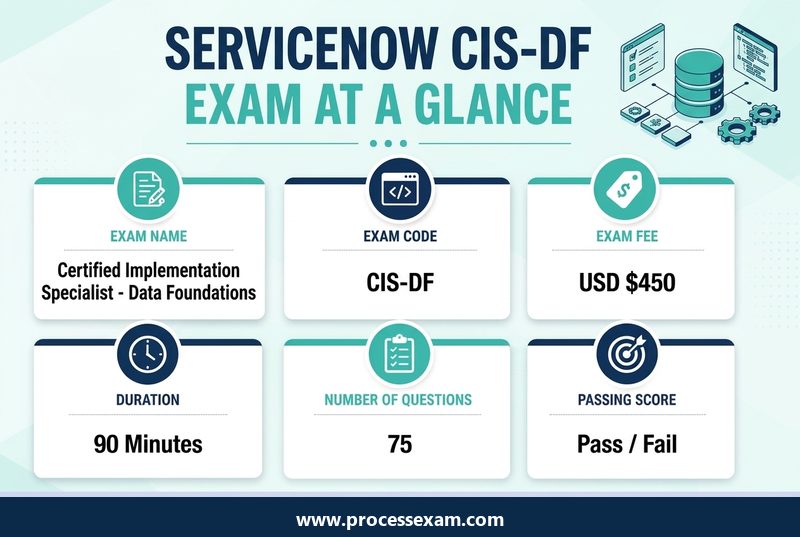
ServiceNow publishes the current exam details and registration steps on its official CIS-DF exam page. Check it before you book, because ServiceNow updates its exams with platform releases. If you want to see how you would score today, the CIS-DF practice exam on ProcessExam uses the same 75-question, 90-minute format, so you can measure your readiness under realistic timing.
What does the CIS-DF exam cover?
The exam content groups into five connected areas. Each one appears in scenario questions, so study them as a system rather than as separate lists.
CMDB fundamentals and configuration
This is the foundation of everything else. You need to know how the CMDB is structured as a hierarchy of tables that extend the base configuration item table, how CI classes inherit attributes from their parents, and why the class you choose for a CI matters for identification, reporting and health. Expect questions on CI classes and their hierarchy, CI attributes, CI lifecycle and operational states, and relationship types between configuration items.
The CI Class Manager is the tool that ties this together. It shows the class hierarchy, the attributes on each class, identification rules, reconciliation rules and health settings in one place. Candidates who have spent time in the Class Manager find this part of the exam straightforward; candidates who only read about it usually struggle.
The Common Service Data Model (CSDM)
CSDM is ServiceNow's standard for modelling services in the CMDB. It defines where business capabilities, business applications, business services, service offerings, application services and technical services belong, and how they relate to the infrastructure underneath. The exam checks whether you can place a given record in the right CSDM domain and explain why.
CSDM is also adopted in stages, commonly described as Foundation, Crawl, Walk, Run and Fly. Questions often describe an organisation at one stage and ask what it should do next. Learn what each stage adds and why the order matters: an organisation that skips Foundation and jumps to service mapping ends up mapping services onto unreliable data.
CMDB health and data quality
ServiceNow measures CMDB health across three dimensions. Completeness asks whether required and recommended attributes are filled in. Correctness asks whether the data is free of duplicates, orphans and stale records. Compliance asks whether the data matches the organisation's own audit rules and governance policies. You need to know what each dimension measures, how the health dashboard reports it, and which action improves each score.
Data governance features come up here too: data certification, which asks owners to confirm their records on a schedule, and the data manager workflows that route stale or retired CIs to the right people.
The Identification and Reconciliation Engine (IRE)
The IRE is what stops the CMDB from filling with duplicates when several sources report the same device. Identification rules decide whether an incoming record matches an existing CI. Reconciliation rules decide which data source is allowed to update which attributes. Data source precedence settles conflicts when two authorised sources disagree.
Scenario questions in this area are common and often subtle. A typical question describes two discovery sources reporting different values for the same server and asks which one wins and why. The answer always comes back to reconciliation rules and precedence, so learn how they are configured and in which order they apply.
Data ingestion and implementation practice
The last area covers how data arrives in the CMDB and how an implementation should be run. That includes discovery and service graph connectors as sources, import sets that pass through the IRE, and the implementation habits that keep data clean from day one: agreeing CI ownership, defining which source is authoritative, and measuring health from the start rather than after go-live.
How hard is the CIS-DF exam, and what is the pass percentage?
CIS-DF is a moderately difficult exam. The questions are rarely about recalling a definition; most describe a situation and ask what you would do. That makes it harder for candidates who learn from notes alone and easier for those who have configured a CMDB themselves.
Many candidates search for the CIS-DF pass percentage. ServiceNow does not publish a pass rate or a numeric passing score for this exam: results are reported only as Pass or Fail. Any figure you see quoted elsewhere is an estimate, not an official number. A more useful measure is your own score on timed practice tests. If you consistently answer most practice questions correctly within the time limit, and you can explain why the wrong options are wrong, you are close to ready.
Three things make the exam feel harder than it is. The scenarios mix areas together, so a single question can touch CSDM, identification and health at once. Several answer options are often technically possible, and you must pick the one that follows ServiceNow best practice. And 90 minutes for 75 questions leaves little over a minute per question, which punishes anyone who reads each scenario twice.
What are the 10 proven tips to pass the CIS-DF exam?
These tips come from how the exam is built: scenario-based, practice-heavy and focused on getting data right before building on it.
1. Start with ServiceNow's own learning path
Begin with the learning path and documentation ServiceNow provides for the credential. It uses the exact terminology the exam uses, which matters because several answer options differ by a single term. The ServiceNow product documentation is the reference to keep open while you study CMDB tables, CSDM domains and IRE settings.
2. Master CMDB fundamentals before anything else
Every later topic depends on the class hierarchy and relationships. Before moving on, make sure you can explain how a CI class inherits attributes, how relationship types differ, and what each operational and lifecycle state means. If you need a neutral refresher on why a configuration management database exists at all, the general overview of configuration management databases is a good starting point before you return to ServiceNow specifics.
3. Learn CSDM domain by domain
Take the CSDM domains one at a time and, for each, write down which tables belong there and what a typical record looks like. Then practise placing real examples: a payroll business application, an email business service, a database technical service. Placement questions are among the easiest marks on the exam once this is done.
4. Understand CMDB health in all three dimensions
Do not memorise the words completeness, correctness and compliance; learn what raises and lowers each score. Know which issues count against correctness, such as duplicates, orphan CIs and stale records, and which settings define the required attributes that completeness measures.
5. Spend real time on the IRE
Identification and reconciliation are where most candidates lose marks. Configure an identification rule in a personal developer instance, send the same CI from two sources, and watch what happens. Change the data source precedence and repeat. Ten minutes of this teaches more than an hour of reading.
6. Practise with scenarios, not definitions
For every topic, ask yourself three questions: what is the root cause of the problem, which ServiceNow capability solves it, and which best practice applies. The exam's scenarios follow exactly that pattern. Working through the free CIS-DF sample questions shows you what the scenarios look like before you commit to full-length tests.
7. Use one structured study guide
A single organised study guide beats a pile of scattered notes. Choose one that follows the exam areas above, gives worked examples, and ends each topic with questions. Keep your own notes inside that structure so revision in the final week takes hours, not days.
8. Build hands-on experience in a developer instance
A free personal developer instance is enough to practise almost everything the exam covers: creating CIs and relationships, exploring the CI Class Manager, running health dashboards and configuring identification rules. Candidates with hands-on time answer scenario questions faster because they recognise the situation instead of reasoning it out from scratch.
9. Take timed, full-length practice tests
Practice tests do two jobs. They show which areas are weak, and they train your pace for 75 questions in 90 minutes. Take at least two full-length tests under exam conditions, review every question you got wrong or guessed, and track your score across attempts. A rising score on fresh questions is the clearest sign you are ready.
10. Follow a written study plan
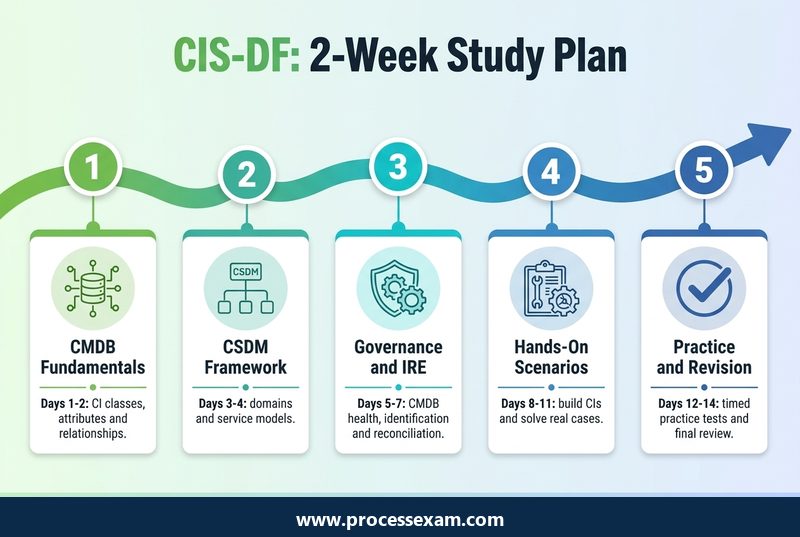
Without a plan, preparation drifts toward the topics you already like. A two-week plan, set out below, keeps every area covered and leaves the final days for practice and revision.
What does a two-week CIS-DF study plan look like?
This plan assumes you already use ServiceNow at work and can study for one to two hours a day. If CMDB is new to you, stretch each block and allow three to four weeks instead.
Days 12 to 14 work best with realistic timing: the CIS-DF practice exam follows the same 75-question, 90-minute format, so your last sessions show exactly where you stand.
| Days | Focus | What to finish |
|---|---|---|
| 1–2 | CMDB fundamentals | Class hierarchy, CI attributes, relationship types, lifecycle and operational states |
| 3–4 | CSDM framework | Every CSDM domain, placement of example records, adoption stages |
| 5–7 | Governance and IRE | Health dimensions, data certification, identification and reconciliation rules, source precedence |
| 8–11 | Hands-on scenarios | Build CIs and relationships in a developer instance; solve duplicate and precedence cases |
| 12–14 | Practice and revision | Two timed full-length practice tests, review of every wrong answer, final notes |
Keep the last evening free of new material. Review your error log from the practice tests instead: the topics you missed twice are the ones most likely to cost marks on the day.
Which mistakes make candidates fail the CIS-DF exam?
The same mistakes come up again and again, and every one of them is avoidable.
- Treating CSDM as optional. CSDM appears throughout the exam, including in questions that look like they are about something else.
- Memorising instead of understanding. Scenario questions reward knowing why a practice is recommended, not reciting its name.
- Skipping hands-on practice. Identification and reconciliation are hard to understand from reading alone.
- Leaving practice tests to the last day. Timed practice early in the plan shows weak areas while there is still time to fix them.
- Ignoring the clock. With 90 minutes for 75 questions, flag difficult questions and come back to them rather than stalling.
- Studying an older version. ServiceNow updates exams with platform releases, so confirm the current details on ServiceNow's exam page before you book.
What should you do in the final week and on exam day?
The last week is for consolidation, not new topics. By now you should have covered every exam area at least once; the aim is to turn that coverage into fast, confident answers.
Seven days out
Take a full-length timed practice test and write down every question you got wrong, guessed or took too long over. Sort them by exam area. The area with the most entries is where the next three days go. If one area stands far above the rest, return to the documentation and your developer instance for that area rather than doing more questions on it; repeated questions on a weak topic mostly repeat the same misunderstanding.
Three to four days out
Take a second full-length test on questions you have not seen. Compare the result with the first. A rising score and a shorter error list mean the plan is working. If the same topics keep appearing, spend one more session on them, then stop adding material. Build a single page of final notes: the CSDM domains and what belongs in each, the three CMDB health dimensions and what lowers each score, and the order in which identification rules, reconciliation rules and data source precedence apply.
The day before
Read your one-page notes and your error log, confirm the exam time and delivery details, and check the testing requirements if you are sitting the exam online: a quiet room, a clear desk, a working webcam and a stable connection. Then stop. A rested candidate reads scenarios more accurately than a tired one who studied late.
During the exam
Read the last line of each scenario first, so you know what the question is asking before you read the details. Eliminate options that break ServiceNow best practice, such as bypassing the IRE or loading data without an agreed authoritative source; they are often the distractors. Flag any question that takes more than two minutes and come back to it at the end. With 75 questions in 90 minutes, finishing a first pass with fifteen minutes to spare gives you time to revisit the flagged ones calmly.
After the exam
Your result is reported as Pass or Fail. If you pass, add the credential to your profile and plan how you will keep your knowledge current as ServiceNow releases new platform versions. If you do not pass, note which areas felt weakest while they are fresh, go back to the study plan for those areas, and retake once your practice scores are consistently strong.
Is the CIS-DF certification worth it for your career?
For anyone whose work touches ServiceNow data, CIS-DF is one of the more valuable implementation specialist credentials. Organisations rely on accurate configuration data for incident correlation, change risk, discovery, service mapping, security operations and asset management. When the CMDB is unreliable, every one of those processes suffers, which is why skills in CMDB design and governance are in steady demand.
The credential helps in three practical ways. It gives employers and clients independent proof that you can build a CMDB that others can trust. It supports the move from administrator into implementation and architecture roles, where data design decisions are made. And it strengthens every other ServiceNow credential you hold, because the other products all depend on the data foundations this exam covers.
Typical roles that benefit include ServiceNow administrator, CMDB or configuration manager, ServiceNow implementation consultant, ITOM specialist and platform architect. If your organisation is starting or repairing a CSDM rollout, the knowledge behind CIS-DF is exactly what that project needs.
When you are ready to check your preparation, work through the free sample questions first, then take a full timed practice exam. Together they tell you which areas still need work and whether your pace is right for exam day.
Frequently Asked Questions
How many questions are on the CIS-DF exam?
The ServiceNow CIS-DF exam has 75 questions and a time limit of 90 minutes. That leaves a little over one minute per question, so practise under timed conditions and flag difficult scenario questions to revisit rather than spending too long on any single one.
What is the passing score for CIS-DF?
ServiceNow reports CIS-DF results as Pass or Fail and does not publish a numeric passing score or a pass percentage. The best indicator of readiness is your own score on timed practice tests, together with being able to explain why each wrong answer is wrong.
How much does the CIS-DF exam cost?
The CIS-DF exam fee is USD $450. ServiceNow may change fees or offer vouchers through its learning programmes, so confirm the current price and any voucher options on ServiceNow's official exam page before you register for a date.
How long should I study for the CIS-DF exam?
Most candidates who already use ServiceNow need two to four weeks of focused study. Two weeks works if you know the CMDB well and can study daily; allow three to four weeks if CMDB, CSDM or the Identification and Reconciliation Engine are new to you.
Which topics carry the most weight in CIS-DF?
The exam centres on CMDB fundamentals, the Common Service Data Model, CMDB health and data governance, the Identification and Reconciliation Engine, and data ingestion. Scenario questions often combine several of these, so study how they connect rather than learning each topic in isolation.
Are practice tests useful for CIS-DF preparation?
Yes. Timed practice tests show which areas are weak and train your pace for 75 questions in 90 minutes. Take at least two full-length tests, review every wrong or guessed answer, and treat a rising score on fresh questions as the sign that you are ready.
- Platform and AI |
- ServiceNow Data Foundations Test Questions |
- CIS-DF Question Bank |
- CIS-DF Body of Knowledge (BOK) |
- CIS-Data Foundations Simulator |
- CIS-Data Foundations Mock Exam |
- ServiceNow Data Foundations Book |
- ServiceNow CIS-DF BOK PDF |
- Data Foundations Certification Cost |
- Data Foundations Certification Requirements |
- ServiceNow CIS-Data Foundations Question Bank |
- ServiceNow CIS-Data Foundations Book |
- ServiceNow CIS-Data Foundations Study Guide |
- CIS-Data Foundations Certification |
- CIS-Data Foundations Certification Cost |
- CIS-Data Foundations Certification Requirements |
- ServiceNow Data Foundations Sample Questions |
- CIS-DF Exam Questions Download |
- CIS-DF Test Questions |
- Data Foundations PDF |
- ServiceNow CIS-Data Foundations Exam Questions |
- ServiceNow CIS-Data Foundations Sample Questions |
- CIS-Data Foundations |
- CIS-Data Foundations PDF


