Blogs

SMC-PE Exam Guide: 7 Crucial Topics to Master for Guaranteed Success

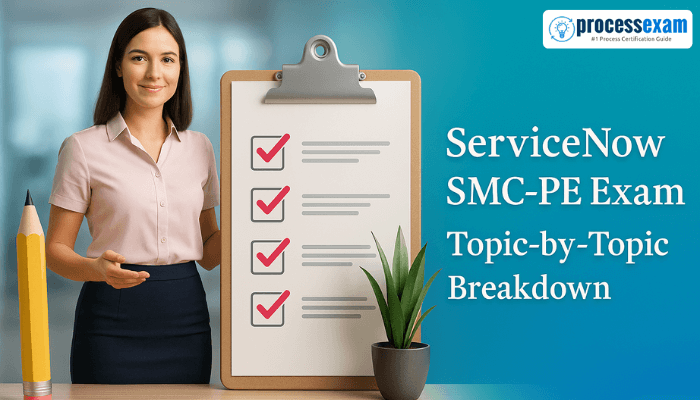
A professional woman stands beside a checklist clipboard in an office setting with the title ServiceNow SMC-PE Exam: Topic-by-Topic Breakdown and the ProcessExam logo on a teal gradient background.

Becoming the go-to expert for process automation on the ServiceNow platform starts with a single, powerful credential. For professionals aiming to validate their skills, passing the SMC-PE Exam is a critical milestone that demonstrates mastery over streamlined, automated, and highly efficient business processes. But how do you conquer an exam where a staggering 70% is focused on a single, dense topic like Playbook Development?

The SMC-PE Certification is not just another badge; it's a testament to your ability to transform complex, multi-departmental processes into simple, guided experiences. The pressure to pass is real, as is the challenge of mastering the material. Many professionals feel overwhelmed by the depth required and are unsure how to allocate their study time for the SMC-Playbooks Essentials Exam.

ISTQB Performance Testing Syllabus, Exam Pattern and Study Plan

A checkout page that slows to a crawl on launch day is the kind of failure CT-PT prepares you to prevent. The exam itself is a 90-minute paper of 40 questions on how performance testing is planned, modelled, measured and reported, and you need 26 correct answers (65%) to pass. The syllabus is v1.0 from 2018, the fee is USD $199, and you must already hold the ISTQB Foundation certificate. This guide walks through the syllabus chapter by chapter.

Tester in a performance testing lab with dashboards of response time and load graphs

Is syllabus v1.0 from 2018 still the one to study, and what must you hold before booking?

Yes. In October 2026 the ISTQB page for Certified Tester Performance Testing still points to the same document: the Foundation Level Performance Testing syllabus, version 2018, dated 9 December 2018 and listed as v1.0 in its file name. No newer syllabus has replaced it, and the ISTQB sample exam is marked as compatible with it. Study that version and nothing else.

ISTQB states the entry rule on the same page: to gain this certification you must hold the Certified Tester Foundation Level certificate. The syllabus repeats it, saying the Foundation Level core certificate must be obtained before the performance testing exam. If you have not passed CTFL yet, that exam comes first; this one builds on its vocabulary of test levels, test process and risk.

OGIT-101 Study Plan: Pass IT4IT 3 Foundation in 6 Weeks

Updated on 9 October 2026. What’s new: exam fee corrected to $405 USD, and the syllabus now follows The Open Group's question counts for all eleven units

Six weeks is enough for the Open Group OGIT-101 exam if you treat IT4IT 3 as a model you can redraw from memory, not a glossary to cram. The IT4IT 3 Foundation paper is 40 multiple-choice questions in 60 minutes, you need 26 right (65%), and the fee is $405 USD. This plan turns those numbers into six weekly targets.

Laptop showing a 6-week OGIT-101 success plan beside a weekly goals notebook and a practice test sheet

People who stall on this exam rarely lack time. They read the standard front to back, highlight everything and arrive at the test unable to say which backbone owns a data object or what separates two neighbouring value streams. The plan below is built around the questions the paper really asks, which the vendor publishes unit by unit.

Is six weeks enough to pass the IT4IT 3 Foundation exam?

For most working IT professionals, yes. The exam sits at foundation level: The Open Group describes it as testing knowledge and comprehension of the standard's terminology, structure and core concepts, not design skill or tool configuration. There is no prerequisite, so a service manager, an enterprise architect, a product owner or a student can sit it.

5 Ways the OGOF-101 Exam Helps You Analyze Risk Like a Pro

A professional analyzes a threat heat map in a modern office with overlaid text reading 5 Ways the OGOF-101 Exam Prepares You for Real-World Risk Analysis.

Navigating the complex landscape of organizational risk, especially in the realm of cybersecurity, demands more than just theoretical knowledge. Professionals need concrete skills to identify, analyze, and communicate potential threats and their impact effectively. This is where certifications like The Open Group Open FAIR 2 Foundation, specifically the OGOF-101 Exam, become invaluable.

Passing the OGOF-101 Exam isn't merely about earning a credential; it's about building a robust foundation in a quantitative approach to risk analysis that is directly applicable to real-world challenges. Unlike purely qualitative methods that rely heavily on subjective assessments (like "high," "medium," or "low" risk), Open FAIR (Factor Analysis of Information Risk) provides a structured, data-driven framework for understanding and measuring risk.

Let's explore five significant ways the knowledge gained while preparing for and passing the OGOF-101 Exam equips you for practical, impactful risk analysis in your professional role.

CBAP Requirements Checklist and Application Process

Some CBAP applications come back marked approved pending audit. It is not a rejection. IIBA is asking you to prove the numbers you typed in: your professional development documents go in for validation, and both of the references you named are contacted directly. Everything below is written so that, if yours is the application that gets pulled, the evidence is already in a folder and the answer is already yes.
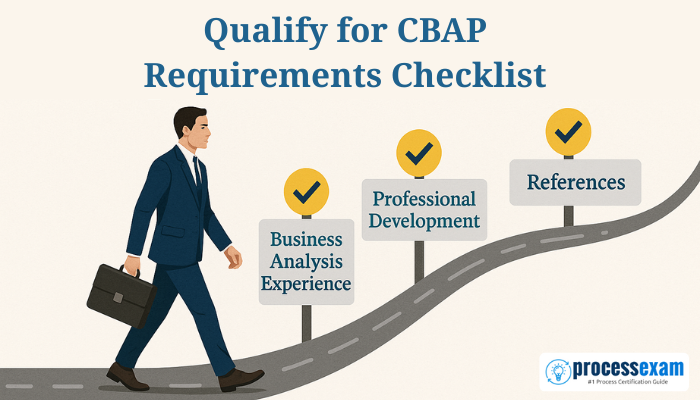
CBAP requirements checklist road with milestones for business analysis experience, professional development and references

The Certified Business Analysis Professional is IIBA's senior credential, assessed against A Guide to the Business Analysis Body of Knowledge — the BABOK Guide, version 3 on the current product. Most guides to it start with the exam. This one starts with the paperwork, because the paperwork is what decides whether you ever book a seat.

What follows is the application route in the order you will walk it: what an audit asks for, what evidence to gather before you submit, how IIBA counts experience and training, what each fee buys, and which deadlines begin ticking the moment you pay.

What happens when IIBA marks a CBAP application "approved pending audit"?

An audit is a verification step, not a penalty. IIBA's handbook describes the sequence plainly: when an application is approved pending audit, you complete the audit process and submit your professional development documents for validation, and your personal and work history references are contacted. When the application passes, you receive an email confirming approval and the next steps to purchase the exam.

AgileBA Foundation Certification Prep Strategy

A focused student prepares for the AgileBA Foundation exam on his laptop, with the title The Ultimate AgileBA Foundation Exam Prep Toolkit - Resources, Strategy & Mock Tests displayed beside him.

Preparing for the AgileBA Foundation exam? Whether you're a business analyst aiming to validate your agile knowledge or transitioning from a traditional role, having a smart preparation strategy can make all the difference. This comprehensive toolkit covers everything from syllabus insights to a week-by-week study plan and the best AgileBA Foundation mock test platforms to ensure you're fully equipped to pass the APMG International Agile Business Analysis Foundation exam on your first attempt.

What is the AgileBA Foundation Certification?

The AgileBA Foundation certification is a globally recognized credential offered by APMG International that validates a professional’s understanding of business analysis within agile project environments. With agile methodologies becoming the new standard across industries, business analysts must adapt to agile principles while continuing to deliver value-driven analysis. The Agile Business Analysis Foundation exam helps bridge this gap by aligning agile techniques with core business analysis competencies.

From IT Hopeful to ServiceNow Certified System Administrator Pro: Adam’s Story

A motivational blog header featuring a professional man in a formal setting, representing Adam, with the title “From IT Hopeful to CSA Pro: Adam’s Story” and the ProcessExam.com logo.

Adam didn’t set out to be a ServiceNow expert. He was just another IT support professional trying to break the cycle of routine tasks, searching for something that would elevate his career. A suggestion from a colleague led him to the ServiceNow Certified System Administrator (CSA) certification - an achievement that would redefine his professional path.

This story isn’t just about one person’s success. It’s a blueprint, filled with practical tips, emotional highs and lows, and hard-earned lessons that will resonate with every IT aspirant looking to earn the ServiceNow CSA certification and open doors to better opportunities.

What is the ServiceNow Certified System Administrator (CSA) Exam?

ServiceNow is a powerful platform that enables digital workflows across enterprise systems. For professionals who want to prove their mastery of the platform’s core configuration and administration capabilities, the ServiceNow Certified System Administrator exam is the go-to credential.

  • Duration: 90 minutes

Why Should You Take a Free CAPM Practice Test?

Updated on 22 September 2026. What’s new: CAPM exam fees corrected to $225 for PMI members and $300 for non-members.

Picture a candidate who scores almost perfectly on a short free CAPM quiz, books the exam that week, and leaves the 150-question, 180-minute paper with a fail and Below Target in two domains. Both results were honest. The quiz measured recall on a small, friendly sample; the real paper measured judgement across four domains, held for three hours. That gap is why a free CAPM practice test is worth taking, provided you know what kind of test it is and what its score can tell you.

Candidates working through free CAPM practice tests before booking the PMI exam

This article is about using practice tests well, not about whether the credential is right for you. It covers when to sit your first one, how to read a practice result against the four bands PMI uses on its score report, how to drill each domain, the myths that make free question banks less useful than they look, and how many full papers to sit before you pay for an exam appointment.

Why did a strong free quiz score not survive the real paper?

The candidate in the opening did nothing wrong on the quiz. The quiz simply answered a different question from the one PMI asks. Five differences explain almost every case like this, and each one points to a way of practising that closes the gap.

[Step-by-Step Guide] Pass Your ICLL Certification Exam Confidently

Students happily preparing for IASSC Lean Leader Certification using effective ICLL Certification tips from ProcessExam.

Obtaining the prestigious ICLL Certification - or IASSC Certified Lean Leader - can significantly elevate your professional value, enhance your leadership abilities, and open doors to career growth in the field of process improvement. But navigating through certification exams can often feel daunting. This guide simplifies your path, ensuring comprehensive understanding, strategic preparation, and confident exam success.

Whether you're an aspiring Lean practitioner, a professional aiming for career advancement, or a manager seeking effective leadership skills, this article will thoroughly guide your preparation and guarantee your journey towards ICLL Certification is smooth and successful.

All About the ICLL Certification

The IASSC Certified Lean Leader (ICLL) is an authoritative credential designed by the International Association for Six Sigma Certification (IASSC). It validates an individual’s proficiency in Lean methodologies, tools, and best practices.

ASQ CQIA Certification Exam: How to Pass It First Time

Updated on 21 September 2026. What’s new: CQIA exam fees corrected to $334 for ASQ members, $434 for non-members and $234 for retakes.

To pass the CQIA you need to answer 110 multiple-choice questions in 198 minutes and reach a scaled score of 550 out of 750. Forty of the 100 scored questions come from a single domain, Improvement, so weight your study time towards it and train yourself to read quality tools at a glance.

CQIA certification pathway to career advancement with a quality professional studying on a laptop

That sentence hides a good deal of detail, and the rest of this article unpacks it: what the American Society for Quality asks about in each of the five Body of Knowledge domains, who is allowed to sit the exam, what it costs, how to build a study plan around the question weights, and what separates candidates who finish comfortably from those who run out of time.

The ASQ Certified Quality Improvement Associate is a foundation-level credential in ASQ's Foundation Quality category. It does not assume you lead a Six Sigma programme or audit suppliers for a living. It assumes you work somewhere quality matters, whether that is manufacturing, healthcare, logistics, financial services or software, and that you want independent proof you understand the vocabulary, the tools and the team behaviours that improvement work depends on.

Syndicate content