Blogs

Why the PMI GPM-b Certification is the Smartest Move for Project Managers

The global business landscape is undergoing a fundamental transformation. Companies are no longer judged solely on their financial performance but on their commitment to sustainability. This shift has created an urgent demand for a new kind of leader: the green project manager. The PMI GPM-b Certification (PMI Green Project Manager - Basic) has emerged as the global standard, validating your expertise in integrating sustainable practices into project delivery. This credential isn't just a certificate; it's a career catalyst, positioning you at the intersection of innovation, responsibility, and professional growth.

Illustration of a professional with gears and charts beside the title Passing the GPM-b Exam A Career-Changing Step into Green Project Management with the Processexam logo.

For project managers feeling the pressure to adapt or facing career stagnation, this certification offers a clear path forward. It provides the language, frameworks, and credibility to lead projects that deliver value not just to the bottom line, but to the planet and its people. This guide breaks down the tangible career benefits of earning the PMI GPM-b Certification, from exam specifics to salary expectations, and provides a roadmap for your success.

Strategic SMC-AAE Certification Journey: Complete Planning Guide

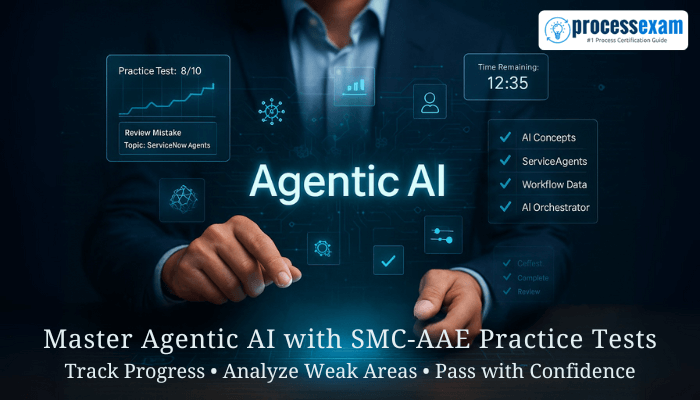
A business professional interacts with a glowing Agentic AI dashboard featuring practice test scores, a timer, checklist, and the tagline Master Agentic AI with SMC-AAE Practice Tests for ProcessExam.

The ServiceNow Micro-Certification Agentic AI Executive (SMC-AAE) represents the cutting edge of AI-driven enterprise solutions. This specialized certification validates your expertise in ServiceNow's revolutionary agentic AI capabilities, positioning you as a leader in the rapidly evolving landscape of intelligent automation and AI orchestration.

Professional success in today's AI-first business environment demands more than theoretical knowledge - it requires strategic certification planning that maximizes your investment in learning while accelerating career advancement. The SMC-AAE certification offers a unique opportunity to demonstrate mastery of ServiceNow's most innovative AI technologies, but achieving success requires a methodical approach that addresses every aspect of exam preparation.

ServiceNow CPOA vs Other Certifications: Which Path Fits Your Career?

The ServiceNow CPOA (Certified Platform Owner Associate) certification proves you can run the Now Platform as a business asset: strategy, people, process, technology, data and governance. It differs from the CSA, CIS and CAD exams, which test configuration and build skills. The exam has 70 questions in 90 minutes, costs USD $300 and is scored Pass / Fail.

ServiceNow CPOA vs other certifications guide showing a professional with a laptop between CPOA and certification badges

Most ServiceNow credentials ask whether you can configure or build something. The Certified Platform Owner Associate asks a different question: can you decide what the platform should do next, who should do it, how it should be released and how its value is shown to the business? That is why many experienced administrators, business analysts and ServiceNow programme leads look at the CPOA once they have spent a few years on the platform.

This guide compares the ServiceNow CPOA with the other mainstream ServiceNow certifications, walks through all six syllabus domains, explains how the exam is run and how difficult it is, and sets out a five-step preparation plan, the mistakes to avoid and the career value of the credential.

ASQ CMDA Certification Guide: 2026 BoK, Eligibility and Exam Day

Updated on 19 September 2026. What’s new: CMDA exam fees corrected, and the syllabus moved to ASQ's 2026 Body of Knowledge.

To earn the ASQ Certified Medical Device Auditor (CMDA) certification, you need five years of relevant experience (one in a decision-making role, with degree waivers), then pass one open-book exam of 145 multiple-choice questions in 258 minutes with a score of 550/750. From the November 2026 testing window, ASQ tests the new 2026 CMDA Body of Knowledge, so study from the 2026 BoK.

Want to see how ready you are today? Take a timed CMDA practice exam built on the same 145-question format.

Medical device auditors with equipment and reference books, illustrating the ASQ CMDA certification path

The medical device industry runs on evidence. Every design decision, supplier approval, sterilization cycle and complaint investigation has to be documented, reviewed and defensible in front of a regulator or a notified body. The people who test whether that evidence holds up are auditors, and the ASQ CMDA credential is the one that proves an auditor understands both the auditing craft and the medical device rules behind it.

This guide takes you from the first question, whether you are eligible, to the last one, what to do in the exam room. It covers the exam facts, what changed in the 2026 Body of Knowledge, what each of the five domains asks of you, a preparation plan, the mistakes that cost candidates the most marks, and how the credential helps your career.

APMP AI Micro-Certification: Exam Format, Cost and How to Prepare

The APMP AI Micro-Certification (AI-M APMP) is a 30-question, 30-minute multiple-choice exam that checks whether you can use artificial intelligence sensibly in bid and proposal work. You need 73% to pass, which is 22 correct answers. The fee is $165 for APMP members and $300 for nonmembers, and most working proposal people can prepare in two to three weeks.

Banner reading Why Mid-Career Professionals Need the APMP AI Micro-Certification with professionals and AI visuals

If you have been in bids for ten years or more, you probably do not need someone to tell you that AI has arrived in your team. Your colleagues are pasting requirements into chat tools, your sales director has asked whether a model can write the executive summary, and your security lead has asked you to stop. This credential exists for exactly that moment: it tests judgement about where AI helps a proposal, where it does harm, and who stays accountable for the words that go to the customer.

This guide covers what the credential is and whether the details are current, how the paper is built, what it costs, what the seven topic areas ask, who gains most from it, a three-week preparation plan and the mistakes that cost marks. The exam figures come from our exam data and match what APMP and its training providers publish; we checked them in September 2026.

ASQ CQA: 7 Essential Resources to Pass the Quality Auditor Exam

Updated on 21 September 2026. What’s new: CQA exam fees corrected to $450, $550 and $350 for retakes, and the syllabus updated to ASQ's 2026 Body of Knowledge.

You have been running internal audits for six years, your manager has started saying you should have the CQA after your name, and the ASQ application page is open on your screen with three different fees on it. Is the credential worth the money and the paperwork, and if it is, what do you actually read first? For anyone who audits for a living the answer to the first question is yes, and the answer to the second is the 2026 Body of Knowledge, not a textbook.

ASQ Certified Quality Auditor guide cover showing the best CQA certification prep tools

That order matters more than most candidates expect. The ASQ Certified Quality Auditor exam is an open-book test built from a published outline, which means the outline tells you what to buy, what to read closely and what to leave alone. This guide keeps the seven resources that matter, puts them in the order a working auditor should use them, and ties each one to the domain it is supposed to cover.

Is the ASQ CQA certification worth the fee and the experience it demands?

The ASQ Certified Quality Auditor credential makes a narrow and useful claim on your behalf: that you can plan an audit, select the right criteria, gather objective evidence, group observations into findings that survive challenge, and follow corrective action through to closure. That is a different skill from knowing a quality management system well. Plenty of excellent quality engineers make poor auditors, and the CQA exists precisely to separate the two.

SRE Foundation Certification: 7 Proven Ways to Pass

A focused professional studies on a laptop with a digital certificate in the background under the title Acing Your SRE Foundation Certification Test on a promotional banner from ProcessExam.

Advancing in the tech landscape requires mastering the principles that keep digital services reliable and resilient. For professionals in IT operations, development, and system administration, the SRE Foundation certification offered by the DevOps Institute stands as a critical benchmark of expertise. It validates your understanding of Site Reliability Engineering (SRE), a discipline pioneered by Google that transforms operations management through software engineering practices.

This comprehensive guide provides a strategic roadmap to navigate your preparation. We will explore seven proven methods to not only prepare for the exam but to deeply internalize the concepts that define modern reliability. Following these steps will equip you with the knowledge and confidence needed to earn your certification and excel in an SRE-driven environment.

Is the GInI AGVA Certification Worth It? 7 Career Benefits That Say Yes

Flat-lay image showing notebooks, pastel sticky notes labeled Career, a magnifying glass, and pen on a textured surface, alongside text reading GInI AGVA Certification 7 Powerful Career Benefits.

In a business world driven by relentless innovation, the ability to accurately assess a company's potential for growth is no longer a soft skill - it's a critical, verifiable expertise. For professionals aiming to lead in this domain, the question isn't just about gaining knowledge, but about proving it with a globally respected credential. This brings a pivotal career decision into focus: pursuing the GInI AGVA Certification.

Offered by the renowned Global Innovation Institute (GInI), the Authorized Growth Venture Assessor (AGVA) certification is a specialized credential designed for individuals who evaluate the innovation readiness and performance of small and medium-sized enterprises (SMEs). If you're a consultant, business analyst, or aspiring venture expert, you've likely wondered about its tangible value.

This guide moves beyond the surface to provide an in-depth analysis of the GInI AGVA Certification. We will explore seven compelling career benefits that highlight its return on investment, break down the exam structure, and clarify how this certification positions you as an indispensable asset in the global innovation ecosystem.

CInA Certification: From Student to Innovator

A diverse group of young professionals collaborates at a modern workspace while a bold blue panel displays the text How CInA Certification Empowers Students to Lead Innovation Projects.

Graduating into today’s competitive job market requires more than just a degree; it demands a demonstrated ability to drive real-world value. For students poised to enter the business world, the capacity for innovation is no longer a soft skill - it's a core competency that employers actively seek. The CInA Certification from the Global Innovation Institute (GInI) is the definitive credential that transforms ambitious students into recognized innovators, equipped to lead projects and shape the future of business.

This comprehensive guide will walk you through every aspect of the GInI Certified Innovation Associate (CInA) credential. We will explore how its curriculum empowers you to manage innovation projects, dissect the CInA Exam Syllabus, and provide a strategic roadmap for success. Whether you are aiming to become a valued Innovation Associate or launch your venture, this certification is your first major step toward a dynamic and impactful career.

PSM I vs PSM II: From Running Scrum to Defending It

Two years into the Scrum Master role, your events run smoothly and the team trusts you. Then a director asks why the Sprint Goal cannot absorb one urgent request, and you answer with a rule instead of a reason. The argument is lost. That moment marks the line between the two credentials: PSM I proves you know Scrum as the Scrum Guide defines it, while PSM II proves you can apply it, and defend it, when real people push back.

PSM I and PSM II certification badges beside a laptop, about leveling up Scrum Master skills

Both certifications come from Scrum.org, both are passed online without a mandatory class, and both carry the same 85% pass mark. After that, almost everything changes: the number of questions, the time you get for each one, the focus areas, the way answers are scored and, above all, the kind of thinking the questions reward. This article sets the two side by side, explains what the advanced exam adds, and helps you decide when the step up is worth taking.

What really separates PSM I from PSM II?

Scrum.org describes PSM I as evidence of a fundamental level of Scrum mastery: you understand Scrum as written in the Scrum Guide and share a consistent vocabulary with other practitioners. PSM II is described as an advanced level, for Scrum Masters who can support Scrum Teams and solve complex problems in the real world, and Scrum.org says candidates should bring in-depth Scrum Master experience before attempting it.

Syndicate content